


BFCM for the Other Half: Seven Shapes for Brands That Don’t Peak in November
Most Black Friday advice assumes November is the most important month on your calendar, but for roughly half of Shopify’s larger brands, it isn’t.
Shoplift’s Storefront Index found that 53% of $10M+ Shopify brands do not have a natural BFCM peak. We call them ‘the Other Half’. Most of them still get a lift in November. It just doesn’t define their year.
That was the starting point for our BFCM for the Other Half masterclass. We ran it with Bryan Bumgardner, Head of Content at Northbeam, the marketing measurement platform, who brought the acquisition data from before the click. Nick Shackelford, VP Partnerships at Common Thread Collective, brought the view from the operator’s seat.
The same season does a different job
November looks very different depending on which half you’re in.
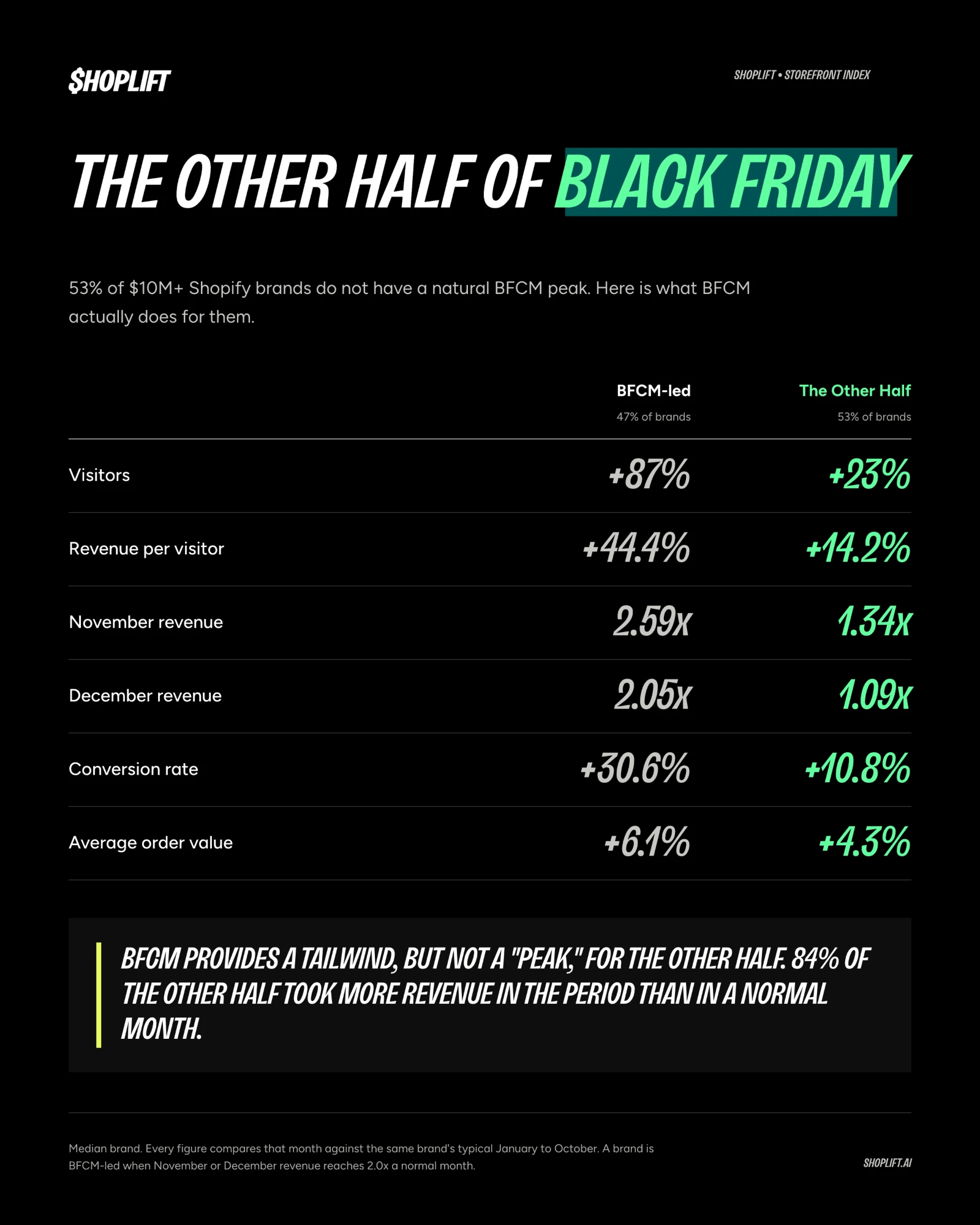
Black Friday brands saw visitors rise 87%, revenue per visitor (RPV) rise 44.4%, and November revenue reach 2.59x a normal month. The Other Half saw 23% more visitors, a 14.2% increase in RPV, and 1.34x normal monthly revenue.
December is where the gap becomes obvious. Black Friday brands were still running at 2.05x a normal month. The Other Half was at 1.09x.
By December, the Other Half is already back to normal.
Buying more traffic doesn’t close that gap on its own. Among the brands that added the most November traffic, traffic grew 1.54x and RPV didn’t move at all. Every other group saw RPV lift of 15% to 24%. More traffic can still mean more revenue, but it doesn’t make each visitor more valuable.
Meanwhile, the auction gets more expensive whether your demand peaks or not. In Northbeam’s Meta data, CPM peaked at $23.06 during BFCM week last year. First-time CAC peaked at $309.17 in the same week.
So the useful question for the Other Half isn’t whether to participate in Black Friday. It’s what job Black Friday should do for your business.
Find the Shape before choosing the tactic
We describe seven buying patterns we call Shapes. Most brands recognize one or two.
.webp)
- The Season's mood rungs against you.
- Your Season is a different season.
- The Purchase cannot close inside a weekend.
- Demand comes from an event, not a date.
- It's a refill. Your Customer was already coming back.
- Your buyer is a professional, not a holiday shopper.
- A real deadline changes when your customer acts.
You don’t need to work through all seven we found that most brands will recognize one or two and the process for each is the same: recognize the Shape, check it against your own data, understand what’s driving it, decide BFCM’s job, then optimize for that job.
Shape 1: The season’s mood runs against you
Products that fall in shape one sell a fresh start, as the season turns, your customer’s motivation changes with it. Demand rises into January, but the buying journey starts earlier.
The data shows it. 37% of Other Half brands had a January bigger than December. Among Black Friday brands, it was 11% (in 2025).
Operators in this Shape prepare for January before January arrives. A non-alcoholic beer brand sold a Dry January kit in December with a December 20 order-by date. A men’s skincare brand launched its New Year campaign on December 26.
The play runs in four stages: prepare, transition, validate, measure. Three optimizations do most of the work:
- Capture future intent. Give visitors a fresh-start reason to sign up, like early access. Judge it on capture rate, then revenue per captured customer.
- Make starting easier. Lead with a starter option built around the first useful period of the routine. Judge it on RPV.
- Change the site when the customer changes. When your data shows the turn, shift the hero, navigation or merchandising to the fresh-start job. Judge it on RPV.
Shape 2: Your season is a different season
Your product can be off-season. Your customer doesn’t have to be.
A large U.S. pool supplies retailer books about 14% of its annual sales in the Black Friday and Christmas quarter. An even split across the year would be 25%. Spring and summer products, and brands selling into the Southern Hemisphere, often look like this.
The work here is to find the Q4 job first, then optimize it. Q4 might be a gifting occasion, a chance at an immediate purchase, a moment to capture future intent, or no job at all. “No job at all” is a legitimate answer.
Depending on which job your data points to:
- Make the gift card a product. Merchandise it around the gifting occasion instead of leaving it as a footer link. Judge it on gift card RPV, and follow redemption.
- Let interested customers commit early. Offer a pre-order or deposit with a clear fulfillment window. Judge it on completed pre-order rate.
- Make giftable products easier to choose. Put a gift-ready kit beside the individual products. Judge it on RPV.
- Capture future intent. Offer dated early access tied to your season. Judge it on signup rate, then in-season revenue.
Operators in this Shape sell the season before it starts. A home improvement retailer runs “Spring Black Friday” every April. A UK. garden gift card found that buyers spend 20% above face value, and recipients spend 53% above it when they redeem. A ski resort operator enters winter with about 74% of skier visits already committed.
Shape 3: The purchase cannot close inside a weekend
The sale runs four days. The purchase journey might run for weeks.
Time can enter at every step: the decision, a consultation or measurement, production, then delivery or installation. A promotional window sits on top of all of those clocks without making any of them move faster.
The first job for brands and products that fall in Shape 3 is to identify which clock is in the customer’s way. Then work with the constraint instead of around it:
- Make delivery timing specific. Show an expected delivery date instead of a broad lead time. Judge it on RPV.
- Route customers to what still fits their timeline. Make the cutoff clear and link to faster-shipping options. Judge it on RPV for eligible traffic.
- Create the next commitment. When the full purchase can’t happen yet, offer one next step: a swatch, consultation, deposit or pre-order. Judge it on completion rate, then follow it through to purchase.
Operators here need to make the clock visible and give people another path. One furniture brand publishes different order-by dates for custom and quick-ship products. A diamond retailer built a ready-to-ship range beside its 8 to 12 week custom rings.
Shape 4: Demand comes from an event, not a date
The baby arrives, or the car fails, or a storm arrives. The event puts the customer in the market. What she finds on your site influences who captures the order.
You can’t create the event with a discount. You can still win the order once it happens. We covered this pattern in depth in Discounting Can’t Create the Reason to Buy.
The sequence is to map the trigger, find the intent, resolve the barrier, and capture the demand. Then test the fix for the specific barrier you found:
- Match the path to problem-led intent. Build a landing experience around the problem the visitor arrived with.
- Resolve the specific doubt. Put a fitment checker, eligibility answer or proof point where the decision happens.
- Make arrival timing specific. Show a reliable expected arrival date instead of “ships in 1 to 2 days.”
Judge each of these on RPV (revenue per visitor).
Once the need exists, operators compete on more than price. One auto parts retailer competes on service, delivery, availability and warranty, with price as one factor among many. Two big U.S. baby registries offer a 15% completion discount about two months before the due date. During a shortage, one formula brand paused one-time sales to keep subscribers supplied.
Shape 5: It’s a refill. Your customer was already coming back
Your customer was already coming back.
That changes what a discount buys you. A UK. study broke down where promoted volume came from:
- 23% came from shoppers who would have bought anyway.
- 18% was new demand.
- 1% was pulled forward.
When you discount a recurring purchase, the question is how much additional customer value you’re paying for.
Don’t judge the promotion by the order it produced. Separate the audiences first, because each one has a different job:
- Existing subscribers. First-order discounts are wasted on them. Merchandise an expansion, or better, a limited-edition giftable subscription. Judge it on RPV.
- One-time purchasers. This is a strong moment to test converting one-time buyers. Judge it on subscription conversion rate.
- First-time visitors. Don’t force the subscription on her. Offer starter kits, holiday limited editions, or “something for everyone in the family.” Judge it on one-time conversion rate and AOV.
- Gifters. Give gifting its own catalog, at every price point. Judge it on RPV.
Operators judge refill customers on a longer clock. A major pet retailer reports active customers over 364 days, and autoship makes up 83.3% of its net sales. A coffee company sees brewers and accessories spike for the holidays while coffee itself follows the weather.
Shape 6: Your buyer is a professional, not a holiday shopper
For operators in this shape its curcial to understnad that your buyer is a professional, not a holiday shopper. They can reorder supplies on one calendar, replace equipment on another, and still shop Black Friday.
Two things shape the curve: a reason to buy at a set time, and more or fewer chances to buy. A UK. builders merchant saw December sales fall 37.5% against November. Adjusted for six fewer trading days, the drop was 14.1%. Check whether the calendar changed before you read a December decline as a demand problem.
Professional buyers also shop where Black Friday already is:
- In one survey, 85% of B2B sellers planned to run Black Friday.
- A U.K. trade retailer ran its biggest-ever Black Friday with app-only daily deals for tradespeople.
- The share of salons calling ecommerce important rose from 19% to 26% in a year.
Separate the purchases, then build for the ones that respond:
- Make a recurring purchase easier to repeat. Surface past or common reorders for returning customers. Judge it on RPV for returning visits.
- Make a verified deadline easier to act on. Show the deadline alongside the order-by, delivery or install timing needed to meet it. Judge it on the next real commitment, like a purchase or a qualified quote.
- Build a BFCM path for the purchase that responds. Do this only for the part of the catalog your data shows reacting. Judge it on RPV for that audience.
Shape 7: A real deadline changes when your customer acts
Some customers run on a deadline that has nothing to do with your promotion.
FSAs have a use-it-or-lose-it deadline, while HSA balances carry over. Roughly half of FSA account holders forfeited funds in 2023, with an average loss of $436. First, check that the deadline applies to your customer. Then build in order, because each optimization depends on the one before it:
- Make eligibility clear on the product page. Judge it on RPV for eligible PDP visits.
- Make eligible products easier to find, for example with an “FSA eligible” collection filter. Judge it on revenue per collection visitor.
- Add the verified deadline to the existing offer. Keep the offer the same and test only the deadline message. Judge it on RPV.
- Optimize the offer once the deadline is clear. Judge it on RPV.
A real deadline gives you a reason to send the message. You still need to test which offer wins. An FSA retailer paired “Beat the FSA Deadline Clock” with a Buy More, Save More offer. Deadlines don’t always land in December, either. Spending in the final week of the U.S. federal fiscal year runs 4.9x the weekly average, and that year ends September 30.
Measure on your customer’s clock
Across all seven Shapes, the sequence holds:
- Recognize the pattern.
- Check your own data.
- Understand what’s driving it.
- Decide BFCM’s job.
- Build and optimize around that job.
- Measure on the customer’s clock rather than the promotional calendar.
You already know when Black Friday is. Your customers tell you what to do with it.
BFCM for the Other Half
The full playbook covers all seven Shapes, with every optimization and the primary metric for each. Don’t read it front to back. Jump to your Shape.
The masterclass replay runs 60 minutes:
- Bryan Bumgardner of Northbeam covers what happens before the click.
- Nick Selman of Shoplift covers what happens on your site before checkout.
- Nick Shackelford of Common Thread Collective covers what operators actually do.
FAQ
What does “the Other Half” mean in BFCM?
The Other Half refers to the 53% of $10M+ Shopify brands that do not have a natural BFCM peak. Most of these brands still see a November lift, with 23% more visitors and 1.34x normal monthly revenue. Their year peaks somewhere else, though, and by December their revenue is close to a normal month.
Should I run a Black Friday promotion if BFCM isn’t my peak season?
Usually yes, but give it a specific job. For some brands that job is gifting, for others it’s capturing future intent or converting one-time buyers to subscribers. For a few brands, Q4 has no meaningful job, and that’s a legitimate answer too.
Does more BFCM traffic increase revenue per visitor?
Not necessarily. In Shoplift’s Storefront Index, the brands that added the most November traffic grew traffic 1.54x and saw no lift in revenue per visitor. Every other group saw RPV rise 15% to 24%.
Why do Meta ad costs rise during BFCM even if I’m not running a sale?
Paid inventory is a shared auction, so when other advertisers raise budgets, the price rises for everyone bidding.
How do I know which BFCM Shape my brand is in?
Start with your own demand curve rather than your category. Look at when visitors, conversion rate and RPV change. Then check which products move first and whether gifting, delivery timing, a life event, a reorder cycle or a deadline explains the change. Most brands recognize one or two of the seven Shapes.
Should subscription brands discount during Black Friday?
It depends on who the discount reaches. First-order discounts are largely wasted on existing subscribers, while BFCM can be a strong moment to test converting one-time buyers. Judge refill promotions on longer-term customer value, not on the order the promotion produced.
What should made-to-order brands do during BFCM?
Identify which part of the journey is slowing the purchase, whether that’s consultation, production or delivery. Then make delivery dates specific, route shoppers to products that can still arrive in time, or offer a next commitment like a swatch, deposit or pre-order. Measure that commitment first, then follow it through to purchase.
What metric should I use to judge a BFCM test?
Use the metric that matches the job the experience is supposed to do. Revenue per visitor works for most merchandising and messaging tests. Capture rate, pre-order completion or subscription conversion rate fit tests that move a shopper toward a later purchase.
Do FSA deadlines matter for Black Friday promotions?
They can, if your products are FSA-eligible and your customers have funds to use before year-end. Make eligibility clear on the product page first, then make eligible products easy to find. Only then add the deadline message to your existing offer and test it.


