Shoplift vs. Dynamic Yield

A straight comparison for Shopify Plus brands.

Both run experiments. Dynamic Yield was built as enterprise personalization infrastructure and installed on Shopify. Shoplift was built for it. If you run a Shopify store, that one difference decides everything.

Trusted by 2,000+ Shopify Plus Brands

Haus Labs, Kitsch, and Dreamland Baby run their CRO programs in Shoplift.

The Key Differences At a Glance

On a feature checklist, both test and both personalize. What separates them is what your team's week looks like running it: who can launch, how fast, and how much dev and QA stands between an idea and a live test.

Shoplift logo
Advantage

Runs Inside Your Shopify Workflow

View more →

Runs Inside Your Shopify Workflow

Your team builds tests in Shopify's own Theme Customizer, the same place they'd edit the site any other day, and tests serve through Shopify, so every result reconciles against Shopify orders. Dynamic Yield installs as a certified app, but it runs as its own layer on top of the store, with standardized events you don't control.
Shoplift logo
Advantage
Shoplift logo
Advantage

A Program Your Team Runs, Not a Rollout You Staff

View more →

A Program Your Team Runs, Not a Rollout You Staff

Standard Shoplift tests are no-code and go live the same week, on the team you already have. A realistic Dynamic Yield deployment is a month-long implementation followed by a roughly 90-day model warm-up. Independent reviews describe it needing a multi-person team to run well.
Shoplift logo
Advantage
Shoplift logo
Advantage

Pricing You Can Read

View more →

Pricing You Can Read

Shoplift's plans are public, self-serve, and traffic-metered, with a 14-day free trial. Dynamic Yield is quote-only enterprise sales. Third parties report it starts around $35K/year and reaches six figures for full deployments.
Shoplift logo
Advantage
Advantage

Enterprise 1:1 Personalization & Omnichannel Reach

View more →

Enterprise 1:1 Personalization & Omnichannel Reach

Dynamic Yield runs true 1:1 personalization and a mature ML recommendation engine across web, app, email, push, and physical kiosks. It's a repeat Gartner Magic Quadrant Leader for Personalization Engines. Shoplift does segmentation and targeting on the Shopify storefront, and won't pretend to match that depth. If personalization across many channels is the mandate, Dynamic Yield is a strong option. But it's a heavier lift than most Shopify teams signed up for.
Advantage

Which Platform Fits Your Situation?

It comes down to what you're running: a coordinated CRO program on a Shopify storefront, or enterprise personalization spread across many channels.

Shoplift logo
Advantage
Built for Shopify Plus brands running a serious CRO program.
Shoplift makes sense if…
Your store runs on Shopify or Shopify Plus, and you want tests that live in your theme and reconcile against real orders.
Your ecommerce lead should be launching 2 to 3 tests a month without waiting on the eng backlog or a model warm-up.
You want a coordinated program that groups tests under one goal, on a calendar, scheduled around launches and code freezes, instead of one more one-off testing tool.
You measure in revenue per visitor and want subscription and one-time order data matched from Shopify, automatically.
You want winners made permanent in your theme in one click, not held in an external engine.
You want transparent, self-serve pricing that doesn't punish you for testing more.
If you want your team to be great at CRO on Shopify, starting this week, that's Shoplift.
A fit for enterprise personalization across many channels.
Dynamic Yield makes sense if…
You personalize across web, mobile app, email, push, ads, and offline, not just a Shopify storefront.
You have a dedicated personalization or CRO team; independent reviews describe realistic deployments needing 8 to 15+ people.
Deep 1:1 personalization and an ML recommendation engine are core to your strategy.
You're an enterprise retailer, QSR, or financial-services brand, typically above ~$20M GMV.
A six-figure budget and a multi-month implementation are acceptable trade-offs for that depth.

A Testing Tool vs. a CRO Platform

Both platforms can run an experiment. But launching an experiment is the easy part. A CRO platform does the rest of the job: it helps you decide what to test, organize the work around real initiatives, schedule it around launches and sale periods, measure it against revenue, keep the learnings, personalize the winners, and keep the program moving. That's the difference between owning a tool and running a program.

Shoplift's Campaigns is where that program lives: experiments grouped under one goal metric, on a calendar your whole team can see. Dynamic Yield has deep decisioning, but it's an engine you build campaigns on, staffed by a team that keeps it running. Same word on the checklist, "campaigns," a very different job on your store.2
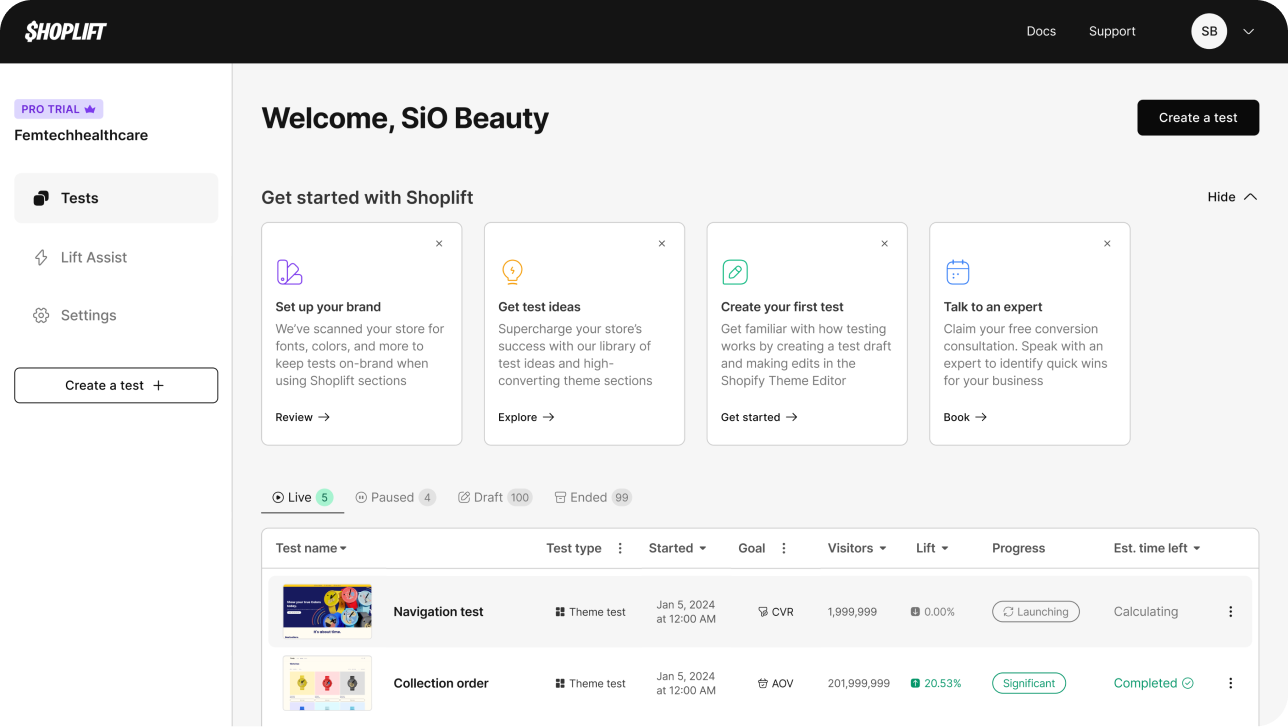
Shoplift Dashboard

Shoplift vs. Optimizely At a Glance

Both can be installed on Shopify. Only one was built for it, and the parentheses are where that shows.


Feature
Shoplift
1) How does this fit our Shopify workflow?
Purpose-built for Shopify
Yes
(tests authored in Shopify's Theme Customizer)
No
(platform-agnostic engine, Shopify app bolt-on)
Native theme-level testing
Yes
(theme-native execution)
Via its own script layer on the storefront
No page flicker / no site-speed hit
Yes
(confirmed in independent reviews)
Script-layer flicker risk
No-code test building
Yes
(marketers launch without devs)
Template-led; developer-dependent beyond templates
Developer / Git workflow
Yes
(edit theme code, Git-sync compatible)
APIs, but page-by-page integration
Apply winning variant natively
Yes
(one click in your Shopify theme)
Change lives in the external engine layer
Test the apps you already run (reviews, UGC, upsell)
Yes
(runs under Shopify, no separate integration)
Requires its own events / product-feed setup
2) Can our team run a program, not just isolated tests?
Coordinated program layer
Yes
(Campaigns: goal-based grouping + calendar)
Experiment/experience management, not a Shopify CRO program layer
Roadmap / backlog + scheduling around launches & code freezes
Yes
Not native to a Shopify workflow
Reusable audiences across tests
Yes
Yes
Expert strategy support
Yes
(Pro plan strategy support)
Professional services (paid engagement)
Time to first test
Same week
Multi-month rollout + ~90-day model warm-up (reported)
3) Can we trust and act on the data?
Revenue-per-visitor & AOV reporting
Yes
(1:1 Shopify order matching)
Shopify revenue/CTR/AOV/RPV events supported; depth of native reporting
Subscription revenue in test reporting
Yes
Not documented
Auto-end on statistical significance
Yes
(Bayesian analysis)
Not documented
Analytics & heatmap integrations
Direct GA4; open API (e.g., Hotjar, Clarity, Amplitude)
Its own analytics; export to external tools
Behavioral research / heatmaps
No
Yes
(built-in)
4) Do we need enterprise personalization & omnichannel depth?
1:1 personalization + ML recommendations
Segmentation & targeting toward best variant
Yes
Omnichannel (app, email, push, kiosk)
No
(Shopify storefront only)
Yes
Cross-platform / non-Shopify stacks
No
(Shopify-native by design)
Yes
Price testing
Yes
Native Shopify price testing
Checkout testing
No
(storefront templates only)
No
(no checkout scripts on Shopify)
Bottom Line
Entry price
$99/mo
(See shoplift.ai/pricing)
Quote only, reported to start ~$35K/year
Best for
A coordinated CRO program on Shopify Plus, run by the team you have
Enterprise 1:1 personalization across many channels, run by a dedicated team

How Real Brands Run CRO in Shoplift

These aren't pilots. Shopify Plus brands run their full CRO programs in Shoplift right now.

Diego Castro, Strategist at on/SightDiego Castro, Strategist at on/Sight

“Campaigns gives our team a layer of structure that a flat test list never could. We can now organize experiments around real initiatives, like a PDP overhaul or a homepage redesign, and track progress against those goals. For an agency running testing across multiple clients, that's a meaningful unlock.”

Diego Castro
Strategist at on/Sight
Sophie Pilkington, Senior Manager of Ecommerce at MinnowSophie Pilkington, Senior Manager of Ecommerce at Minnow

“We've been testing and increasing the price by 10% with really good results. Customers have been converting at their usual rate even with the price increase.”

Sophie Pilkington
Senior Manager of Ecommerce at Minnow
Joseph Lam, Founder/CEO of Parents Are HumanJoseph Lam, Founder/CEO of Parents Are Human

“Hands down, the best A/B testing app on the market for Shopify. So easy to use, without any setup headaches like you might get with other apps.”

Joseph Lam
CEO & Co-founder of Parents Are Human
The Lifecycle

How Tests Are Built, Maintained, and Implemented

A feature match doesn't mean the same thing happens on your store. Follow one test through its whole life: built, QA'd, kept alive when the theme changes, and rolled out when it wins. The two platforms stop looking alike.

01
Built in Your Shopify Workflow, Not on Top of It

Dynamic Yield can be installed on Shopify. Being built for Shopify is a different thing. It's invisible on a starter campaign, unmissable the moment you go past one.

Shoplift logo
Advantage
Tests are authored in Shopify's Theme Customizer and run through Shopify's own architecture, the same workflow your team uses to edit the site any day of the week. No external script layer, so no flicker and no site-speed tax, and results reconcile against Shopify orders.
Deploys as a JavaScript and API layer on essentially any stack. On Shopify, the app's events and scripts are standardized and non-customizable ("managed by the app"), no scripts run on the checkout page, headless/Hydrogen storefronts require manual build-out, and product-feed sync depends on AWS S3 credentials.
Why it matters:

On a script-injection layer, a slow variant corrupts the very test you're trusting to make revenue decisions.

02
Live This Week vs. Staffed for Next Quarter

Every DTC team knows the bottleneck is the engineering queue. The second bottleneck is the team you'd have to hire to run the tool.

Shoplift logo
Advantage
Standard tests are no-code, so your optimization lead builds and launches without a developer, the same week. Need something custom? A JavaScript API on the Advanced tier handles engineering-level experiments, server-side by default, delivered through Shopify's servers.
Independent reviews describe enterprise implementation measured in months, heavy reliance on professional services beyond template campaigns, and roughly a 90-day model warm-up before meaningful lift. Reviewers frame realistic deployments as needing an 8-to-15+ person team.
Note on Dynamic Yield:

The team-size and warm-up figures are third-party estimates. Dynamic Yield publishes neither.

03
Reporting You Can Bet Revenue On

A test result is only worth as much as the number underneath it.

Shoplift logo
Advantage
Bayesian analysis with automatic significance detection, plus 1:1 Shopify order matching, so you read revenue per visitor and AOV, and separate one-time from subscription revenue, the way a Shopify brand measures.
A deep decisioning engine with Shopify conversion/revenue events and CTR/AOV/RPV reporting. Reviewers note native reporting runs shallow, with the expectation that you export into external analytics for the full picture.
Why RPV matters:

Conversion rate alone can hide whether a "winning" variant made you money. Revenue per visitor shows it.

04
Personalization: Where Dynamic Yield Wins

This is the section where Dynamic Yield earns its reputation, and where the Shopify question still bites.

Shoplift logo
Shoplift's job is different: turn a scattered set of tests into a coordinated CRO program. Campaigns groups experiments under one goal metric and a calendar; that planning layer is what makes Shoplift a CRO platform. Lift Assist generates proven conversion patterns (countdown timers, sticky carts, inventory indicators) from session data.
Advantage
True 1:1 personalization and a mature ML recommendation engine (AdaptML: next-item prediction, affinity, visual similarity) across every channel a global retailer touches. Shoplift doesn't out-personalize it, and won't pretend to.
Put plainly:

You can run experiments on a personalization engine. Building a whole program on one is a different job, and a heavier lift than most Shopify teams signed up for.

05
Reliability: The Edge Cases Shopify Throws

Shopify stores break tests in specific, repeatable ways. A theme gets duplicated mid-test. A variant caches. A preview bar leaks to a shopper. Theme-native testing has to solve for all of it.

Shoplift logo
Advantage
Built-in safeguards: if a published theme is missing a test template, the test auto-pauses and emails you exactly how to fix it; caching that could strand a visitor in a variant gets redirected back to the live theme; and preview-bar suppression keeps the unpublished-theme banner from ever reaching a shopper.
As a script layer rather than a theme-native system, these Shopify-specific failure modes aren't addressed in its documentation. They're artifacts of testing inside Shopify's theme architecture, which isn't where Dynamic Yield operates.
06
No Lock-In: Your Store Stays Yours

The tool you pick is one you have to live with. With enterprise infrastructure, leaving means unwinding an engine your team built around.

Shoplift logo
Advantage
Every change lives in your Shopify theme. When a test wins, you apply the variant in one click, natively, with nothing to translate back or rebuild. And because Shoplift runs under Shopify, you can test the apps you already use, like reviews, UGC, and upsell, without wiring up a separate integration.
Dynamic Yield is a persistent external engine on an enterprise contract. Its value depends on the JavaScript layer, the product-feed sync, and the team that maintains them, so the setup you build is the setup you have to keep running.
Why it matters:

No external layer to maintain, no multi-year contract, and no dedicated team just to keep the lights on.

Close Cookie Popup
Cookie Preferences
By clicking “Accept All”, you agree to the storing of cookies on your device to enhance site navigation, analyze site usage and assist in our marketing efforts as outlined in our privacy policy.
Strictly Necessary (Always Active)
Cookies required to enable basic website functionality.
Cookies helping us understand how this website performs, how visitors interact with the site, and whether there may be technical issues.
Cookies used to deliver advertising that is more relevant to you and your interests.
Cookies allowing the website to remember choices you make (such as your user name, language, or the region you are in).