
Shoplift vs. A/B Tasty
One is built for Shopify Plus. The other is an enterprise suite reaching your store through a tag.
A/B Tasty is built to optimize every channel an enterprise runs. Shoplift is the only CRO platform built for Shopify Plus. The right pick comes down to your program’s channel and breadth.


Trusted by 2,000+ Shopify Plus Brands





The Key Differences At a Glance
Both run A/B tests. The difference shows up in your team's week: how fast you launch, who has to get involved, what happens after a test ends, and whether the platform was built for Shopify or adapted to it.


Works the Way Your Team Already Works

Works the Way Your Team Already Works

No Rework, No Vendor Lock-In
No Rework, No Vendor Lock-In

No Flicker, Clean Results
No Flicker, Clean Results

Measured in Revenue, Not Just Clicks
Measured in Revenue, Not Just Clicks


Enterprise Breadth
Enterprise Breadth
Which Platform Fits Your Situation?
Both are strong tools. The right fit depends on your stack, your team, and how far your program has to reach.
Same Checklist, Different Story
A/B Tasty is built to optimize every channel a global enterprise runs: testing, personalization, and feature flags across any web stack. That breadth is the whole pitch, and it's native to none of those stacks. On Shopify it lands as a tag on top of your store. Shoplift is built exclusively for Shopify and it shows in both efficiency and architecture.
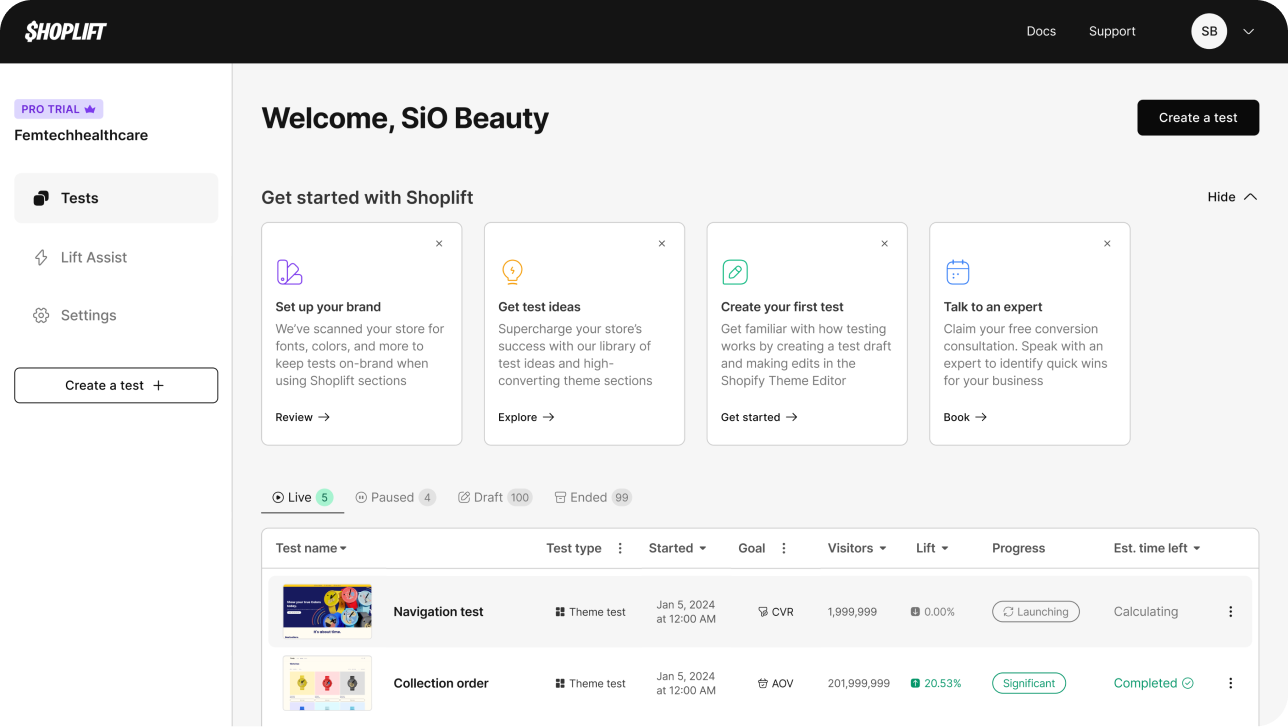
The difference is what testing costs your team. With Shoplift, tests are built and shipped inside Shopify, winners stay live with no re-implementation, and results read against real revenue. And because Shoplift sits underneath Shopify on events, it inherits the apps you already run. You can test your reviews, UGC, or upsell apps, or prove the ROI of a tool by running the store with and without it, without wiring up a single integration.
Shoplift vs. Optimizely At a Glance
Both are strong tools built for different jobs. Only one was built for speed, stability, and revenue accuracy inside Shopify.


How Real Brands Run CRO in Shoplift
These aren't pilots. Shopify Plus brands run their full CRO programs in Shoplift right now.


“Campaigns gives our team a layer of structure that a flat test list never could. We can now organize experiments around real initiatives, like a PDP overhaul or a homepage redesign, and track progress against those goals. For an agency running testing across multiple clients, that's a meaningful unlock.”


“We've been testing and increasing the price by 10% with really good results. Customers have been converting at their usual rate even with the price increase.”


“Hands down, the best A/B testing app on the market for Shopify. So easy to use, without any setup headaches like you might get with other apps.”
What the Checklist Doesn't Show
How each of these works on a real Shopify store and what that means for your team.
The fastest testing program is the one your team doesn't have to change their day to run. Where a test gets built decides how fast it ships and who has to be involved.
To avoid re-implementing a winner, teams leave the tag live at 100% traffic, so a script meant for a test now sits on every shopper's page load.
On a conversion-sensitive storefront, the testing tool can depress the very metric it's measuring.
Flicker doesn't just look bad, it degrades page speed and can corrupt the results of the test itself.
"Can it do engineering-led experiments?" is the enterprise question. The answer for Shoplift is yes, with a different architecture.
A test is only as useful as the number you trust at the end of it — and whether that number is real revenue.
Testing a Shopify price means touching the catalog, not restyling a rendered page.
Both platforms help you build tests. They're built for different jobs.
The number matters. So does whether you can start today or have to run a procurement cycle.


