


We’ve analyzed dozens of A/B testing platforms and helped thousands of Shopify DTC brands increase their conversion rates. Through this experience, we’ve identified the tools that actually move the needle for e-commerce brands and those that overpromise and underdeliver.
This guide breaks down the 10 best A/B testing tools for Shopify and DTC brands in 2026, with honest pros, cons, and pricing so you can pick the right one for your store.
Table of Contents
- What is A/B Testing?
- Why Shopify DTC Brands Needs A/B Testing
- Key Features to Look For
- The Top 10 A/B Testing Tools for Shopify DTC Brands
- Shoplift
- Visually
- Intelligems
- Elevate
- VWO + A/B Tasty
- Convert
- ABConvert
- Optimizely
- Crazy Egg
- Dynamic Yield
- Comparison Table
- Choosing the Right A/B Testing Tool for Your Store
- Ready to Start Testing?
- FAQ
What is A/B Testing?
A/B testing (also called split testing) is a method of comparing two or more versions of a webpage, product element, or user experience to determine which performs better. Instead of guessing what your customers want, you let their behavior tell you.
How A/B testing works in practice:
- Pick what to test → Headlines, images, pricing, layouts, CTAs, entire themes
- Create variations → Version A (control) vs. Version B (or C, D, etc.)
- Split your traffic → Randomly show different versions to different visitors
- Measure results → Track conversions, revenue, click-through rates
- Implement the winner → Roll out the best-performing version to all visitors
An A/B testing tool automates this entire process. The best e-commerce CRO tools handle traffic splitting, statistical analysis, and revenue tracking, so you can focus on generating test ideas rather than wrestling with code.
For Shopify DTC brands specifically, the right Shopify A/B testing solution integrates directly with your store, letting you test everything from product pages to pricing without developer involvement.
Why Shopify DTC Brands Need A/B Testing
Every e-commerce brand is sitting on untapped revenue. The question is whether you’ll find it through systematic testing or leave it on the table.
Here’s why A/B testing for online stores has become non-negotiable:
1. Run Experiments Faster Than Manual Approaches
Traditional optimization means making a change, waiting weeks, and hoping sales improve. A/B testing lets you run controlled experiments with statistical confidence, often reaching conclusive results in days, not months.
2. Lower Customer Acquisition Costs
As ad costs continue to rise across Meta, Google, and TikTok, improving your conversion rate is often more profitable than increasing ad spend. A 20% improvement in conversion effectively reduces your cost per acquisition by 20%.
3. Test Pricing Strategies Safely
Price testing is one of the highest-leverage experiments you can run. But changing prices across your entire store is risky. E-commerce split testing lets you test different price points with a portion of traffic before committing to one.
4. Discover Unexpected Wins from Small Changes
The changes that move the needle often surprise you. A different product image angle. A shorter headline. A trust badge placement. Without testing, you’d never know that a “minor” tweak could lift revenue by 15%.
5. Scale Testing as Your Brand Grows
What works at $100K/month may not work at $1M/month. Continuous testing builds a culture of optimization that compounds over time, creating sustainable competitive advantages.
Key Features to Look For
Not all conversion rate optimization tools are created equal, especially for e-commerce. When evaluating the best A/B testing tools, prioritize these capabilities:
1. Price Testing
What it does: Let's you test different product prices with different visitor segments.
Why it matters: Pricing is the most direct lever for profitability. A 5% price increase with no drop in conversion goes straight to your bottom line. Price testing helps you find the optimal balance.
2. Native Shopify Builder (No-Code)
What it does: Leverages the native Shopify Theme Editor to build test variations visually without code, eliminating the need for brittle third-party overlays.
Why it matters: Because it loads natively, you avoid page flicker. You can launch production-grade experiments in minutes.
3. Theme and Content Testing
What it does: Enables testing of entire page templates, themes, and content blocks, not just isolated elements.
Why it matters: Sometimes the biggest wins come from wholesale changes. Testing a complete redesign against your current theme reveals opportunities that element-level testing misses.
4. Native Platform Integration
What it does: Connects directly to your e-commerce platform (Shopify, WooCommerce, etc.) for seamless data flow.
Why it matters: Native integrations mean accurate revenue tracking, faster setup, and fewer technical issues. Generic tools often struggle with platform-specific elements like dynamic carts and checkout flows.
5. Revenue Tracking
What it does: Measures actual revenue per visitor, not just clicks or conversions.
Why it matters: A variation might increase conversions but decrease average order value. Revenue tracking shows the true impact on your business.
6. Page Speed Impact
What it does: Determines how much (if any) the testing tool slows down your site.
Why it matters: Page speed directly affects conversion rates. A tool that adds 2 seconds of load time could hurt conversions more than any test that improves them.
7. Ease of Setup
What it does: Determines how quickly you can go from signing up to running your first test.
Why it matters: Complex implementations create friction and delay ROI. The best A/B testing tools for Shopify can have you running tests in under an hour.
The 10 Best A/B Testing Tools for Shopify DTC Brands
Shoplift

The native Shopify A/B testing platform built for conversion optimization.
Shoplift is purpose-built for Shopify merchants who want to run rigorous A/B tests without technical complexity.
As the first and only A/B testing app to achieve Shopify Plus Certification, it’s designed from the ground up for the Shopify ecosystem, not retrofitted from a generic testing tool.
What sets Shoplift apart is its native theme integration. Instead of injecting code that can cause flickering or slow load times, Shoplift duplicates your theme templates and makes changes directly in the Shopify theme editor. This means tests run fast, look right, and don’t break when Shopify updates.
Standout Features
Native Shopify Integration
Tests are created by duplicating theme templates and editing within Shopify’s native theme customizer. This prevents page flicker, ensures compatibility with all Shopify themes, and makes implementation seamless.
Price Testing
Available in the Advanced plan, price testing lets you experiment with different price points to find the sweet spot between conversion rate and margin. Changes sync across product pages, collections, cart, and checkout.
Theme Testing
Running a rebrand? Testing a new page layout? Shoplift lets you split traffic between entirely different themes to measure impact before committing to a full rollout.
Content Testing
Test any content element: headlines, images, product descriptions, trust badges, CTAs, using a visual editor that works directly in your Shopify admin.
Revenue Tracking
Shoplift tracks Revenue Per Visitor (RPV), Average Order Value (AOV), conversion rate, and clickthrough rate. Machine learning models predict statistical significance in real-time, helping you reach confident conclusions faster.
Lift Assist™
Lift Assist is a library of pre-built “tests in a box” based on proven CRO patterns from tens of billions of shopper sessions. Unlike widgets or overlays, Lift Assist sections are real Liquid code dropped right into your theme files with zero platform lock-in, helping you generate high-converting test variations all styled to match your brand.
Pros
- Built specifically for Shopify - No awkward workarounds or compatibility issues
- No-code visual editor - Create tests without touching code
- Tracks actual revenue impact - Not just clicks or conversions
- Fast implementation - Get your first test live in under 10 minutes
- Zero page flicker - Native integration eliminates the flash of content swapping
- Minimal page speed impact - Optimized script that won’t hurt your Core Web Vitals
- One-click winner deployment - Apply winning variations instantly
- Excellent customer support - Highly rated on the Shopify App Store (4.8/5 stars)
Cons
- Shopify-only - Not an option if you’re on WooCommerce, BigCommerce, or custom platforms
- Price testing requires Advanced plan - Entry-level plan covers content and theme testing only
- Visitor-based pricing - High-traffic stores will need higher-tier plans
Check out the Shoplift Pricing page. All plans include a 14-day free trial. Custom enterprise pricing available for stores with 1M+ monthly visitors.
Visually.io
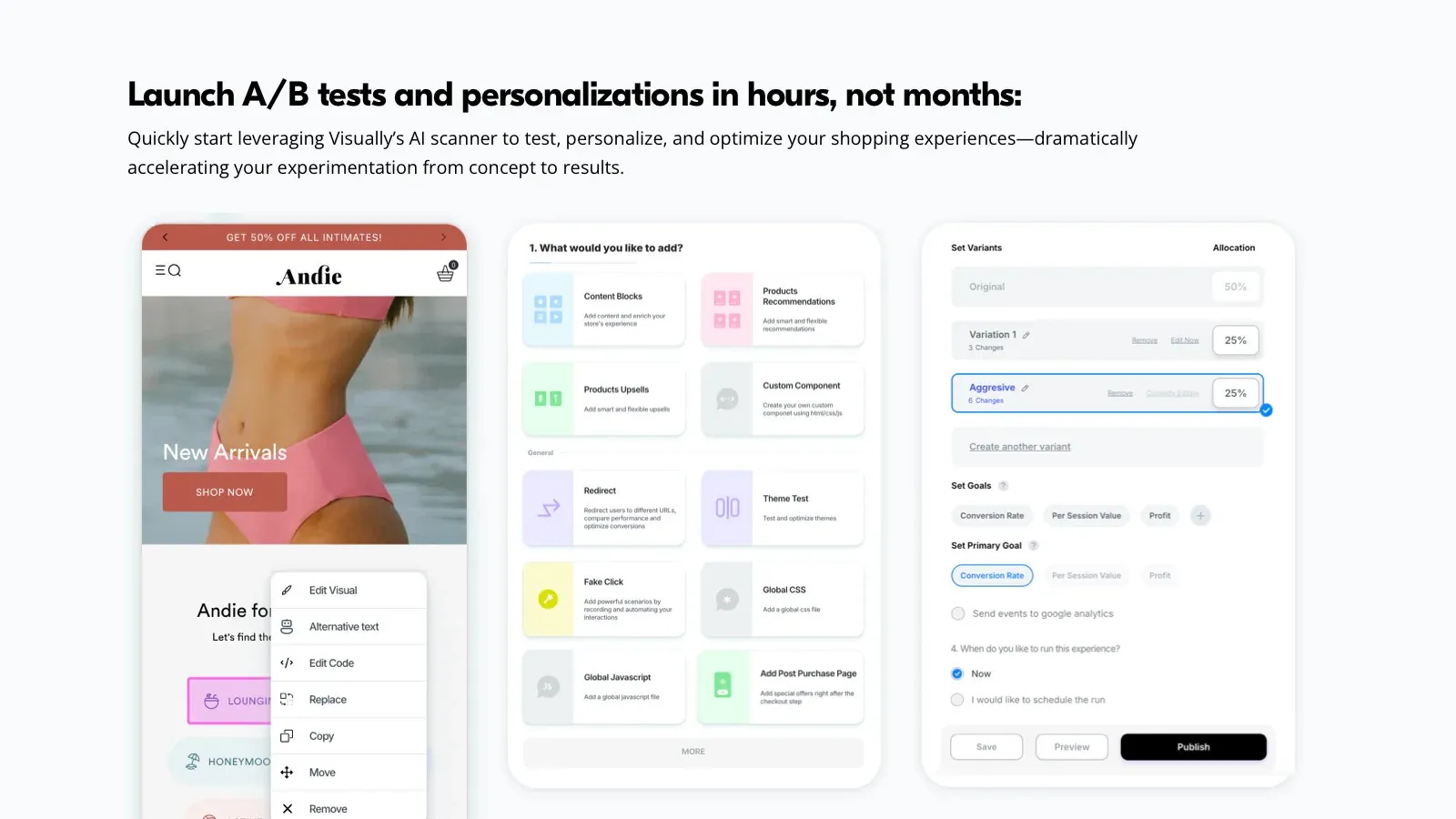
Full funnel personalization tool
Visually positions itself as an A/B testing and personalization platform; however, most users rely on it for its personalization features because its strength is giving brands surface-level overlays and widgets for their store. Unlike Shoplift, Visually is not Shopify Plus Certified, and its well-documented performance problems prevent it from gaining mass appeal with Shopify Plus brands. Furthermore, while the tool is marketed as no-code, its most robust functionality typically requires developer involvement to implement, adding a layer of technical dependency and hidden cost to unlock its true power.
Key Features
- JavaScript-based A/B testing and personalization overlays
- Product recommendation and upsell widgets to influence AOV
- AI-assisted test generation and editing
- Behavioural segmentation and personalization
Pros
- Upsell and recommendation widgets
- Behavioral personalization for showing different content to different segments
- Pre-built personalization upsell patterns to get started quickly
Cons
- Overlay/JavaScript approach adds performance overhead, which can introduce flicker issues
- Changes live in Visually’s layer, creating vendor lock-in (You lose functionality if you leave)
- Weaker Shopify-native integration compared to theme and template-based approaches
- Not Shopify Plus Certified
Pricing
Launch Plan - $720/mo ($648/mo Annual giving you 10% savings)
Pro Plan - $1200/mo ($1080/mo Annual giving you 10% savings)
Scale Plan - $3600/mo ($3240/mo Annual giving you 10% savings)
*Note that this is specific to 1 store with an avg monthly order vol of 7500-10,000.
14-day free trial available. Higher volume plans are available to Shopify Plus merchants.
Intelligems
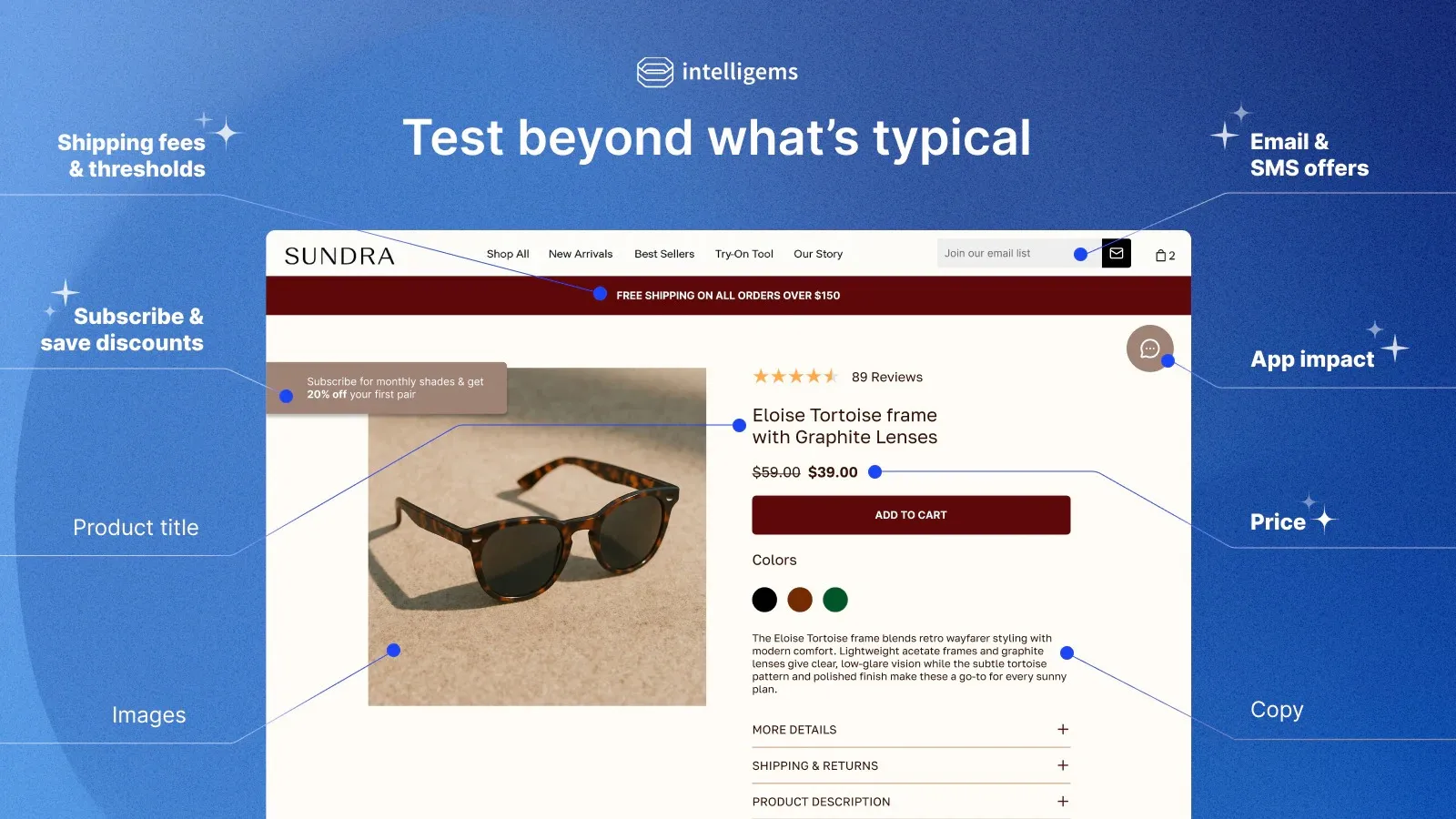
Price and offer testing specialist
Intelligems focuses specifically on profit optimization through price, shipping, and offer testing. It is a solid choice for brands whose primary goal is to find optimal pricing strategies. However, unlike Shoplift, Intelligems is not Plus Certified, so you miss out on speed and seamless integration.
Key Features
- Pricing experiments focused on profit optimization
- Basic profit analytics when product costs are loaded manually
- Support for testing shipping thresholds and discount charges
- Ability to run tests on themes and templates but with developer involvement
Pros
- Strong emphasis on pricing and profit optimization
- Supports subscription price tests (for eligible stores)
- Useful profit reporting once product cost data is configured
Cons
- Not built as an A/B testing platform for fast content and template iteration
- Heavier setup: often requires custom code, dev time, and manual configuration
- Tests execute via additional scripts and page loads, with potential for flicker and slower performance
- Pricing tied to order volume, with price testing available as a more expensive add-on
- Interface and workflow can feel complex compared to more Shopify-native, no-code tools
Pricing
Core Redirect Only Plan - $49/mo ($37/mo Annual giving you 25% savings)
Core Plan - $79/mo ($59/mo Annual giving you 25% savings)
Plus Plan - $499/mo ($374/mo Annual giving you 25% savings)
Blue Plan - $999/mo ($749/mo Annual giving you 25% savings)
14-day free trial available on entry plans
Elevate A/B Testing

Comprehensive testing with a strong price optimization focus
Elevate A/B testing offers a full suite of testing capabilities with particular strength in price testing and shipping optimization. The platform provides detailed analytics and integrates with 100+ platforms. However, Elevate is not Plus Certified, so DTC brands miss out on Plus-grade reliability.
Key Features
- Price testing with real-time traffic splitting
- Shipping rate and threshold testing
- Visual content editor for no-code changes
- Theme and split URL testing
- Advanced analytics with 100+ metrics
Pros
- Good price testing capabilities
- Strong analytics and reporting
- Supports integration ecosystem
- AI-powered test suggestions
Cons
- Price Testing is not available on the basic plan
- Premium features require significant investment
- Can be overwhelming for testing beginners
- Steeper learning curve than other alternatives
Pricing
Basic Plan - $49/mo ($34/mo Annual giving you 30% savings)
Standard Plan - $99/mo ($69/mo Annual giving you 30% savings)
Premium Plan - $499/mo ($349/mo Annual giving you 30% savings)
Note: Pricing here is for 0 - 1,000 monthly orders
14-day free trial is included on all plans.
VWO + A/B Tasty

VWO and A/B Tasty recently merged to form a new global digital experience optimization powerhouse. The deal, announced in January 2026, aims to create a combined entity valued at $400–$500 million.
VWO
Enterprise-grade with an enterprise price tag
VWO is a mature, full-featured experimentation platform used by enterprise brands. It offers comprehensive testing capabilities but comes with enterprise complexity and pricing. VWO is also not Shopify native.
Key Features
- A/B multivariate and split URL testing
- Strong behavioral analytics (heatmaps, session recordings)
- AI-powered campaign creation (VWO Copilot)
- Good targeting and segmentation options
- Feature flags and controlled rollouts
Pros
- Extremely powerful and feature-rich
- SmartStats Bayesian engine provides reliable results
- Solid documentation and support
- Strong integrations (Shopify, Magento, GA4)
Cons
- Enterprise pricing puts it out of reach for SMBs
- Significant implementation complexity
- Overkill for basic testing needs
- Not Shopify-native, requires additional setup
Pricing
VWO doesn't publish pricing publicly. The plans (Growth, Pro, and Enterprise) are quoted based on traffic and features. Third-party estimates suggest starting at around $500-$600 per month for basic growth plans, with enterprise tiers significantly higher.
30-day free trial available
AB Tasty
Mid-market experimentation with strong personalization
AB Tasty is best thought of as a broad, enterprise experimentation + personalization platform and not a Shopify-specialist testing app.
Key Features
- A/B, multivariate, and split URL testing
- AI-based targeting and personalization
- WYSIWYG and code editors
- Product recommendation API
- Feature flags for controlled releases
Pros
- Good balance of features and usability
- Strong personalization capabilities
- Solid statistical engine (Bayesian)
- Multi-channel support (web, mobile, email)
Cons
- No public pricing (enterprise sales process)
- Starting around $15,000/year per third-party sources
- Not purpose-built for e-commerce
- Integration with Shopify requires additional configuration
Pricing
AB Tasty requires a demo for pricing. Industry estimates suggest starting at approximately $15,000 per year, scaling with traffic and features
Convert

Privacy-focused testing with transparent pricing.
Convert has built a reputation for transparent pricing, strong privacy compliance, and solid A/B testing fundamentals. It’s a credible alternative for brands wanting more control over their experimentation data. However, Convert is not native to Shopify.
Key Features
- A/B, multivariate, and split URL testing
- Full-stack and feature flag capabilities
- Advanced targeting (40+ filters)
- Sequential testing for risk mitigation
- Convert signals for session insights
Pros
- Transparent, published pricing
- Strong privacy and GDPR compliance
- Good Shopify integration
- Generous tested user limits
- Responsive support
Cons
- Not purpose-built for e-commerce
- Visual editor can be clunky for complex changes
- No native price testing feature
- Steeper learning curve than Shopify-native tools
Pricing
Growth Plan - $399/mo ($299/mo Annual giving you 30% savings)
Pro Plan - $759/mo ($420/mo Annual giving you 30% savings)
Enterprise Plan - Custom
15-day free trial available.
ABConvert

Price and offer testing specialists
ABConvert is a Shopify native A/B testing app designed for ecommerce merchants who want to optimize pricing, shipping, and storefront elements. It’s well-suited for store owners looking to run profit-focused experiments without technical expertise. ABConvert is, however, not Certified Plus.
Key Features
- Price A/B testing to find optimal balance between conversion and profit
- Shipping rate and threshold testing to boost average order value
- Theme and template testing without risking your live site
- Checkout optimization for payment options and UI elements
- Smart audience targeting by location, customer type, and UTM source
Pros
- Built exclusively for Shopify with seamless integration and minimal speed impact
- No-code interface makes test setup accessible to non-technical users
- Comprehensive pricing and shipping tests that directly impact profitability
- Real-time analytics and statistical significance tracking
Cons
- Price testing requires the Advanced plan ($149/mo) or annual Basic subscription
- No visual drag-and-drop editor for on-page content changes
- Shipping rate testing requires Shopify’s carrier-calculated shipping feature
- Limited to Shopfiy platform only
Pricing
Basic Plan - $79/mo ($59/mo Annual)
Advanced Plan - $149/mo ($119/mo Annual)
Plus Plan - $249/mo ($199/mo Annual)
Annual billing saves ~25% (2 months free). All plans include a 14-day free trial.
Optimizely

The enterprise experimentation standard
Optimizely is widely considered the gold standard for enterprise testing. It offers unmatched feature depth but comes with enterprise-level complexity and budgetary requirements. Optimizely is not native to Shopify.
Key Features
- Comprehensive A/B testing and multivariate testing
- AI predictive audiences
- Advanced personalization
- Feature experimentation with SDKs in 10+ languages
- Good statistical engine
Pros
- Industry-leading capabilities
- Excellent for complex, multi-channel programs
- Strong enterprise support and services
- Powerful targeting and segmentation
Cons
- Pricing starts at around $36,000/year minimum
- Annual contracts only - no monthly option
- Significant implementation and ongoing management required
- Massive overkill for most Shopify merchants
- Not Shopify native
Pricing
Optimizely requires custom quotes. Industry estimates range from $36,000-$200,000+/year, depending on traffic and features. No free trial, demo only.
Crazy Egg
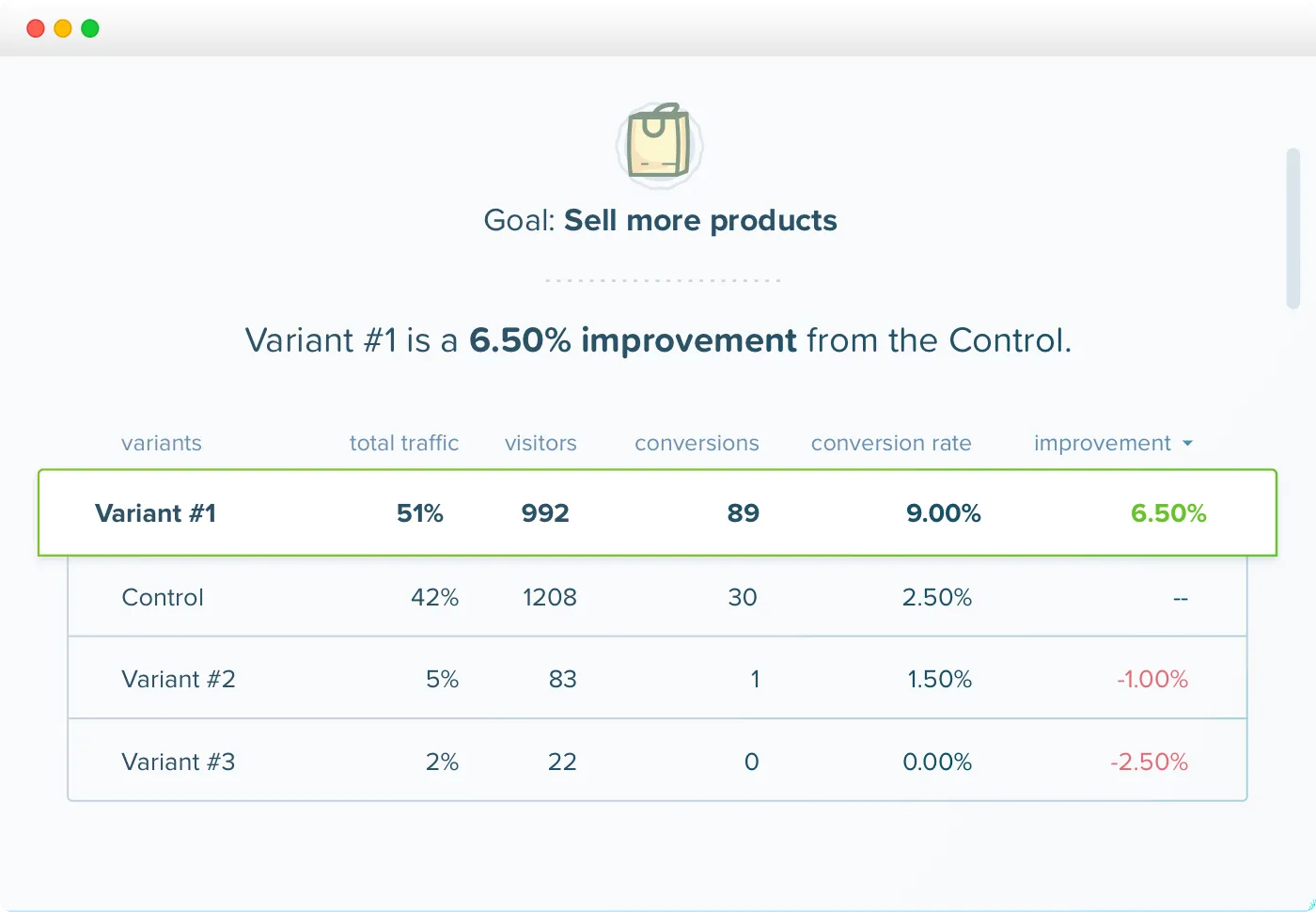
Heatmaps and basic A/B testing combined
Crazy Egg is primarily known for heatmaps and session recordings, but it includes A/B testing capabilities. It’s a good entry point for brands new to optimization who want behavioral insights alongside testing. Crazy Egg is unfortunately not e-commerce specific.
Key Features
- A/B testing with visual editor
- Heatmaps and scroll maps
- Session recordings
- Conversion analytics
- Survey tools
Pros
- Affordable entry point
- Great for understanding user behavior
- Simple, intuitive interface
- Unlimited A/B tests on all paid plans
Cons
- A/B testing is basic compared to dedicated tools
- No price testing capability
- Not e-commerce-specific
- Limited statistical rigor
Pricing
Starter Plan - $29/mo (5,000/mo Tracked Pageviews)
Plus Plan - $99/mo (150,000/mo Tracked Pageviews)
Pro Plan - $249/mo (500,000/mo Tracked Pageviews)
Enterprise Plan - $599/mo (1,000,000/mo Tracked Pageviews)
30-day free trial available. All prices billed annually.
Dynamic Yield

Enterprise personalization with experimentation
Dynamic Yield (acquired by Mastercard) is a full-featured personalization platform that includes A/B testing as part of its broader "Experience OS.” It’s designed for large enterprises with sophisticated personalization needs. Dynamic Yield is, however, not native to Shopify.
Key Features
- Omnichannel personalization (web, mobile, email)
- A/B and multivariate testing
- AI-powered product recommendations
- Advanced audience segmentation
- Journey orchestration
Pros
- Extremely powerful personalization
- Strong recommendation engine
- Multi-channel capabilities
- Enterprise-grade infrastructure
Cons
- Starts at around $35,000/year minimum
- Complex implementation
- Overkill for pure A/B testing needs
- Not Shopify-native
Pricing
Dynamic Yield requires custom quotes. Industry sources estimate starting prices around $35,000/year, scaling significantly with traffic and modules.
Comparison Table
Choosing the Right A/B Testing Tool for Your Store
So how do you choose the right A/B testing tool for your store, with so many options? Below is a framework
- Define Your Testing Needs
Start with what you want to test. If price optimization is your priority, ensure the tool has robust price testing capabilities (Shoplift, Elevate, Intelligems, Visually). If you are focused on content and design, most tools will work
- Analyze Ease of Use and Test Setup
A tool that requires extensive developer involvement for every test will severely limit your experimentation velocity. For Shopify merchants, native integrations (Shoplift, Visually, Elevate) offer the fastest path to running tests.
- Compare Pricing and Scalability
Understand how pricing scales with your store traffic. A tool that’s affordable at 50,000 visitors might become prohibitively expensive at 500,000. Factor in your growth trajectory.
- Consider Support
When tests break or results seem off, responsive support matters. Check reviews specifically for support quality, as it is often the difference between a successful testing program and a tedious one.
- Test Before You Buy
Use free trials extensively. Run a real test, not just a demo, to see how the tool performs with your actual store traffic and team.
Subscribe to the Shoplift newsletter
Get insights like these emailed to you bi-weekly!
{{hubspot-form}}
Ready to Start Testing?
Every day you don't test is a day you’re leaving revenue on the table. Your customers are telling you what they want through their behavior. The only question is whether you are listening.
Start your free 14-day trial with Shoplift today, and start optimizing your Shopify store in minutes.
FAQ Section
What is the best A/B Testing tool for Shopify?
For most Shopify merchants, Shoplift offers the best combination of native integration, ease of use, and comprehensive features. Its direct integration with Shopify’s theme editor eliminates common issues like page flicker and ensures tests work reliably across all themes. For brands specifically focused on price testing, Shoplift, Elevate A/B, and Intelligems are all strong options.
How much traffic do I need for A/B testing?
Generally, you need enough traffic to reach statistical significance within a reasonable timeframe. For most tests, this means at least 1,000-5,000 visitors per variation over 1-2 weeks. Lower-traffic stores can still test; they just need to run tests longer or focus on higher-impact changes. Most A/B testing tools include calculators to estimate required sample sizes.
Is A/B testing worth it for small e-commerce stores?
Yes, but with caveats. Small stores should focus on high-impact tests (pricing, major layout changes) rather than micro-optimizations. Even one winning test per quarter can significantly improve profitability. Start with an affordable tool that has a free trial, prove ROI with your first few tests, then expand your program.
What’s the difference between A/B testing and multivariate testing?
A/B testing compares two (or a few) distinct versions of a page or element. Multivariate testing simultaneously tests multiple variables and their combinations. A/B testing is simpler and requires less traffic; multivariate testing can reveal interaction effects but needs significantly more visitors to reach conclusions. Most e-commerce brands should master A/B testing before attempting multivariate experiments.
Can A/B testing hurt my SEO?
When implemented correctly, A/B testing does not harm SEO. Google has explicitly stated that A/B testing is fine as long as you’re not cloaking (showing different content to Googlebot than users). Native Shopify tools like Shoplift handle this automatically. Avoid using redirects for simple content tests, and ensure your testing tool properly implements canonical tags.
How long should I run an A/B test?
Run tests until you reach statistical significance, typically 95% confidence that one variation genuinely outperforms the other. This usually takes 1-4 weeks, depending on traffic and the size of the effect. Avoid stopping tests early just because one variation is “winning.” Early results are often misleading. Most testing tools will tell you when results are statistically significant.
What is the difference between price testing and regular A/B testing
Price testing is a specific type of A/B testing where the variable being tested is the product price. It requires additional capabilities to ensure price consistency across the entire site (product pages, collections, cart, checkout) and integration with inventory systems. Not all A/B testing tools support price testing; it’s a feature to specifically look for if pricing optimization is a priority.


