Shoplift vs. Convert

A complete comparison for Shopify merchants.

Both run A/B tests. Convert is an experimentation platform that works across any stack. Shoplift is the operating system for your Shopify CRO program. You plan it, build it, measure it, personalize it, and roll out winners in one Shopify-native workflow. If your revenue runs on Shopify, run your program where it lives.

Trusted by 2,000+ Shopify Plus Brands

Haus Labs, Kitsch, and Dreamland Baby run their CRO programs in Shoplift.

The Key Differences At a Glance

Both platforms run A/B tests and both report results. The difference is the operating model: who on your team can launch a test, how much dev and QA each one takes, and where your ideas, campaigns, results, and winners live. Shoplift runs that whole loop inside Shopify.

Shoplift logo
Advantage

Native Architecture

View more →

Native Architecture

Shoplift is a natural extension of your team's day-to-day Shopify workflow. Edits are made right in the Shopify theme editor, the same way your team changes the site any other day of the week, and tests are served through Shopify itself, just like the rest of your store. Convert is built to be all things to all platforms, so on Shopify it works from the outside: extra code layered on top of your site. That's where the risk lives: broken pages, bugs, slower loads, and flicker.
Shoplift logo
Advantage
Shoplift logo
Advantage

Zero Page Flicker

View more →

Zero Page Flicker

Convert gives teams a choice: load synchronously to prevent flicker at the cost of render blocking, page speed, and site performance, or asynchronously to reduce the page-speed impact with greater risk of flicker. Async anti-flicker can mask the flash, but does so by hiding content until the external script is ready. Shoplift avoids that external assignment tradeoff for test assignment by deciding which version each shopper should see before anything appears on screen. Tests are built directly in Shopify so there’s no need to wait for a separate testing tool to load. Shoppers see the right experience from the start, without the flicker or site-speed tradeoff.
Shoplift logo
Advantage
Shoplift logo
Advantage

Native Price Testing

View more →

Native Price Testing

Shoplift A/B tests price directly on the Advanced plan, natively inside Shopify: it tests the real prices customers pay and runs in the same workflow as the rest of your program, without creating duplicate products or bolting on a separate tool. Convert offers native Shopify price testing too; the difference is that on Shoplift it runs in the same native workflow as everything else you optimize.
Shoplift logo
Advantage
Shoplift logo
Advantage

Measured in Revenue Per Visitor

View more →

Measured in Revenue Per Visitor

Shoplift reads Shopify's order and session data out of the box and reports revenue per visitor, AOV, and CVR, including one-time vs. subscription purchases. Convert provides revenue and conversion tracking through its Shopify app and GA4 sync; Shoplift's reporting is Shopify-native and split by purchase type from the start.
Shoplift logo
Advantage
Advantage

Multi-Client Administration

View more →

Multi-Client Administration

Convert tests any site on any stack, with pooled traffic, permissions, a single multi-client account, and white-labeling built for agencies running many clients across platforms. If you administer experimentation across a book of non-Shopify clients, that's a strength.
Advantage
Shoplift logo
Advantage

Shopify CRO Service Delivery

View more →

Shopify CRO Service Delivery

Convert helps agencies manage experimentation accounts. Shoplift helps Shopify agencies build and deliver a CRO practice. It standardizes delivery inside Shopify, cuts implementation and QA overhead, preserves agency-owned dev work, makes winning variants permanent, enables client collaboration, and turns project relationships into recurring CRO retainers.
Shoplift logo
Advantage
Advantage

Built-In Behavioral Research

View more →

Built-In Behavioral Research

Convert includes built-in behavioral research and heatmaps. Shoplift connects to heatmapping through the API and direct GA4/Heatmap.com integrations.
Advantage

Which Platform Fits Your Situation?

Both are capable tools. The right one depends on what you're optimizing and where it lives.

A testing tool helps you launch an experiment. A CRO platform helps you decide what to test, organize the work around initiatives, schedule it against launches and code freezes, measure the outcome, keep the learnings, personalize the winners, and keep the program moving.

Shoplift logo
Advantage
Built for Shopify Plus brands running a serious CRO program.
Shoplift makes sense if…
Your store is on Shopify or Shopify Plus, and native performance matters.
You want to test price and offers, well beyond page layout.
You want your ecommerce lead launching tests without waiting on dev, while your developers keep their git workflow for the high-lift builds.
You measure success in revenue per visitor, and want subscription vs. one-time revenue in the report.
You want tests live this week, not stuck behind the engineering backlog.
You're ready to run a coordinated program against a goal and a calendar.
Shoplift makes Shopify Plus brands good at CRO.
A capable general-purpose experimentation platform, strongest across multiple platforms.
Optimizely makes sense if…
You test across multiple platforms: a headless build, a marketing site, a non-Shopify property.
You're an agency administering experiments for many clients, and need white-labeling.
You want to choose your statistics per test: fixed-sample, sequential, or Bayesian.
You're an EU organization with hard data-residency requirements (Frankfurt servers, no third-party cookies).
You want breadth and experimentation rigor across more than Shopify: full-stack and server-side tests, bandits, and personalization across every property you run.

Same Tests, Different Depth

Both platforms run A/B tests, support integrations including GA4, and report a winner. Line them up on a checklist and they might start to look interchangeable.

The difference is what happens beneath the checkbox. Because Shoplift installs in two clicks and sits inside Shopify, every app already connected to your store (reviews, UGC, upsell, subscriptions) is testable without wiring up a new integration. Because Convert works across every platform, on Shopify it reaches your store as an outside layer: code goes on top for the test, and after it ends, a developer translates the winner back into your theme. Shoplift only touches code if you asked for custom work, and only once.
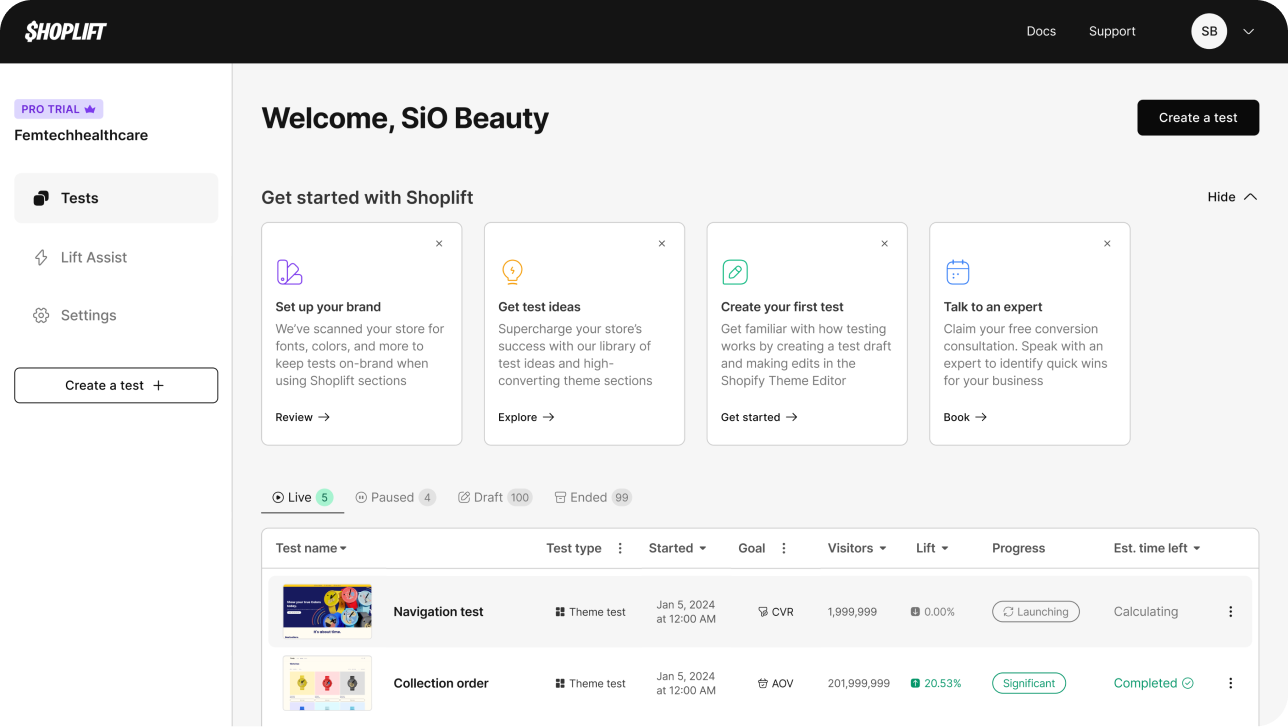
Shoplift Dashboard

Shoplift vs. Convert At a Glance

Both run tests. The questions that decide it for a Shopify Plus team:

Feature
Shoplift
1) How does this fit our Shopify workflow?
Shopify Plus Certified
Yes
(first and only A/B testing app)
No
Shopify app available
Yes
Yes
Variants built and QA’d in Shopify’s theme editor
Yes
No
Shopify setup
App store install
Shopify app, Convert API key, and theme app embed.
Make an editor-built winner permanent in Shopify
Apply Variant
Developer implementation in theme or continue delivering through Convert.
No-code page changes
Native theme editor + LiftAssist
Convert Visual Editor.
2) Can our team run a CRO program, not isolated tests?
CRO program planning layer (Campaigns)
Yes - Shoplift Campaigns
(Advanced & Pro)
Experiment lifecycle management + personalization
3) Can we trust and act on the data?
Commerce-native metrics (RPV, AOV, CVR)
Yes
(Shopify-native, out of the box)
Revenue/conversion tracking via Shopify app + GA4 sync
Subscription vs. one-time revenue in reporting
Yes
Not documented
Statistical methods
Bayesian predictive significance
Fixed-sample, sequential, or Bayesian (choice)
Shopify-native, server-rendered variants
Yes
(native theme and template variants are rendered and served by Shopify)
Web experiments apply variation changes client-side. (Server-rendered implementations are possible through the Fullstack SDK.)
General-purpose server-side/full-stack SDK
No
Yes
(available on Pro, requires dev implementation)
Native GA4 integration
Yes
(direct)
Yes
Page flicker
None
Mitigated
(SmartInsert anti-flicker; still an outside script)
Heatmapping (Hotjar, Clarity, Lucky Orange)
Via API + GA4/Heatmap.com direct
Yes
(built-in)
4) Do we need cross-platform / agency / advanced experimentation depth?
Cross-platform / non-Shopify testing
No
(Shopify only)
Yes
(any stack)
Multivariate testing
No
Yes
(Pro plan)
Native price testing
Yes
(Advanced plan, native inside Shopify)
Yes
(no-code; product, collection, cart, checkout; checkout on Plus)
EU data residency (Frankfurt)
Not documented
Yes
Pricing & trial
Transparent published pricing
Yes
Free trial
14 days
15 days, no credit card
Entry price
$99/mo
$399/mo (Growth)

How Real Brands Run CRO in Shoplift

These aren't pilots. Shopify Plus brands run their full CRO programs in Shoplift right now.

Diego Castro, Strategist at on/SightDiego Castro, Strategist at on/Sight

“Campaigns gives our team a layer of structure that a flat test list never could. We can now organize experiments around real initiatives, like a PDP overhaul or a homepage redesign, and track progress against those goals. For an agency running testing across multiple clients, that's a meaningful unlock.”

Diego Castro
Strategist at on/Sight
Sophie Pilkington, Senior Manager of Ecommerce at MinnowSophie Pilkington, Senior Manager of Ecommerce at Minnow

“We've been testing and increasing the price by 10% with really good results. Customers have been converting at their usual rate even with the price increase.”

Sophie Pilkington
Senior Manager of Ecommerce at Minnow
Joseph Lam, Founder/CEO of Parents Are HumanJoseph Lam, Founder/CEO of Parents Are Human

“Hands down, the best A/B testing app on the market for Shopify. So easy to use, without any setup headaches like you might get with other apps.”

Joseph Lam
CEO & Co-founder of Parents Are Human
Technical Breakdown

What the Checklist Doesn't Show

A matching feature isn't matching implementation. Here's the practical difference behind the checkboxes.

01
How Tests Are Built, Maintained, and Implemented

An A/B test is only as good as the way it's built, maintained, and put live. Follow one from variant creation through QA, through what happens when the theme changes, to how a winning variant ships permanently. That's where a tool built for every platform and a tool built for Shopify part ways.

Shoplift logo
Advantage
Shoplift builds and QA’s test versions directly in Shopify. It decides which version each shopper should see before the tested content appears, so the right experience shows from the start without waiting for a separate testing tool. When a test wins, the team can apply that version directly to the Shopify theme.
Convert injects JavaScript on top of the theme. When a test ends, that code overlay has to be translated back into Shopify by a developer. If the winning version continues running through Convert, the store remains dependent on Convert to deliver it. Making an editor-built winner permanent generally requires implementing the change in the Shopify theme.
Callout:

In Shoplift’s performance research, a cached, locally assigned approach displayed first content in 0.37 seconds versus 1.34 seconds for a network-dependent setup.

02
Statistical Reporting & Test Conclusions

You can only act on a result you trust and can tie to revenue.

Shoplift logo
Advantage
Shoplift reports Bayesian predictive significance and measures in revenue per visitor, AOV, and CVR, pulled straight from Shopify order data and split by one-time vs. subscription purchase.
Convert offers a choice of fixed-sample, sequential, or Bayesian methods, useful for statistically sophisticated teams. It also provides revenue and conversion tracking through its Shopify app and GA4 sync.
03
Price Testing Implementation

For a DTC brand, price and offer are often the highest-leverage things you can test.

Shoplift logo
Advantage
Shoplift A/B tests price directly on the Advanced plan, natively inside Shopify: it tests the real prices customers pay and runs in the same workflow as the rest of your program, without creating duplicate products.
Convert offers native, no-code Shopify price testing across product, collection, cart, and checkout (checkout on Shopify Plus), managed from its own app alongside its cross-platform tooling.
04
No-Code Test Creation: LiftAssist vs. Convert's Visual Editor

Who can launch a test, a merchandiser or only a developer, decides how many tests you run.

Shoplift logo
Advantage
LiftAssist auto-creates branded, pixel-perfect split tests with no code, and offers pre-built tests based on patterns Shoplift sees convert. A merchandiser makes edits the same way they'd edit the live site.
Convert's visual editor is widely described as basic; single-page-app and more advanced tests require code. Independent reviews call onboarding help "almost mandatory" below the top tiers.
05
Shopify Plus Certification & Partnership

Certification is Shopify vouching that a tool meets its performance and security bar.

Shoplift logo
Advantage
Shoplift is the first and only A/B testing app to earn Shopify Plus Certification.
Convert is not Shopify Plus Certified. It's a general-purpose platform that lists a Shopify app.
Close Cookie Popup
Cookie Preferences
By clicking “Accept All”, you agree to the storing of cookies on your device to enhance site navigation, analyze site usage and assist in our marketing efforts as outlined in our privacy policy.
Strictly Necessary (Always Active)
Cookies required to enable basic website functionality.
Cookies helping us understand how this website performs, how visitors interact with the site, and whether there may be technical issues.
Cookies used to deliver advertising that is more relevant to you and your interests.
Cookies allowing the website to remember choices you make (such as your user name, language, or the region you are in).