Shoplift vs. Optimizely

A side-by-side for Shopify teams choosing where to run CRO.

Both run experiments. But one is an enterprise platform that happens to test, and one is a CRO platform built for Shopify. Which wins comes down to what you're running it on.

Trusted by 2,000+ Shopify Plus Brands

Haus Labs, Kitsch, and Dreamland Baby run their CRO programs in Shoplift.

The Key Differences At a Glance

Feature for feature, both platforms test. The difference is what each was built to do, and whether it was built for Shopify at all.

Shoplift logo
Advantage

Built for Shopify

View more →

Built for Shopify

Shoplift installs from the Shopify App Store and tests inside the native theme customizer, using your store's own architecture. Optimizely is a platform-agnostic Digital Experience Platform (DXP) that works on any stack, which means it was never built around Shopify's theme and Liquid model.
Shoplift logo
Advantage
Shoplift logo
Advantage

Revenue Attribution

View more →

Revenue Attribution

Shoplift reads every test against your actual Shopify orders instead of a separate analytics estimate, so revenue per visitor, AOV, and add-to-cart reflect real purchases. Optimizely's experimentation is powerful but generic. Connecting results back to Shopify revenue is on you.
Shoplift logo
Advantage
Shoplift logo
Advantage

Speed to Launch

View more →

Speed to Launch

Marketers ship tests same-day in Shoplift with no dev lift, and Lift Assist builds proven variants for you. Optimizely's depth is real, but sophisticated tests and full-stack experimentation typically wait on developers.
Shoplift logo
Advantage
Optimizely
Advantage

Platform Breadth

View more →

Platform Breadth

Optimizely is a full DXP: CMS, commerce, personalization, analytics, and server-side/feature-flag experimentation in one suite. Shoplift does CRO for Shopify and doesn't pretend to be a content or commerce platform. If you need the full suite, Optimizely is the strong fit.
Optimizely
Advantage

Which Platform Fits Your Situation?

Both are strong tools built for different jobs. The right call depends on what you're running and how big the org around it is.

Shoplift logo
Advantage
Built for Shopify Plus brands that want a serious CRO program without enterprise overhead.
Shoplift makes sense if…
You're on Shopify or Shopify Plus and want testing that lives inside your store, not bolted on top.
Your team wants to ship tests same-day without queuing behind the dev backlog.
You measure by revenue per visitor and want results tied to real Shopify orders.
You run price and subscription tests native to Shopify.
You want transparent, predictable pricing you can start today.
Shoplift makes Shopify Plus brands good at CRO: a coordinated program, not a pile of one-off tests.
Optimizely
A fit for large enterprises running experimentation across many properties.
Optimizely makes sense if…
You run on a non-Shopify or mixed stack and need one tool across all of it.
You want CMS, commerce, personalization, and analytics from a single vendor.
You need server-side and feature-flag experimentation, not just front-end tests.
You have a dedicated experimentation team and developer resources on hand.
Budget isn't the deciding factor, and enterprise governance and services are.

Same Checklist, Different Story

On paper, both run A/B, multivariate, and split tests. Line up the feature lists and they look like cousins.

The comparison that matters is underneath: whether a test loads without flicker, whether results tie to Shopify revenue, and whether your team can launch it today or wait on a sprint. That's where a Shopify-native platform and an enterprise DXP stop looking alike.

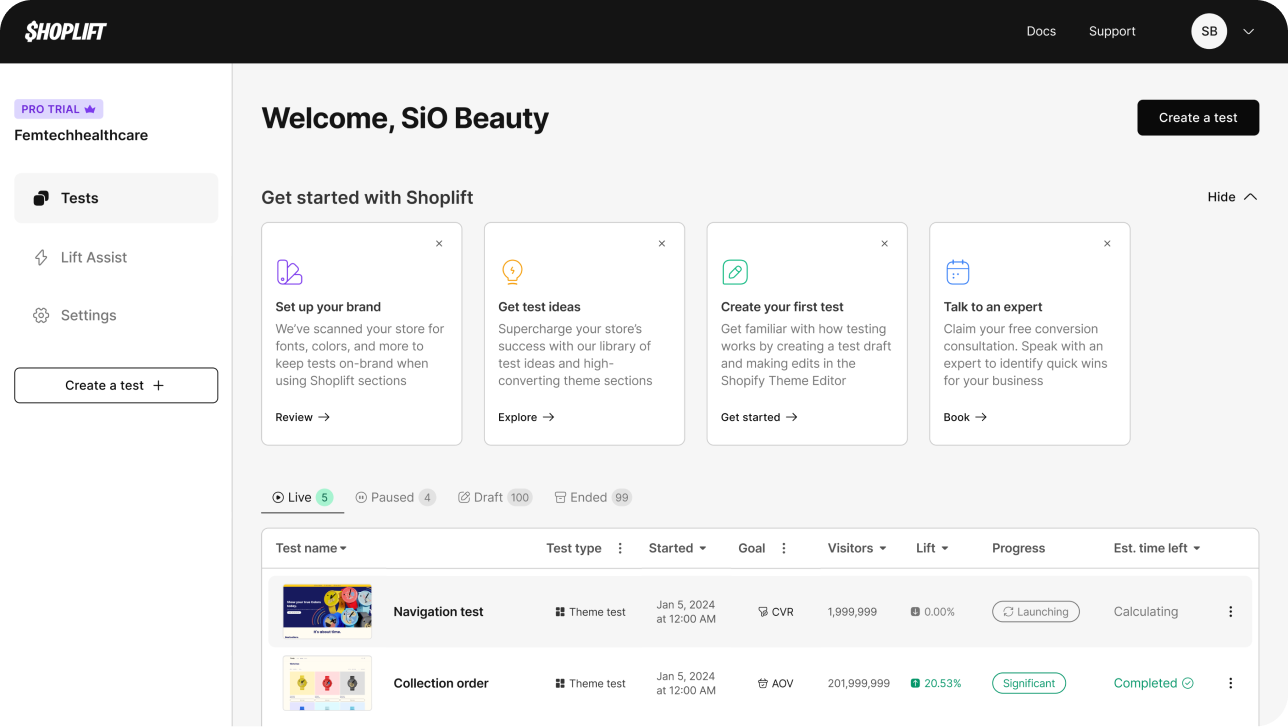
Shoplift Dashboard

Shoplift vs. Optimizely At a Glance

Both are strong tools built for different jobs. Only one was built for speed, stability, and revenue accuracy inside Shopify.

Feature
Shoplift
Optimizely
Purpose-built for Shopify
Yes
(native install + theme customizer)
No
(platform-agnostic DXP)
Shopify Plus Certified App
Yes
Not documented
Native theme / template testing
Yes
Not built for Shopify's theme model
1:1 Shopify order revenue attribution (RPV, AOV)
Yes
Generic analytics; not Shopify-native
Price testing
Yes
(native, one-time setup)
Not documented
Subscription testing
Yes
Not documented
Anti-flicker / edge-rendered variants
Yes
(about 2 to 4 pt page-speed impact)
Client-side mitigation
Launch tests without dev
Yes
(Lift Assist variants)
Often needs developer involvement
Server-side / feature-flag experimentation
No
Yes
Multivariate testing
Yes
Yes
CMS / commerce / personalization suite
No
(CRO focus)
Yes
(full DXP)
Established Stats Engine (sequential testing)
Bayesian predictive analysis
Yes
(widely respected)
Transparent, self-serve pricing
Yes
(public tiers)
No
(custom, quote-only)
Entry price
(from $99/mo)
Custom quote, est. $36K+/year

How Real Brands Run CRO in Shoplift

These aren't pilots. Shopify Plus brands run their full CRO programs in Shoplift right now.

Diego Castro, Strategist at on/SightDiego Castro, Strategist at on/Sight

“Campaigns gives our team a layer of structure that a flat test list never could. We can now organize experiments around real initiatives, like a PDP overhaul or a homepage redesign, and track progress against those goals. For an agency running testing across multiple clients, that's a meaningful unlock.”

Diego Castro
Strategist at on/Sight
Sophie Pilkington, Senior Manager of Ecommerce at MinnowSophie Pilkington, Senior Manager of Ecommerce at Minnow

“We've been testing and increasing the price by 10% with really good results. Customers have been converting at their usual rate even with the price increase.”

Sophie Pilkington
Senior Manager of Ecommerce at Minnow
Joseph Lam, Founder/CEO of Parents Are HumanJoseph Lam, Founder/CEO of Parents Are Human

“Hands down, the best A/B testing app on the market for Shopify. So easy to use, without any setup headaches like you might get with other apps.”

Joseph Lam
CEO & Co-founder of Parents Are Human
Technical Breakdown

What the Checklist Doesn't Show

A feature match isn't implementation parity. Here's what actually differs behind the checkboxes.

01
Native Shopify vs. Bolt-On

Generic testing tools give you their own editor, then overlay the changes on top of your live site. That's the root of flicker, site-speed drag, and developer cleanup after every test.

Shoplift logo
Advantage
Shoplift tells Shopify to load different theme files inside the native customizer, the same way Shopify always loads them. Variants are edge-rendered with an anti-flicker script, so page-speed impact stays minimal (about 2 to 4 points, blanking resolved in roughly 90 to 150ms). When a test wins, you apply the variant in one click, with no recording.
Optimizely
Optimizely is built to run on any stack, which is its strength for multi-property enterprises. It wasn't designed around Shopify's theme and Liquid model, so a Shopify merchant carries flexibility they'll never use.
02
Revenue Attribution & Test Conclusions

You're making revenue decisions off this data. How results tie back to actual orders isn't a detail. It's the whole point.

Shoplift logo
Advantage
Shoplift matches tests 1:1 to Shopify orders and reads them on revenue per visitor, AOV, and add-to-cart. Bayesian predictive analysis estimates duration and significance in real time, so you know when to call it.
Optimizely
Optimizely's Stats Engine, which uses sequential testing with controlled false-discovery rates, is a mature, respected methodology trusted by large programs. It's general-purpose, though, so connecting results to Shopify revenue is work you own.
Why it matters:

On Shopify, "did it lift RPV" beats "did it lift a generic conversion event" every time.

03
Price & Subscription Testing

Price testing on Shopify is fragile if the tool has to hunt for every place a price appears. Miss one dynamic upsell and the test corrupts.

Shoplift logo
Advantage
Shoplift tags the base-level price attribute in the theme once. From then on it references that attribute everywhere, so you can add products, change layouts, or run upsells and the test still holds. Subscription testing is native too.
Optimizely
Optimizely's public docs don't cover Shopify-native price or subscription testing. It wasn't built for that job.
04
Speed to Launch: Lift Assist vs. Enterprise Setup

The best test is the one that actually ships. Time-to-launch is where lean teams win or stall.

Shoplift logo
Advantage
Lift Assist auto-generates proven variants (sticky add-to-cart, countdown timers, inventory counters, trust badges) from patterns across thousands of brands. Marketers launch same-day without waiting on design or dev.
Optimizely
Optimizely's visual editor handles basic tests, but reviewers consistently cite a longer, more complex implementation for sophisticated experiments and personalization rules.
05
Shopify Plus Certification & Pricing

Two things de-risk the buy: is the vendor endorsed by Shopify, and can you predict what it costs?

Shoplift logo
Advantage
Shoplift was the first testing app admitted to the Shopify Plus Certified App Program, a real strategic partnership. Pricing is public and self-serve: from $99/mo, with a 14-day free trial and no order-volume surprises.
Optimizely
Optimizely is custom, quote-only, with third-party estimates starting around $36K/year and running into six figures. That buys an entire platform, not just testing. Fair for an enterprise, heavy for a Shopify brand that only wants CRO.
Close Cookie Popup
Cookie Preferences
By clicking “Accept All”, you agree to the storing of cookies on your device to enhance site navigation, analyze site usage and assist in our marketing efforts as outlined in our privacy policy.
Strictly Necessary (Always Active)
Cookies required to enable basic website functionality.
Cookies helping us understand how this website performs, how visitors interact with the site, and whether there may be technical issues.
Cookies used to deliver advertising that is more relevant to you and your interests.
Cookies allowing the website to remember choices you make (such as your user name, language, or the region you are in).