
How Ramen Bae Raised Paid Acquisition and Grew Revenue Per Visitor 26%

Building a category from scratch
Three and a half years ago, Jonathan Lam started selling something nobody else was making: premium, U.S.-made ramen toppings, sold direct to consumer under a brand loud enough to stand out anywhere. He had a handful of SKUs, a Shopify theme he'd put together himself, and an obsession with getting the product right.
He also had no A/B testing experience.
Building a category from scratch means there's no playbook to copy. What goes above the fold, how a product page is structured, how many flavors a shopper should see at once. Each of those is a hypothesis. Without a way to test a hypothesis, a founder is guessing.
Testing started with the founder
Ramen Bae installed Shoplift in October 2024, and Jonathan ran the first experiments himself. The appeal in those early months wasn't the analytics or the reporting. He could use the tool without writing code, without filing tickets, and without waiting on anyone. An idea could be live as a test the same day he had it, and the result a few days later would settle the argument.
That mattered more once Ramen Bae outgrew the Shopify template Jonathan had built and moved to a custom site designed by Manufactur, their long-time agency partner. Custom sites are powerful, but they are harder for a non-developer to touch. Shoplift's theme-level, Shopify-native approach kept Jonathan iterating without a developer in the loop for every idea. He moved social proof around the page. He rewrote headlines. He swapped hero imagery. Several of those early experiments reached statistical significance and became permanent changes to the site.
The contrast with physical retail wasn't lost on him. In a store, a different shelf placement or a new packaging callout requires coordination, time, and measurement infrastructure that most early-stage brands don't have. On a website, the loop from idea to result runs in just days.
More paid traffic brought colder visitors
Through the first half of 2026, Ramen Bae leaned harder on paid acquisition. Shopify recorded an increase of 22.9% paid sessions in Q2 2026 against Q2 2025.
Paid placements deliver a different visitor than email and direct do. Someone who taps a Meta ad hasn't decided to buy anything yet; someone who opens a reorder email usually has. As Ramen Bae grew the paid share of its traffic, a larger portion of the people landing on a product page were meeting the brand for the first time, with no prior decision behind the click. As a result, Ramen Bae's conversion rate for the half came in 1.81% lower year over year.
However, revenue per visit ran in the other direction. Ramen Bae raised RPV 26.4% across the same half and increased their average order value by 27.8%. Sales grew 76.4% and orders grew 37.8%.
Put together, a visit to ramenbae.com in the first half of 2026 was worth 26% more than a visit a year earlier, even though a slightly smaller share of visits ended in an order. Ramen Bae grew basket size by more than enough to cover the gap. That is what a working CRO program buys a brand scaling paid: the freedom to keep buying traffic without watching the economics of each visit deteriorate.
Rebuilding the flavor selector
The clearest example of the work behind those numbers is the flavor selector on the Protein Ramen product page.
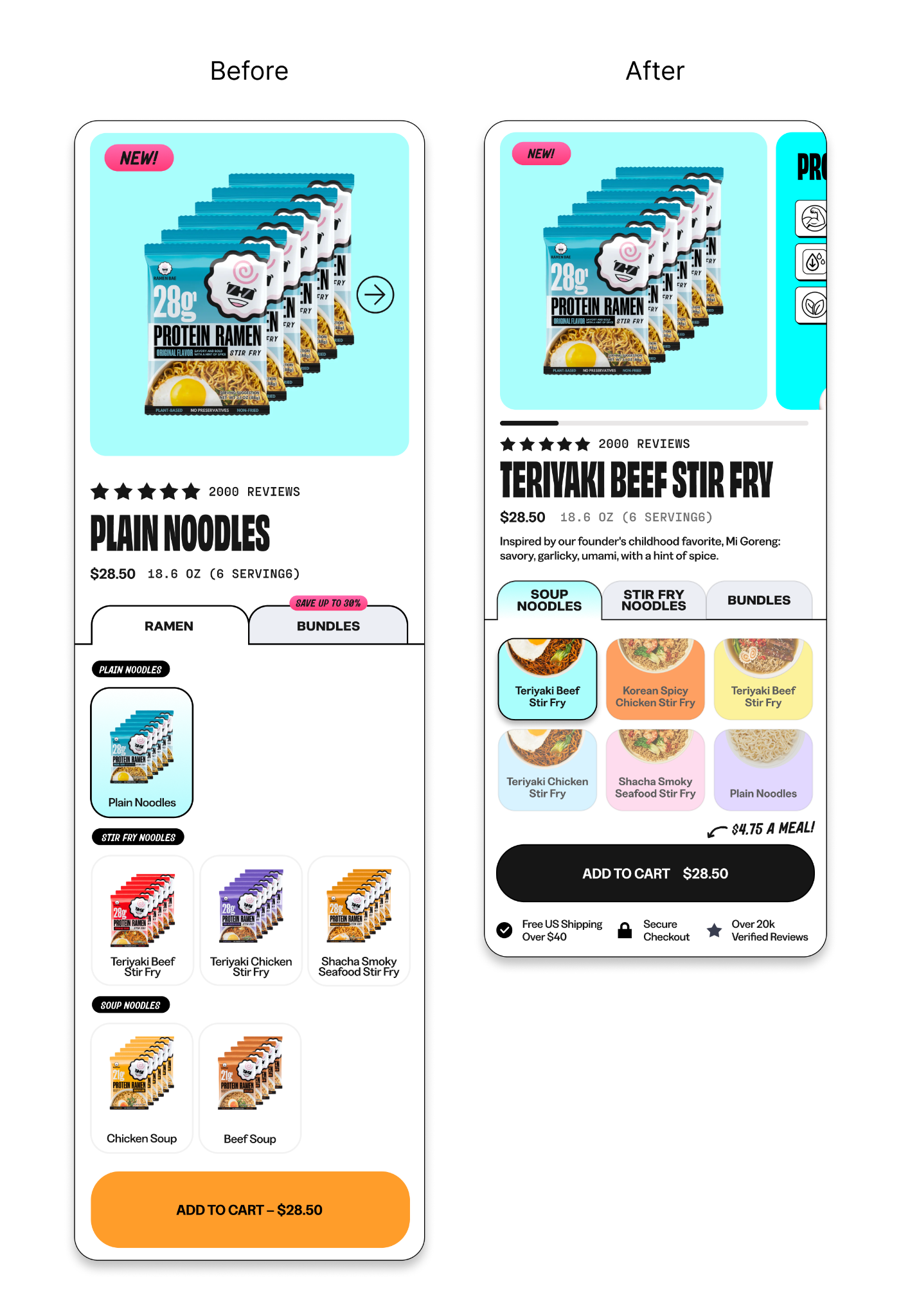
Before. The selector sat under two tabs, Ramen and Bundles. Choosing a flavor meant scanning six options, each of them rendered as a photograph of five identical retail bags fanned out. Plain Noodles, Teriyaki Beef Stir Fry, Teriyaki Chicken Stir Fry, Shacha Smoky Seafood Stir Fry, Chicken Soup, Beef Soup. Six near-identical packshots, separated mostly by the color of the bag. Manufactur's read: the selectors "were getting out of hand, showing full pack artwork."
After. Manufactur reformatted every selector to show the prepared bowl rather than the packshot, on a solid color background instead of a gradient, so the flavor reads as food rather than as inventory. They split the two tabs into three, Soup Noodles and Stir Fry Noodles and Bundles, which cuts how many options render at once. They added a one-line product description under the title, so a shopper gets some context about the flavor before the selector mechanics start: "Inspired by our founder's childhood favorite, Mi Goreng: savory, garlicky, umami, with a hint of spice." They shortened the add to cart button and moved the per-meal price callout above it.
None of that is simply cosmetic. Choosing between six flavors is a decision cost, and a first-time visitor from a paid placement pays it in full while a returning customer skips it entirely. The more of your traffic arrives with less intent, the more that one screen is worth fixing. Manufactur shipped the redesign as a sequence of experiments through July and August 2026, each variant tested against a control on live traffic: flavor selector layouts, image carousel designs, trust bar treatments, and add to cart button length.
For Manufactur, Shoplift slots into a workflow they already had. Their developers create test branches in their existing repo and push variant themes. Shoplift handles the split. No JavaScript injected into the live site, and none of the performance-degrading instrumentation that competing tools rely on.
Grand slams, and the small wins that add up
Jonathan measures everything against revenue per visitor. Average order value and conversion rate sit underneath it, and the two of them sometimes trade against each other in ways that take judgment to navigate. A bundle push that raises average order value can cost conversion rate on the product page promoting it. When a single experiment moves the whole stack at once, Jonathan calls it a grand slam. Conversion up, average order value up, revenue per visit up. Those are rare, and Ramen Bae has had several.
Most experiments aren't grand slams. Most are a percentage point here and a percentage point there, and a fair share are losses that turn into learnings. The value isn't in any single result. It's in running them continuously: Ramen Bae has launched 141 experiments on Shoplift since October 2024, and the wins that survived are still working on every visitor who lands on the site today.
"You multiply it by a hundred different tests, and there are things that compound," Jonathan said. "Continuous improvement. When you add it all up, there's just so much value you can gain."
From one person to a multi-channel brand
Ramen Bae is now expanding into physical retail, into the kind of stores where the brand's packaging will pull double duty as product and billboard. They've grown from a one-person operation into a team with a CMO, a long-tenured agency partner, and a roadmap that spans multiple channels.
The DTC site remains the engine. Most of the revenue still runs through it, and as Ramen Bae buys more traffic, every point of revenue per visit is worth more than it was the year before. Jonathan started testing with no experience, while building a category from nothing. That habit is what now lets the brand grow its audience without giving up efficiency.


