


53% of $10M+ Shopify Plus brands don't experience a November or December peak.
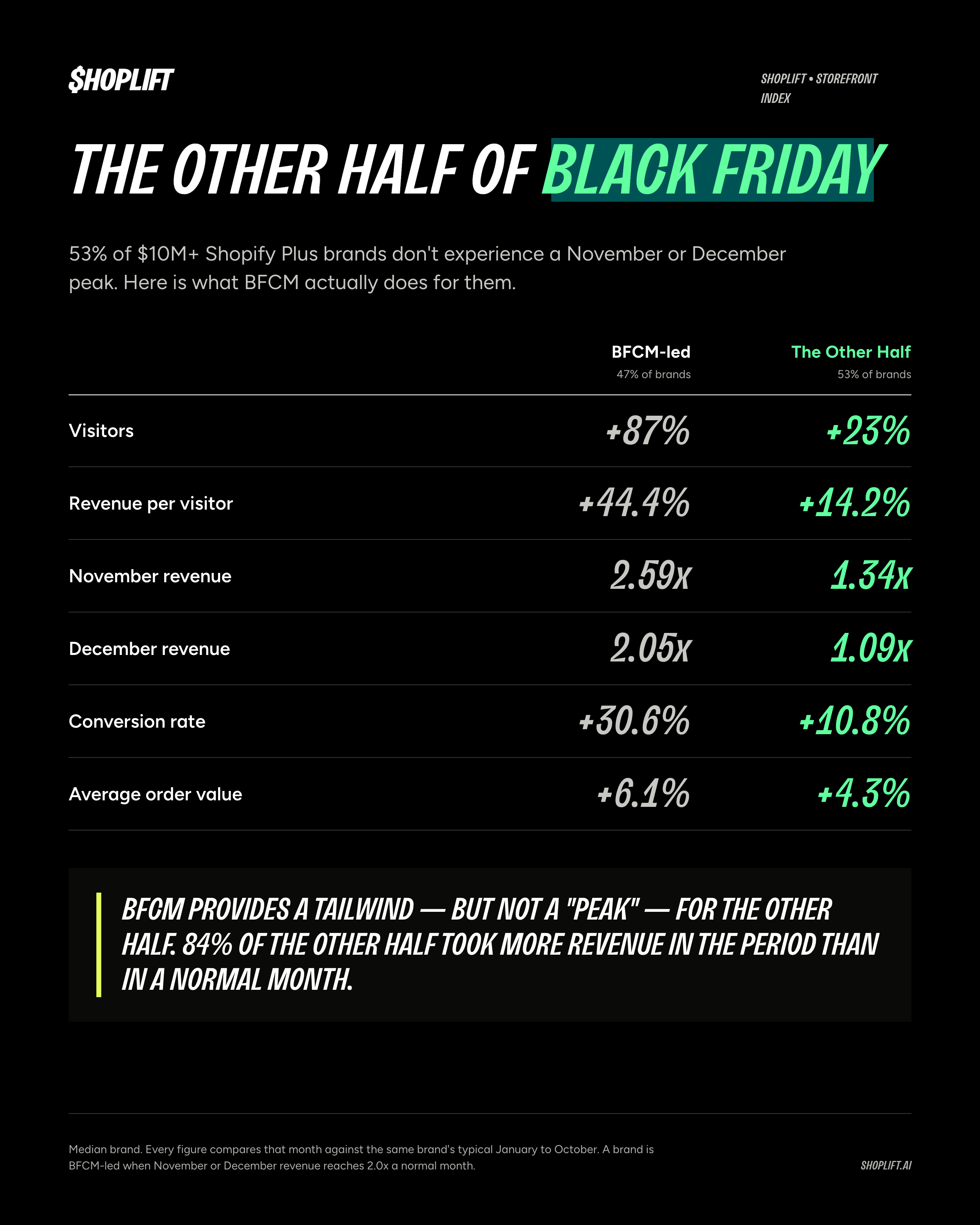
That doesn't mean Black Friday does nothing for them. Shoplift's Storefront Index found that the Other Half still saw 23% more visitors, a 14.2% increase in revenue per visitor, and 1.34x normal monthly revenue in November. 84% still took more revenue during the period than in a normal month.
Black Friday clearly helps these brands. It just doesn't define their year.
A lot of BFCM advice misses that nuance. It starts with the category and works backwards from there: apparel brands do this, wellness brands do that, home and furniture brands do something else.
Our research kept pointing us in a different direction. The customer doesn't buy a category. They buy a particular product, for a particular reason, at a particular point in their journey.
The label gives you a hypothesis. Your customer's actual behavior tells you the strategy.
Category is a useful place to start, but a bad place to stop
Take wellness as an example. There's good reason to investigate whether fresh-start behavior changes the demand curve for certain products.
SPINS found repeated January sales lifts in performance nutrition, protein supplements and meal replacements across U.S. retail. Sales jumped 33% in January 2021, 22% in 2022 and 26% in 2023. The same research found that some more specific wellness subcategories, including superfood and whole-food supplements and mood-support supplements, tend to record their highest sales in January.
That's useful evidence of a fresh-start effect. It isn't evidence that every wellness brand peaks in January.
We found another interesting clue in holiday shopping data. Retail Brew, using Shopify data, reported that spin-bike orders jumped 384% in December 2024. The behavior event might be the New Year's resolution, but at least some of the shopping was already happening before January arrived.
That's a much more useful CRO question than “are we a January brand?”
When does the customer's fresh-start journey actually begin, and what job should the storefront perform at each point?
For your own store, look at when traffic, conversion rate and revenue per visitor begin to change. Look at which products move first. Look at whether the customer mix changes with them. Then decide when the storefront experience needs to change.
Category gives you somewhere to look. Your own demand curve tells you whether the pattern is actually yours.
Use season and purchase occasion aren't the same thing
The same problem comes up with seasonal products.
Say you sell something primarily used in spring or summer. The easy conclusion is that Black Friday doesn't matter because the customer's real season is months away. But when a product gets used and when it gets bought are two different questions.
A customer might have little reason to buy the product for themselves in November and plenty of reason to buy it for someone else in December. Gifting creates a different purchase occasion, even though the product's use season hasn't moved.
This is also where we need to be careful not to replace one generic BFCM rule with another. We looked for evidence that seasonal brands should broadly solve the problem with gift cards, preorders or pre-commitment. The evidence doesn't support making any one of those the default.
They're options to test when they fit the customer journey.
If you're trying to work out what Q4 should do for a seasonal product, start with your own product mix. Compare what people buy during Q4 with what they buy during your actual peak. Look at whether gifting changes the mix and whether customers are buying for immediate use or something later.
Then ask:
If the customer isn't buying for immediate use, what can the storefront make valuable and deliverable now?
For one brand, the answer could still be the product itself. For another, it might be a giftable version, gift card, preorder, reservation or scheduled delivery. For another, there may simply not be much Q4 demand worth chasing.
You want the customer behavior to tell you which hypothesis is worth testing, rather than choosing the tactic because “seasonal brands should do preorders.”
Some purchases run on clocks Black Friday doesn't control
Furniture makes the category problem even easier to see.
Two products can sit in the same catalog and have completely different relationships with BFCM. One is stocked and ready to ship. Another needs consultation, customization, production and delivery.
Lovesac's holiday delivery guidance is a good real-world example. Its current Christmas delivery guidance gives Sactionals and Snugg with Quick Ship Covers a December 2 order-by date, while Sacs with Quick Ship Covers, accessories and throw pillows can be ordered through December 9. Lovesac also notes that these dates only apply to products with a 1–3 week shipping lead time. Products with longer lead times aren't guaranteed to arrive by Christmas.
Same brand. Same broad category. Different products running on different fulfillment clocks.
The useful lesson isn't that furniture has a long consideration cycle. It's that some purchases run on clocks Black Friday doesn't control.
Depending on the product, time can enter through the customer's decision, consultation or measurement, customization or production, and delivery or installation. The promotional window is another clock layered on top. It doesn't make the others move faster.
That changes the CRO problem. Instead of immediately deciding to extend the sale because the product takes longer to buy, figure out which clock is actually getting in the customer's way.
If delivery is the constraint, clearer arrival dates may be worth testing. If only part of the catalog can arrive in time, make the eligible products or configurations easier to find. If the full purchase can't reasonably complete during the window, the next valuable commitment might be a sample, swatch, consultation, deposit or preorder.
Those aren't prescriptions for every considered purchase. They're examples of interventions that match different constraints.
Find the clock first. Then test the intervention.
It's not the buyer. It's the purchase.
We ran into the same issue when researching professional buyers.
It's tempting to treat “professional” as the thing that determines the calendar. But the same business customer can make a recurring operating purchase, a larger capital purchase and a purchase governed by a real fiscal or procurement deadline. Those transactions don't necessarily behave the same way.
The more useful distinction is the purchase itself.
If a real fiscal, budget, tax or procurement deadline affects the decision, make that deadline and the relevant information clear. If it doesn't, don't manufacture urgency because the customer happens to be buying for work.
There's a measurement lesson here too. Before treating a December decline as a demand problem, check whether the calendar itself changed. Fewer selling days, purchasing schedules or a different procurement cycle can change the monthly curve before anything about customer preference has changed.
It's not the buyer. It's the purchase.
Diagnose the mechanism before choosing the tactic
This is the thread that kept coming back as we worked through the research.
A lot of BFCM advice starts with the prescription: discount more, discount less, start earlier, run longer, stop testing, buy more traffic, push gift cards, move the campaign to January.
Any of those could make sense for a particular business. But the tactic should come after you've worked out what is actually happening.
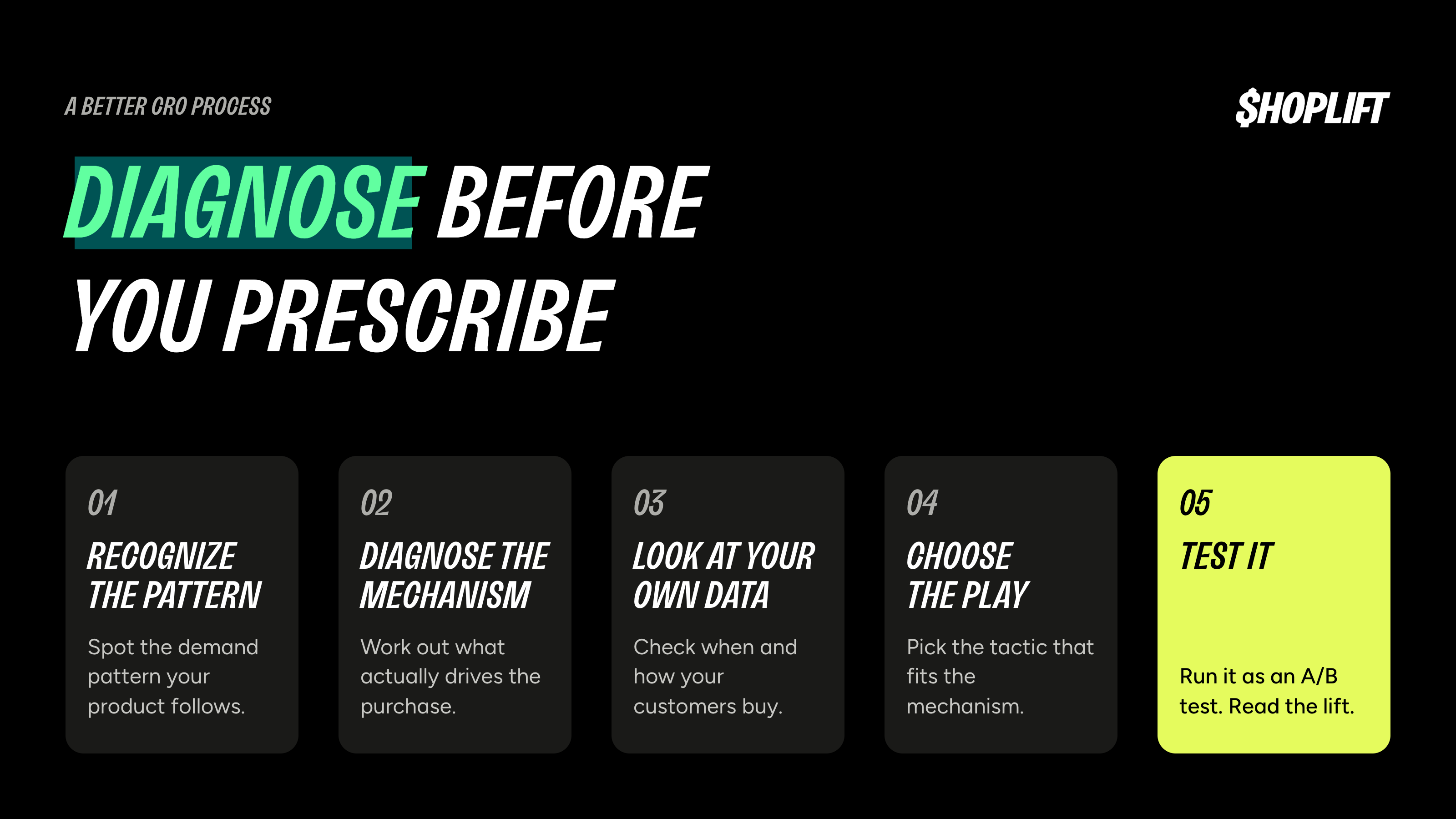
A better CRO process is:
Recognize the pattern → diagnose the mechanism → look at your own data → choose the play → test it.
If your product is associated with a fresh start, find out when the buying journey actually begins.
If your use season sits somewhere else on the calendar, find out whether Q4 creates another purchase occasion.
If the purchase takes time, identify which clock creates the constraint.
If demand comes from a life event, separate what creates the demand from what helps you capture it. A discount can't make the car break, the baby arrive or the storm appear. It can still affect which brand wins the order once the customer is in the market.
If customers replenish, don't assume a discounted order proves the promotion created additional value. Follow what happens afterward.
If the buyer is a professional, identify the calendar governing the purchase rather than assuming the buyer type determines it.
And if you're building a campaign around a deadline, verify that the customer actually has that deadline before turning it into urgency.
The common thread is simple: diagnose before you prescribe.
What to look at in your own data
You don't need to put your brand into a permanent BFCM category to start doing this. Start with your own demand curve and find the periods when revenue, visitors, conversion rate and revenue per visitor actually change.
Then go underneath the topline.
Does the product mix change during Q4? Does gifting create another purchase occasion? Are customers buying for immediate use or something later? Does a meaningful part of the purchase journey continue beyond Cyber Week? Is a delivery or consultation step creating the delay? Does the deadline you're marketing actually change when customers buy?
Once you have a plausible mechanism, look at the part of the storefront where that mechanism should show up.
If customers are uncertain about delivery, test how you communicate arrival dates or eligible products. If they're uncertain about eligibility, make it easier to understand what qualifies. If Q4 introduces a different purchase occasion, test merchandising and messaging built for that occasion.
The metric should match the job the experience is supposed to do. A test designed to change what people buy may need to be judged on revenue per visitor or average order value, while an intervention designed to move someone into a longer purchase journey may need an observable next commitment and a downstream purchase measure.
The measurement window needs the same discipline. If the normal purchase journey takes several weeks, don't declare the strategy a failure because the customer didn't buy by an arbitrary date on the marketing calendar.
Black Friday can help without defining your year
None of this is an argument for sitting Black Friday out.
The Storefront Index shows why. The Other Half still saw 23% more visitors, 14.2% higher revenue per visitor, 10.8% higher conversion rate and 4.3% higher average order value during the period. November revenue reached 1.34x a normal month.
There is real opportunity there.
But compare that with brands whose year does peak around Black Friday: visitors rose 87%, revenue per visitor 44.4%, conversion rate 30.6%, and November revenue reached 2.59x normal.
The same season is doing different jobs for those two groups.
For one business, BFCM may be the demand peak it spends the year preparing to capture. For another, it might introduce a gifting occasion, land in the middle of a longer consideration journey, help capture demand created by a completely different event, or simply provide a commercial lift before the brand's real peak arrives.
They can all participate in Black Friday. They just shouldn't automatically run the same playbook.
That's why BFCM for the Other Half is built around seven diagnostic patterns rather than seven new categories to put brands into. The point is to recognize the pattern, diagnose the mechanism in your own customer journey, and work out what job BFCM should do for your business.
Your category can point you toward the question. Your customer's behavior has to answer it.
BFCM for the Other Half
Register for the free masterclass on October 8 to see the seven patterns, the research behind them, and how to turn each one into a storefront strategy.
[Register for the free masterclass →]
Subscribe to the Shoplift newsletter
Get insights like these emailed to you bi-weekly!
{{hubspot-form}}


