


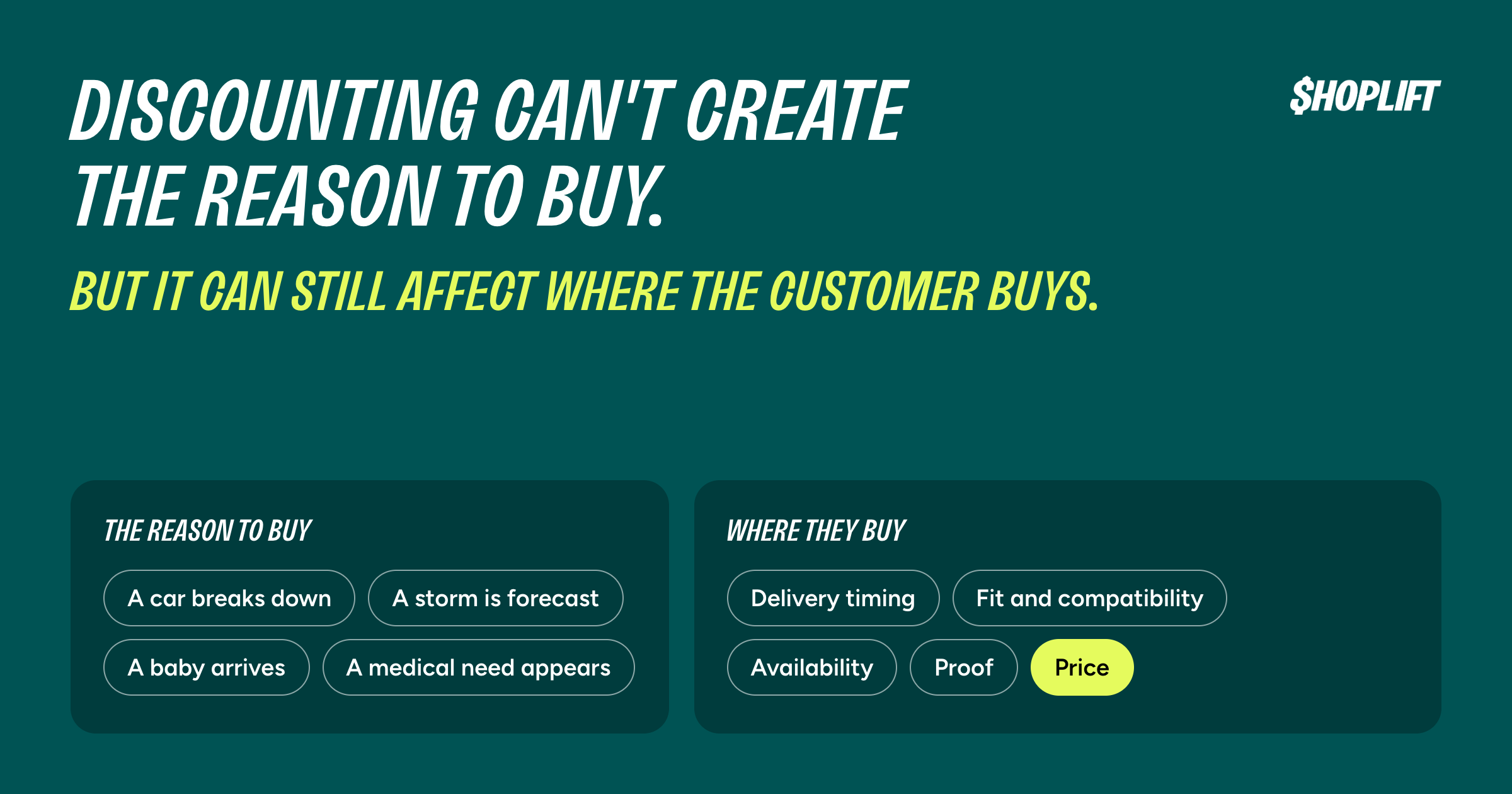
A customer whose car breaks down doesn’t start shopping because it’s Black Friday. Neither does someone buying after a medical need appears, a storm is forecast or a baby arrives.
Something else created the need. It's one of the patterns we introduced in Your Category Is Not Your BFCM Strategy, where the argument was that a customer's reason for buying tells you more than the category you sell in.
That doesn’t make Black Friday irrelevant. Once the customer is shopping, a promotion can still influence where they buy. But that is a different job from creating the demand in the first place. For brands that sell around these kinds of events, that distinction matters. If you assume the promotion created the demand, it’s easy to make price the center of the strategy. If you start with what actually got the customer shopping, you can ask a more useful CRO question:
What does this customer need from the site to choose us now?
Start with what created the need
Some purchases start because something happens, not because a shopping season arrives.
The event can be planned, like having a baby. It can be unexpected, like a broken appliance or car repair. It can be a medical need. It can be environmental, like a storm that suddenly makes preparedness products relevant.
The timing varies, but the pattern is the same: something outside the promotion gives the customer a reason to buy.
That changes how you should read BFCM performance.
A November lift doesn’t necessarily mean Black Friday suddenly created more underlying need for the product. More people may be shopping. Promotions may make one seller more attractive than another. The customer may even decide to buy sooner. But the reason they started shopping can have nothing to do with the sale.
That means the first job isn't deciding how big the discount should be. It's understanding the buying moment you're trying to convert.
Follow the intent onto your site
Once you know what gets the customer shopping, look for where that intent shows up on your site.
A customer replacing something that broke behaves differently from someone casually browsing for a gift. They may arrive on a specific product page from search. They may need to confirm compatibility. They may care more about whether the product can arrive by Friday than whether it is 20% off.
Someone buying around a medical need may need to understand eligibility or exactly which product is appropriate. Someone preparing for a storm may care about availability and delivery certainty.
Those behaviors give you something much more useful than a generic list of BFCM best practices: a place to investigate.
Look at the landing pages these customers enter through. Look at what they search for, which products they compare, where they add to cart and where they leave.
You're trying to find the gap between “I need this” and “I'm comfortable buying it here.”
Then find what could stop the order
This is where the CRO problem becomes clearer.
Price might be the barrier. But it might not be. The customer might be unsure whether the product fits their situation. They might not know whether it is compatible with what they already own. Delivery timing may be unclear. The right product may be difficult to find. A claim they need to trust may not have enough proof behind it. If you haven't diagnosed the barrier, increasing the discount is just one possible solution.
The better sequence is simple:
Find the trigger. Follow the intent. Diagnose the barrier. Then choose what to test.
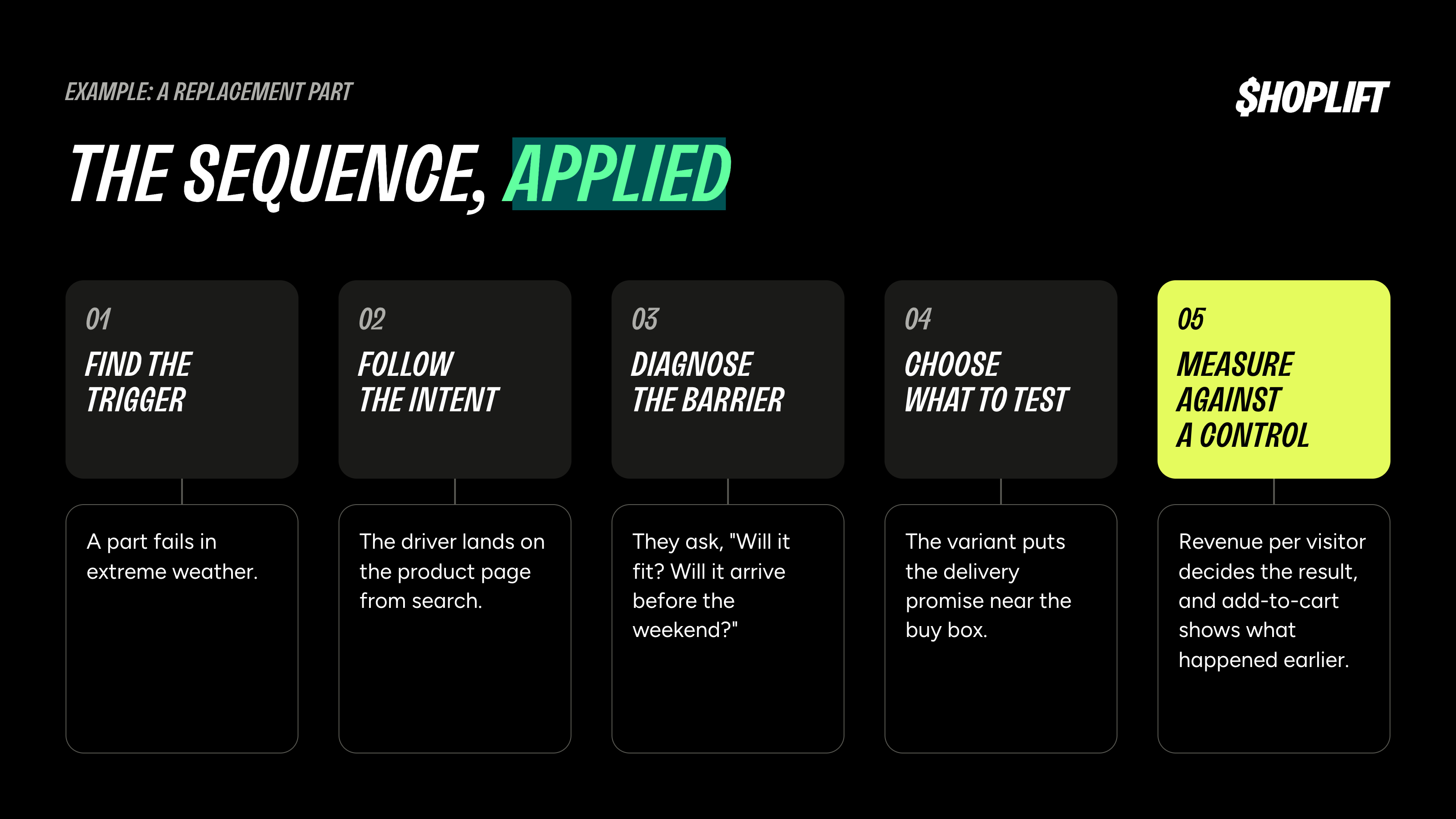
That could lead to a price test. It could also lead to clearer delivery information, better product comparison, compatibility guidance, stronger proof, different merchandising or a faster path to the product the customer actually needs.
Choose the intervention based on the problem, not the calendar.
A real need can still become a BFCM order
Separating the reason to buy from the reason to choose you doesn’t mean promotions have no role. It changes how you should use the promotion.
AutoZone is a useful example. In its annual filing, the company says extremely hot or extremely cold weather can increase sales by causing parts to fail. The weather creates the need. A promotion doesn’t.
Once that driver needs the part, there is still an order to win. In the same filing, AutoZone says it competes on customer service and delivery, product quality, selection and availability, warranty, convenience, price and brand.
The event can create the buying moment. What you do on the site can still influence where the customer buys.
Imagine someone lands on a product page because they need a replacement part quickly. You could test a larger discount. But if the real uncertainty is whether the part fits their vehicle or will arrive before the weekend, reducing the price doesn’t resolve either problem.
The same logic applies across very different products. A customer shopping after a medical need may need clearer guidance or proof. A customer preparing for severe weather may care about availability and how quickly they can get the product. A new parent may simply need to find the product they rely on.
During the 2022 infant formula shortage, 87% of surveyed parents who switched formula said they did so because they couldn’t find their usual one.
If availability is the problem, a bigger discount doesn't solve it. If compatibility is unclear, lowering the price doesn't answer the customer's question. If delivery timing matters, hiding that information farther down the page creates friction price may not overcome.
The event tells you why the customer is shopping. Use their behavior to decide what to investigate next.
Turn the behavior into a test
Start with the customers whose shopping behavior you’re trying to understand. Then look for evidence of where their journey is breaking down.
If customers repeatedly reach the product page but don’t add to cart, investigate what they still need to know at that point. If they search for compatibility information, make compatibility easier to confirm. If delivery information is buried while timing matters to the purchase, test making it more prominent.
Use the behavior you observed to decide what to test.
For example, if customers arriving with urgent intent repeatedly interact with shipping information before buying, you could test clearer delivery timing near the buy box. The existing product page is the control. The variant makes the delivery promise easier to find. Revenue per visitor can tell you whether the change improved revenue, while add-to-cart behavior helps you understand what happened earlier in the journey.
That is a much stronger experiment than adding urgency because “urgency works.” The customer already has urgency. Your job is to find out whether the site is helping them act on it.
Measure whether you captured the demand
There’s one more distinction worth keeping clear: observing demand isn’t the same as proving your site change captured more of it.
If sales rise during a storm, for example, you can observe that purchases increased around the event. That doesn’t tell you that a banner, promotion or product-page change caused the increase. The event itself may have changed demand.
To answer whether the site intervention helped, you need a comparison. For a site experiment, that could mean splitting eligible traffic between the existing experience and the new version, then comparing the metric you chose before the test began.
This is especially important for event-driven demand because the event affecting customer behavior is happening at the same time as your test. Without a control, it’s easy to give the site credit for demand the event created.
The useful sequence is:
What created the need → where did that intent show up → what could stop the purchase → what did we change → did that change improve the outcome?
That gives you a CRO program built around the customer’s actual buying moment, not a collection of BFCM tactics.
Give BFCM the right job
For a brand with event-driven demand, BFCM can still matter. More customers are shopping, competitors are making offers and a customer who already has a reason to buy may respond to what they see.
The opportunity is to understand why that customer started shopping, then make it easier for them to choose you. Sometimes that means price. Sometimes it means availability, delivery, product guidance, compatibility or proof. Your customer’s behavior tells you where to look. The test shows you what actually helps.
That is the larger idea behind BFCM for the Other Half. Black Friday can be a meaningful buying moment without being the reason your customer wants what you sell.
The goal isn't to find a reason to ignore Black Friday. It's to give Black Friday the right job.
Join Shoplift, Northbeam and Nick Shackelford + Common Thread Collective for the BFCM for the Other Half masterclass to learn how to recognize your demand pattern, decide what role BFCM should play and build the right testing plan around it.
[Register for the BFCM for the Other Half masterclass →]


