


Black Friday planning gets tactical fast. Discount percentage, email calendar, paid budget, landing page, creative, shipping cutoffs. There’s a lot to get live and not much time to get it wrong.
But before deciding whether the banner says 20% or 30% off, there’s a more important decision to make: what are you actually trying to get shoppers to do?
Picture two people shopping on the same Friday in November. One has been waiting six months for a $2,000 couch to go on sale. The other is staring at a gift list wondering what on earth to buy their dad. They’re both shopping during BFCM, but they don’t have the same problem, and your promotion shouldn’t treat them like they do.
With 53% of $10M+ Shopify brands not peaking during BFCM, plenty of brands have a reason to think beyond the standard November playbook.
Start with the shopper, not the promotion
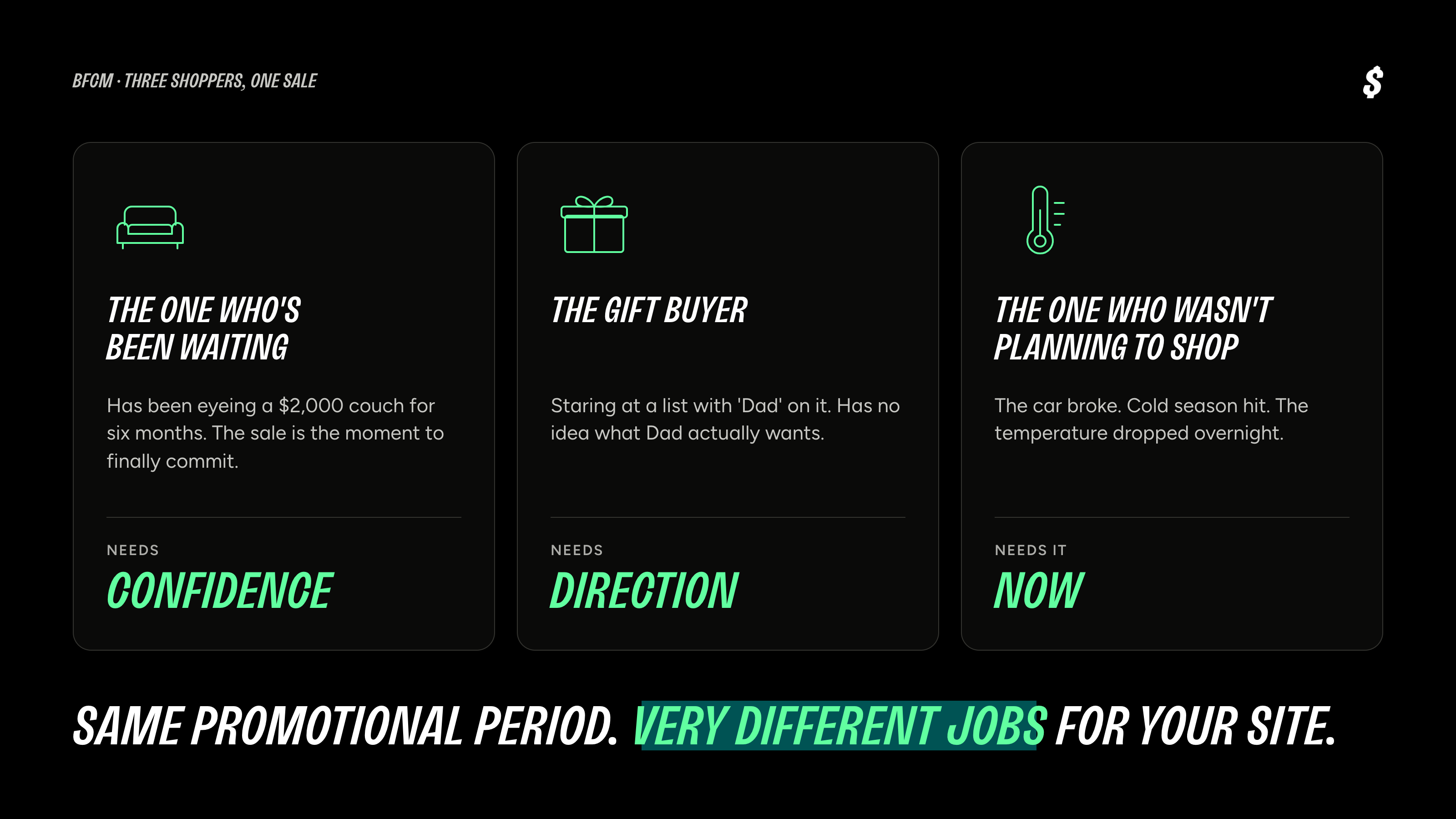
A shopper who has been waiting for that couch probably doesn't need you to manufacture demand. They may need confidence that it fits their space, clarity on when it will arrive and enough of a reason to finally pull the trigger. The person shopping for Dad has a completely different problem. They might love your product and still have no idea whether Dad will.
Then there are shoppers who didn't wake up thinking about Black Friday at all. Their car needs a repair. Cold and flu season has them restocking the medicine cabinet. The temperature suddenly drops and they realize they need a space heater, weatherproofing or warmer bedding.
Same promotional period. Very different reasons for being there.
That's why the first step isn't choosing the promotion. It's understanding the buying behavior you're trying to influence. What needs to happen next for this shopper? That answer gives you something useful to build around.
Give shoppers a reason that makes sense for them
This is where Black Friday gets more interesting than “how big should the discount be?”
Take the shopper buying for Dad. Maybe your opportunity isn't another 10% off. Maybe it's making five products feel obviously giftable, bundling them well and removing the “will he actually like this?” anxiety.
You can't schedule someone's car battery to die during Cyber 5. But if you sell auto parts, you don't have to wait for something to break before giving shoppers a reason to buy. Preventative maintenance, winter prep or products people don't normally think about until they need them can give you something relevant to promote. The opportunity is to find the purchase that makes sense before the emergency.
Cold and flu products have a similar opportunity. You can't create the moment someone gets sick, but you can give shoppers a reason to stock up before they do. A winter-prep or seasonal stock-up offer gives the promotion a purpose that actually fits what you sell.
That's the question to ask about your own products: what could shoppers reasonably buy now, even if the moment that usually forces the purchase hasn't happened yet?
Your existing customers can give you another place to look. Someone who already knows your products may not need the same introduction as a first-time visitor. Newness, early access, a loyalty benefit or a complementary product may give them a more relevant reason to come back.
The promotion gets more useful when you know who you're talking to and what you want them to do next.
Your site should support the plan
Once you know what you want the shopper to do, your CRO plan gets a lot less generic.
For the person shopping for Dad, the interesting test isn't automatically “20% off vs. 25% off.” It might be whether gift-oriented merchandising helps them find something faster. A gift guide, a small set of bundles or clearer delivery information could solve a more important problem than another five points off the price.
If you're promoting preventative maintenance, make those products easy to find and understand. You could test whether a focused maintenance experience gets more shoppers to the right products than sending everyone through the normal site.
Returning shoppers don't necessarily need to see the same experience as someone arriving for the first time either. If you're giving existing customers early access, new products or a loyalty benefit, test an experience built around that reason for coming back.
The test should come from the problem you're trying to solve.
That's a much better starting point than filling a November testing calendar with CRO tactics because somebody put them on a “Black Friday best practices” list.
Don't waste the extra traffic
BFCM can give you something besides November revenue: more shoppers to learn from. If you're going to test a different experience, decide what you want to learn before the traffic arrives.
Does gifting actually create another purchase occasion? Do returning customers respond differently to newness? Does a seasonal stock-up offer give shoppers a compelling reason to buy now? Can clearer merchandising help someone find the products that fit the occasion faster?
Then run the test in a way that lets you compare what happened. More revenue during a busy week doesn't automatically mean your idea worked. You need the comparison that tells you whether shoppers responded differently to the change you made.
The goal isn't to fill November with experiments. It's to leave November knowing more about how your shoppers buy than you knew going in.
Take the answer with you into December
This is the part that gets lost when everyone treats Black Friday like the finish line.
If gift-focused merchandising helps shoppers buy products for other people, you've learned something about an additional purchase occasion you may be able to use again. If returning customers respond to new products but barely move for another blanket discount, you've learned something about what gives them a reason to come back.
And if shoppers respond well when you merchandise products around a seasonal need, that's useful beyond one promotional weekend. The next holiday, product launch or seasonal moment gives you another opportunity to apply what you learned.
The promotion ends. The learning keeps going.
Go into Black Friday knowing what you're trying to learn
The offer is only one decision in a BFCM plan. Start with how shoppers already buy. Choose the behavior you want to influence. Build the promotion and site experience around it. Test the assumption behind the plan. Then measure the outcome that tells you whether it worked.
You don't need another list of BFCM tactics. You need to know which problem you're trying to solve.
On October 8, Shoplift, Northbeam and Nick Shackelford with Brēz + Common Thread Collective are breaking down the seven buying patterns we found, what the data tells us about each one, and how to turn those patterns into acquisition, promotion and testing decisions.
Join us to learn how your shoppers actually buy and how to use that behavior to get more from BFCM. We built BFCM for the Other Half to show you how.
[Register for BFCM for the Other Half →]


