


Half of the customers who come back for a second order place it within 30 days of the first, and three quarters place it within 90. That's from a February 2026 analysis of 156,110 customers across DTC brands in more than ten categories, published by the agency B&S Co.
Zettler Digital found a similar curve at Buckeye Brownies, a gourmet brownie brand. Customers who reordered took a median of 41 days to do it, and 62% of second orders came within 60 days.
You have a short window to win the second order. Yet the customer who clicks your post-purchase email on day 20 usually lands on a homepage built for someone who has never heard of you. They get a welcome popup with 10% off a first order they already placed, and a hero selling the starter pack they already bought.
This one is about the customer who has bought from you exactly once. It's built from the work Ben Zettler, founder of Zettler Digital, will present at our Klaviyo masterclass on October 29.
Define the segment tightly
"Everyone who bought once" is too broad. Zettler builds the one-time buyer segment in Klaviyo with two conditions:
Zettler picked 180 days from Buckeye Brownies' own order history. Of the second orders that customers placed within a year, 86% came inside 180 days. Past that window, the customer moves to your lapsed segment, which needs a different page. Use the same cutoff day in both segments and exclude each one from the other in Klaviyo, so each customer sees one experience.
Set your window from your own repurchase curve, not from Buckeye's. In the B&S Co analysis, the median time to a second order ranged from 15 to 27 days in apparel and beauty and from 27 to 68 days in consumables like supplements, food and pet. Pull your first and second order dates from Shopify, find the day by which customers placed roughly 85% of your second orders, and use that as your cutoff.
ECD Digital Strategy, which covers lapsed customers at the masterclass, sets the same line a different way. ECD takes the typical time between orders and roughly doubles it, which lands near 90 days for a brand whose customers reorder every 45 days. Either method works. Pick one and use it for both segments. Read our lapsed customer post for ECD's side of the line.
Zettler adds one optional split: was the first order a gift, or did the customer buy it for themselves? A gift buyer may never have tasted the product. A self-buyer already knows whether they like it. Those two customers come back for different reasons, so they should see different pages.
Find out what your repeat buyers actually buy
Most brands lead the homepage with whatever sells best to new customers, usually a bestseller, a bundle or a starter pack.
At Buckeye Brownies, Zettler compared first orders with second orders. The starter pack, a four-brownie sampler, appeared in 21% of first orders and 8% of second orders. The top product in second orders was Build Your Box, where the customer picks their own flavors. New customers buy the sampler. Repeat customers come back to choose for themselves.
That doesn't mean every brand should push a new product on the second visit. In the B&S Co analysis, 77% of second purchases were reorders of the same product. In supplements, the reorder share ran from 82% to 93%. In home decor, it was 0%. Those customers came back for the next piece.
Show the one-time buyer whatever your repeat buyers choose, and make it easy to buy. For a supplement brand, that's the same product, one click away, maybe as a subscription. For Buckeye, it's the box they build themselves. For a home brand, it's the piece that goes with what they bought.
Run the same comparison on your own orders before you build anything. Pull your top 10 products in first orders and your top 10 in second orders. Where the lists differ, you're selling to the wrong customer on your homepage.
Match the reason to come back to your category
Zettler groups the reasons one-time buyers return into three patterns:
- Apparel and wide catalogs: what goes with what you bought. Show the pieces that complete the look, and new arrivals in their size and style.
- Wellness and consumables: make it a ritual. Show how to use the product and what week four feels like. Offer the subscription once the habit is forming, not as the first ask.
- Food: new every month, and made to share. At Buckeye, lead with this month's limited flavor and when it goes away. Then the gift: you loved it, so send a box to someone else.
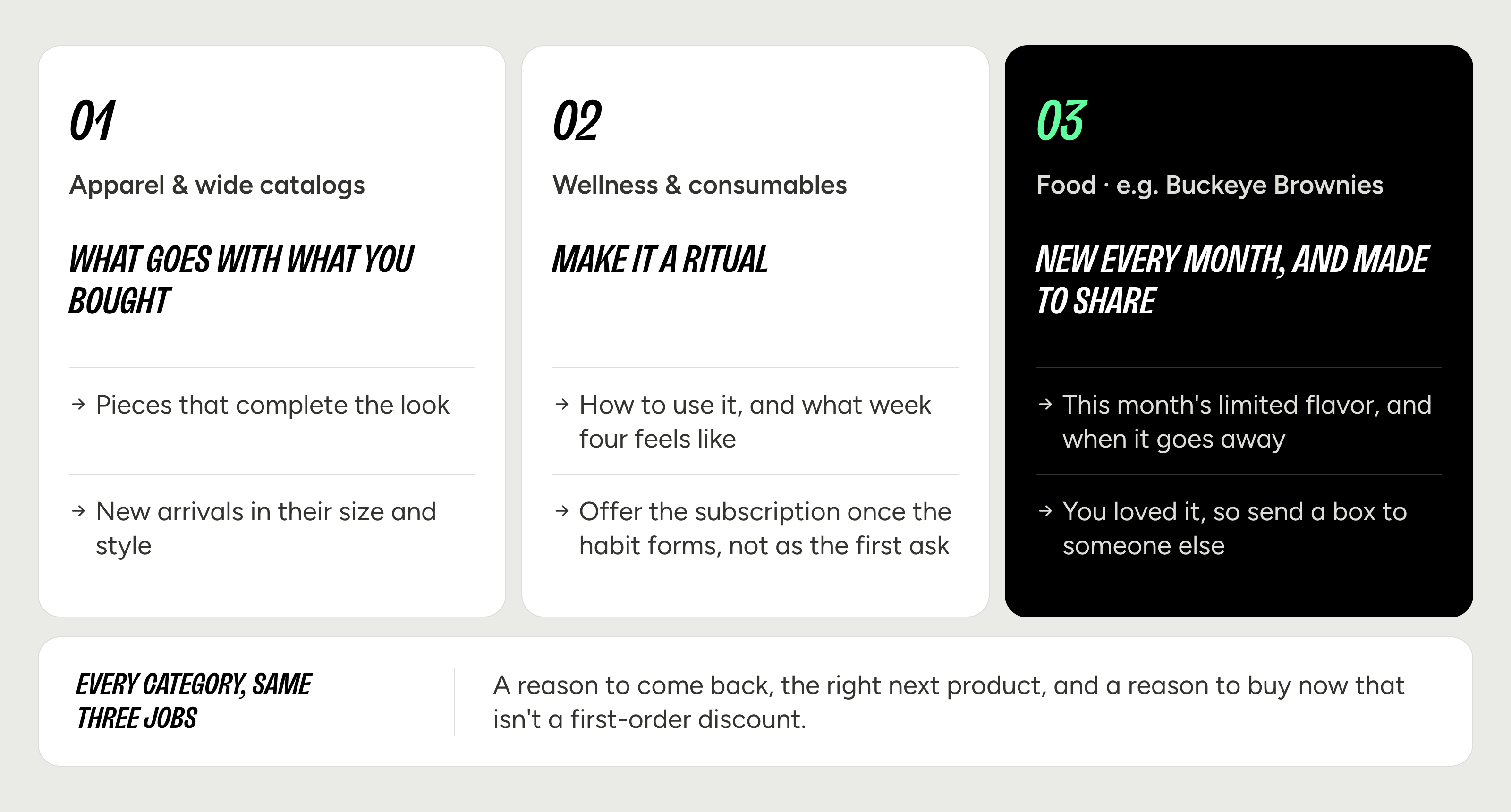
Every category has the same three jobs on the page. Give the customer a reason to come back, put the right next product in front of them, and give them a reason to buy now that isn't another first-order discount.
Test the offer before you add one
You built the first-order popup for someone who hasn't bought yet. This customer has. Zettler's rule for this segment is a reason to buy now that isn't a discount: a limited flavor, a new arrival, a gift.
If you still want to try a second-order offer, test it. Run your one-time buyer page with no offer against the same page with a second-order offer, and read the result by revenue per visitor (RPV). If more customers come back on the offer but each one spends less, you see it in RPV.
The page: generic next to one-time buyer
Zettler rebuilt the Buckeye Brownies homepage for this segment as a concept mockup, not a live page.
Three mistakes Zettler sees most
- Treating them like strangers. Brands show the welcome popup and a first-order discount to someone who already ordered.
- Showing them what they already bought. New customers buy the starter pack first. At Buckeye, repeat buyers rarely bought it again.
- Waiting for the winback. At Buckeye, 62% of second orders came within 60 days. If you wait for the winback to ask for a second order, you've missed most of that window.
Build it and test it in Shoplift
Shoplift's Klaviyo integration, on the Advanced and Pro plans, lets you target the one-time buyer segment you already use in your flows. You don't need to rebuild it.
- Connect Klaviyo. In Shoplift, go to Settings, then Integrations, and connect Klaviyo. Shoplift gets read-only access to your segments and lists. It doesn't pull names or emails, and it never writes to Klaviyo.
- Build the audience. Create an audience from your one-time buyer segment.
- Build the experience. On the homepage, remove the first-order popup, lead the hero with what's new since their order, and put the product your repeat buyers choose one click away.
- Test it. Split the segment between the new homepage and your current one. Read RPV first, then conversion rate and average order value to see why RPV moved. If you sell subscriptions, check the subscription and one-time split too.
- Roll out the winner. Keep the winning page on for the whole segment as a personalization.
Shoplift matches shoppers that Klaviyo already knows, such as someone who clicked your email or SMS or signed up through a Klaviyo form, on that same browser or device. Expect a smaller audience on site than the segment size in Klaviyo. A shopper Shoplift can't match sees your store as normal, and Shoplift never holds up the page to check.
Because you're testing one segment, not all traffic, you'll need more time to reach a confident result. Run at least two full weeks so you cover weekday and weekend buying.
One segment, one line in your program
Once you have a winner, test the offer, then the gift module, then the subscription prompt. You add a little with each winner, and you keep a separate record for each segment, so you know what this customer responds to.
You'll see the full one-time buyer section, plus VIPs from Andzen and lapsed customers from ECD Digital Strategy, at our live masterclass.
Convert Your Klaviyo Traffic. Thursday, October 29, 11:00 AM ET. Free, 60 minutes, with Zettler Digital, Andzen, ECD Digital Strategy and Gina Potenza from Klaviyo. Everyone who registers gets the recording and the full playbook. Save your seat.


