


Your winback email says "welcome back." Your homepage says "nice to meet you."
ECD Digital Strategy audits 30 to 40 Klaviyo accounts a month, across a book of more than 70 brands. The gap it finds most is the winback flow. Teams have welcome and abandonment flows live, and leave the winback flow in draft, switched off, or at a single email. Even when the winback flow runs, customers click through to a homepage built for strangers.
Lapsed customers didn't complain or unsubscribe. Most got busy, switched to something else, or forgot about you. They already know your brand, so ECD treats them as one of the easiest places to find revenue.
Most brands send lapsed customers the same email campaign as someone who bought yesterday.
This one is about the customer who bought, then went quiet. It's built from the work Zak Cassady-Dorion, founder and CEO of ECD Digital Strategy, will present at our Klaviyo masterclass on October 29.
Set the lapsed window from your own buying cycle
ECD doesn't use a universal 90-day rule. Take your typical time between orders and roughly double it. For a coffee or supplement brand, that's often 60 to 90 days. For a grill or furniture brand, it can be 180 days or more. Call a grill customer lapsed at day 90, and you send discounts to healthy customers who didn't need them.
If you run Klaviyo's predictive analytics, you already have the number. Klaviyo shows each customer's average time between orders and an expected date of next order. Klaviyo only turns predictive analytics on once at least 500 customers have ordered, you have 180 days of order history, and some customers have ordered three or more times.
Build two lapsed segments, not one
One-time buyers and repeat buyers go quiet on different clocks, so ECD builds two segments in Klaviyo. For a brand whose customers reorder about every 45 days, the segments look like this. Swap in your own days.
A repeat buyer has earned more time, so their window starts at 120 days. ECD caps both segments at 365 days, so you only reach people who still remember you. Add the refund filter to keep unhappy customers out of a winback push.
Both segments require "can receive email marketing," so they're your email audiences. Add "can receive SMS marketing" to a copy of each segment for SMS. ECD builds a third segment for lapsed customers you can't reach by email or SMS, and sends that one to PostPilot for direct mail.
If you have Klaviyo Marketing Analytics or Klaviyo Personalization, ECD adds profiles whose expected date of next order has passed. You catch customers as they start to slip.
If you also run a one-time buyer segment, set one handoff day between the two. Zettler Digital sets it where most second orders have already happened, which was 180 days for one of its food clients. ECD doubles the typical time between orders. Pick one method, use the same day in both segments, and exclude each segment from the other in Klaviyo, so each customer sees one experience. Read our one-time buyer post for Zettler's side of the line.
Read engagement by clicks, not opens
If you add an engagement rule to either segment, use clicks. Apple's Mail Privacy Protection, which Apple launched with iOS 15 in 2021, downloads email images through an Apple proxy, including the tracking pixel. Your email platform logs that download as an open even when nobody read the email.
Reach them on the channel they still use
A fourth "we miss you" email won't bring back someone who stopped reading email. ECD's view is that every ignored send counts against your sender reputation, which hurts deliverability for the rest of your list.
So ECD runs email, SMS and direct mail as one sequence. Send email and SMS first, led by the channel Klaviyo ranks as each customer's top one. If the customer still hasn't bought by the end of the flow, send a postcard through PostPilot.
Most brands never reach lapsed customers who are suppressed from email and SMS. In the US, mail doesn't need the same opt-in as email or SMS, so ECD sends those customers a postcard. Skip anyone who asked you not to mail them.
Size the offer to the customer
ECD's rule is that reaching a lapsed customer matters more than the size of the offer. Repeat buyers who drifted often come back for what's new. One-time buyers who never returned usually need a stronger nudge. Match the offer to each group, so you protect your margin.
Then test the offer depth. Count only how many lapsed customers come back, and you can pick the offer that earns you the least. Read the result by revenue per visitor (RPV), and read one-time and repeat buyers separately.
Show the same offer on the site
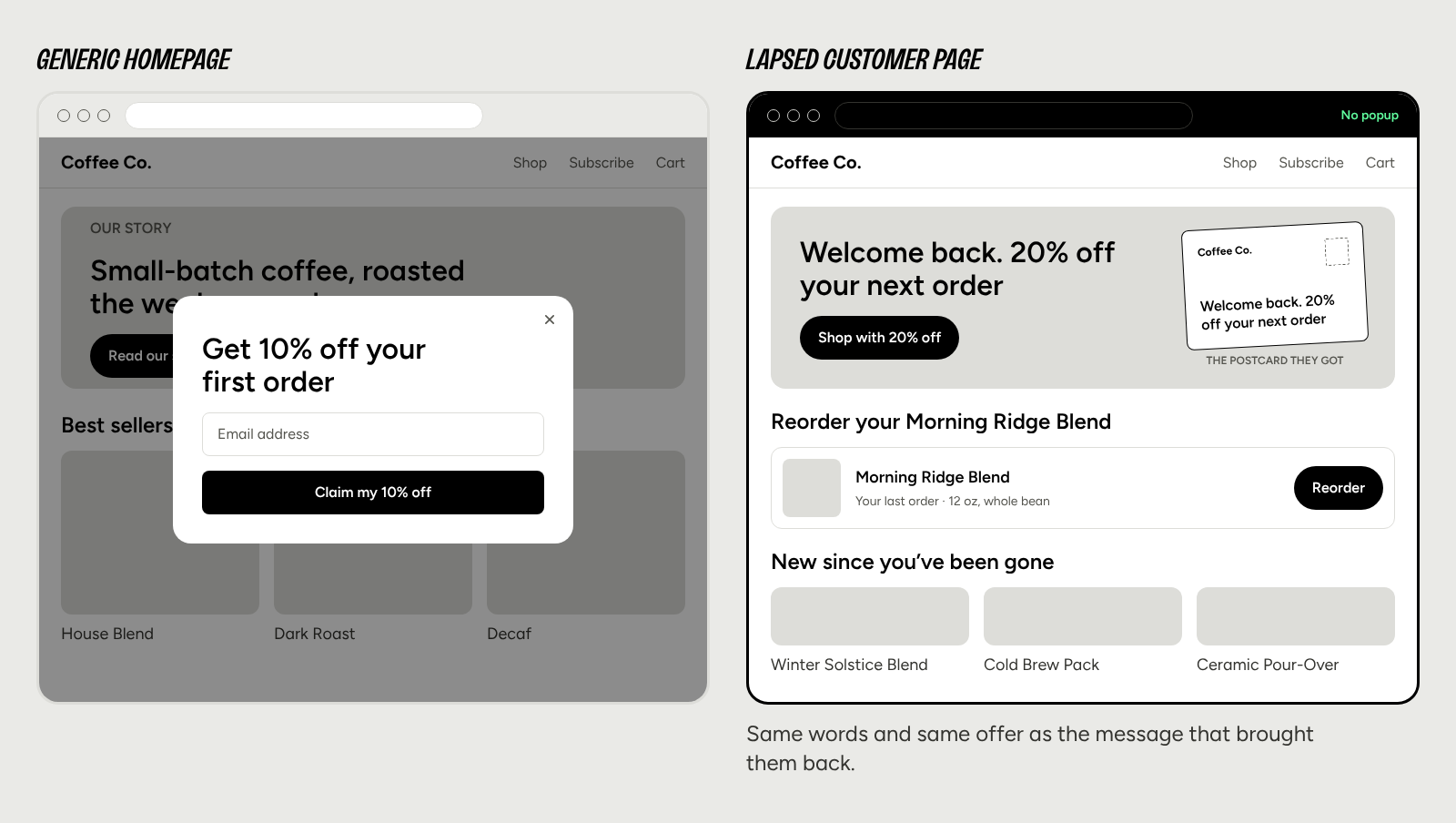
If the postcard says "welcome back, here's 20% off your next order," put the same words and the same offer on the page the customer lands on. ECD sees this in its audits too. Even after a good winback message, customers click through to a homepage with a first-order popup.
Show the product a customer bought last, the refill, or the next logical item. ECD uses Klaviyo's next best product to see what each lapsed customer is most likely to buy next, and leads the email, SMS and postcard with that product. A generic "we miss you" is the weakest version of this message.
Four mistakes ECD sees most
- One lapsed window for everyone. Use a 90-day rule at a brand whose customers buy twice a year, and you call healthy customers lapsed.
- More email to people who stopped reading email. You won't win them back, and you'll hurt deliverability for the rest of your list.
- Discount first, story never. Send 20% off to everyone with no reminder of what they bought or what's new, and you train customers to wait for the next code.
- Treating one-time and repeat buyers the same. A loyal customer who drifted needs a different message than someone who bought once and never came back.
Build it and test it in Shoplift
- Connect Klaviyo. In Shoplift, go to Settings, then Integrations, and connect Klaviyo. Shoplift gets read-only access to your segments and lists. It doesn't pull names or emails, and it never writes to Klaviyo.
- Build the audiences. Create one audience from each lapsed segment, or start with the segment where you send more Klaviyo traffic.
- Build the experience. Shoplift writes it into your Shopify theme, so it isn't a popup on top of your store. Remove the first-order popup, open with a welcome back hero that matches the message, show the winback offer ready to use, and lead the first product row with a reorder or the next logical item.
- Test it first. Split the segment between the lapsed page and your generic page. Read RPV first, then conversion rate and average order value to see why RPV moved. Read one-time and repeat buyers separately.
- Roll out the winner to the whole segment as a personalization.
Shoplift shows one experience per segment, not one page per person. To lead with each customer's last product, split the lapsed segment in Klaviyo by what they bought, for example lapsed coffee buyers and lapsed equipment buyers, and build one experience for each.
Shoplift matches shoppers that Klaviyo already knows, such as someone who clicked your email or SMS, on that same browser or device. A customer who scans your postcard on a phone Klaviyo hasn't seen won't match. Add a UTM to the postcard's QR code and URL, and add the same UTM as an audience rule in Shoplift. Postcard visitors then see the lapsed page whether or not Shoplift matches them to the segment.
Plan for January now
Customers who buy from you for the first time over Black Friday and Cyber Monday enter their second-order window right away. With a lapsed line near 90 days, the ones who don't come back cross it around late February.
Have your one-time buyer page live for January, and your lapsed page live by February. Test each one, keep the winner, and add the next change. Over a year, you build a separate record of what each segment responds to.
You'll see ECD's full lapsed section, plus one-time buyers from Zettler Digital and VIPs from Andzen, at our live masterclass.
Convert Your Klaviyo Traffic. Thursday, October 29, 11:00 AM ET. Free, 60 minutes, with Zettler Digital, Andzen, ECD Digital Strategy and Gina Potenza from Klaviyo. Everyone who registers gets the recording and the full playbook. Save your seat.


