


This week my household rebuilt itself. Lunches, bedtimes, the morning sequence. I restarted two subscriptions I paused in June, reordered the shampoo we ran out of in July, and went back to buying coffee on a schedule instead of whenever I notice it's gone.
School goes back on a rolling calendar, so your customers hit that week now or they hit it within the next few. The restock moves with them.
None of it shows up on anyone's back-to-school list.
Deloitte puts 2026 back-to-school spending at $557 per child, across clothing, technology and supplies. Circana scopes its tracking to school and office supplies. The one survey that does measure food and personal care files them under a dorm packing list. They all count what a kid carries into a classroom, and none of them count the household restocking around it.
What last August did
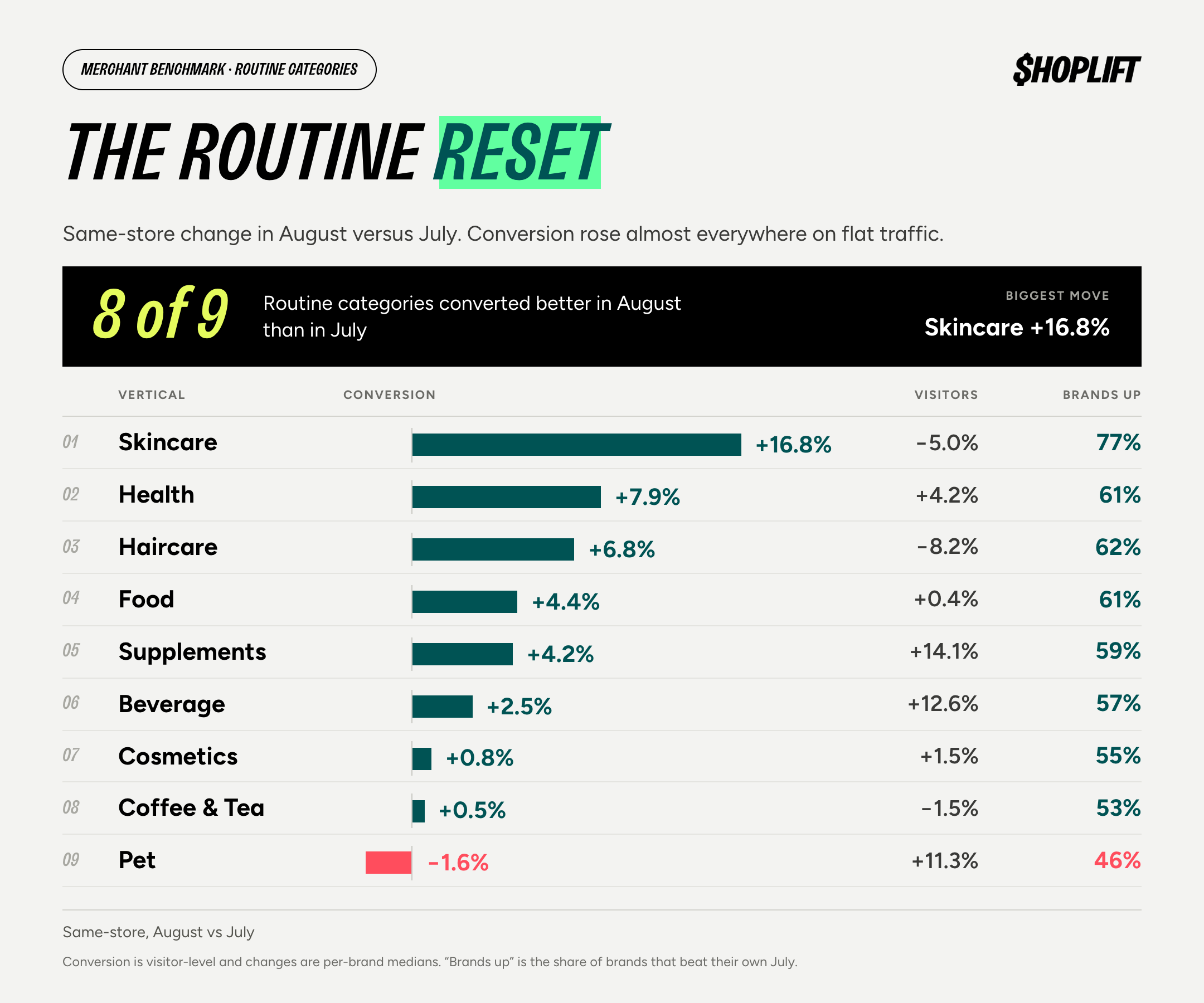
Measured on the same brands month to month, the median routine-category brand added 9.7% more orders in August than in July, and 10.6% more revenue. Conversion carried most of that, up 4.9%, with 61% of brands beating their own July rate. Add-to-cart moved with it at +4.5%.
They come back for exactly what they left
Average order value rose 0.8% in August, and more than half of brands landed within 5% of their July number in either direction. That is not an average hiding two groups. The basket sits still almost everywhere.
Put that next to a tenth more orders and the behavior is a restock. The customer who paused in June comes back for the thing that ran out, and buys it at the same size they always did. Add-to-cart and conversion moved almost in step, at +4.5% and +4.9%, and cart-to-order improved another 2.0%. Nobody is browsing. They arrive knowing the SKU.
So run your one August test on that returning order rather than on the conversion rate, which is already climbing without you. Attach the next step in the routine to the item they came for, the conditioner with the shampoo or the SPF with the serum. Offer the 90-day quantity tier at add-to-cart instead of defaulting to 30, because someone rebuilding a habit is buying against an interval rather than a price. Surface the second product they used to buy and have not restocked yet, which your own order history already knows.
The demand comes back on its own in August. The size of the order is the part you control.
Your traffic report will say nothing happened
Visitors rose 4.0% for the group, and that number buries the useful part. A third of routine brands had traffic fall in August while their conversion rose. Skincare converted 16.8% better on 5% fewer visitors. Haircare gained 6.8% on 8% fewer.
Sessions are the wrong instrument for this month. Watch orders per visitor.
What to run in the next three weeks
Pull the lapsed list today. Anyone who paused a subscription, skipped twice, or blew past their normal reorder gap in June and July. Segment it by product interval rather than by last-order date, so a 90-day refill customer doesn't sit in the same bucket as a 30-day one. This is the cheapest high-intent audience you will have all year, and most brands leave it until October and then pay Meta to reach the same people.
Move subscribe and save onto the PDP and into the cart. A post-purchase email offering a subscription arrives after the customer already chose a one-time order. The decision to be consistent again happens on the product page, and that is where the offer belongs. If you run it in one place this month, run it in the cart, where the customer has already committed to the restock.
Raise your free shipping threshold. Routine categories ran a $61.69 average order in July. A $50 threshold pays for shipping on orders that would have cleared anyway. Set it 20 to 30% above your own median order value, then read units per order rather than conversion rate.
Build the restock as a collection, not as a set of products. A returning customer rebuilding a routine wants one page with quantity tiers and refill bundles, not six product searches. Point your August email and paid traffic at that page instead of at the homepage. If you want to test how different collection layouts impact conversion, you can set up these experiments in Shoplift Campaigns.
Do not read August as a before-and-after. Conversion moves roughly 5% underneath you this month for reasons that have nothing to do with your work. Compare August to July and every change you shipped will look like a winner. Run a split test or wait for one.
What to expect this year
Routine categories closed July at 3.87% conversion with a $61.69 average order, and the typical brand was flat against June rather than falling. If August tracks last year, conversion lands near 4.1% and orders rise around a tenth.
We will publish where it landed once the month closes. Check yourself against it.
Subscribe to the Shoplift newsletter
Get insights like these emailed to you bi-weekly!
{{hubspot-form}}


