


Featuring insights from our friends at Coalition Technologies.
Traditional search visibility is relatively straightforward to track. Google is where the majority of searches happen, and the first page captures most clicks. Results appear in a defined order, with higher rankings generally driving more clicks and, in turn, more organic traffic. Keywords have verifiable search volume, showing how often a term is searched each month, along with quantifiable competition that helps brands determine what to optimize for. And then a tool like Google Search Console makes it easier to track performance over time.
AI search doesn't behave that way. A brand appears in a ChatGPT response just to disappear from the next answer to the exact same prompt, asked by the same user right after. When it appears again, sometimes it lands earlier in the answer and sometimes later, and the description shifts warmer or cooler for seemingly no reason. Sometimes it gets cited as a source without being recommended at all, or it's recommended without a link.
Add to that all the different AI tools and assistants people are using, from Claude and Perplexity to Google's own AI Overviews and AI Mode, each frequently updating its own models, and the same brand has to be tracked across systems that answer the same question differently.
But as unpredictable and chaotic as it might seem, measuring AI visibility is doable. And ignoring this new search landscape isn't really an option for a brand that wants to keep growing, particularly when so many brands still don't appear in these answers at all.
What Makes AI Visibility Harder to Track
Answer engines generate a fresh response to every request instead of returning a ranked list of results, so nothing has a consistent position that can be checked over time. A single spot check tells you what one request returned on one occasion, which is useful context but not a reliable measure of visibility.
There's also no equivalent to keyword volume. In traditional SEO, Google Keyword Planner gives brands an estimate of how often people search for a term each month. But nobody publishes how often people ask ChatGPT or Claude which project management software works best for a ten-person agency. Prompts run longer and messier than keywords. They arrive inside conversations, and they branch into follow-up questions that shift the context. So the measurement framework becomes a prompt library that somebody has to build, document, and keep current as products and positioning change.
That also changes what a result looks like. Instead of checking a position, you're estimating a rate, which is conceptually closer to impression share in paid media than to rank tracking in SEO. Run the same prompt on a schedule for a month, and a mention rate emerges from the results. Skeptics point out that these numbers can be unreliable, and they're correct when the sample is small, which is why sample size deserves as much scrutiny as the figure it produces.
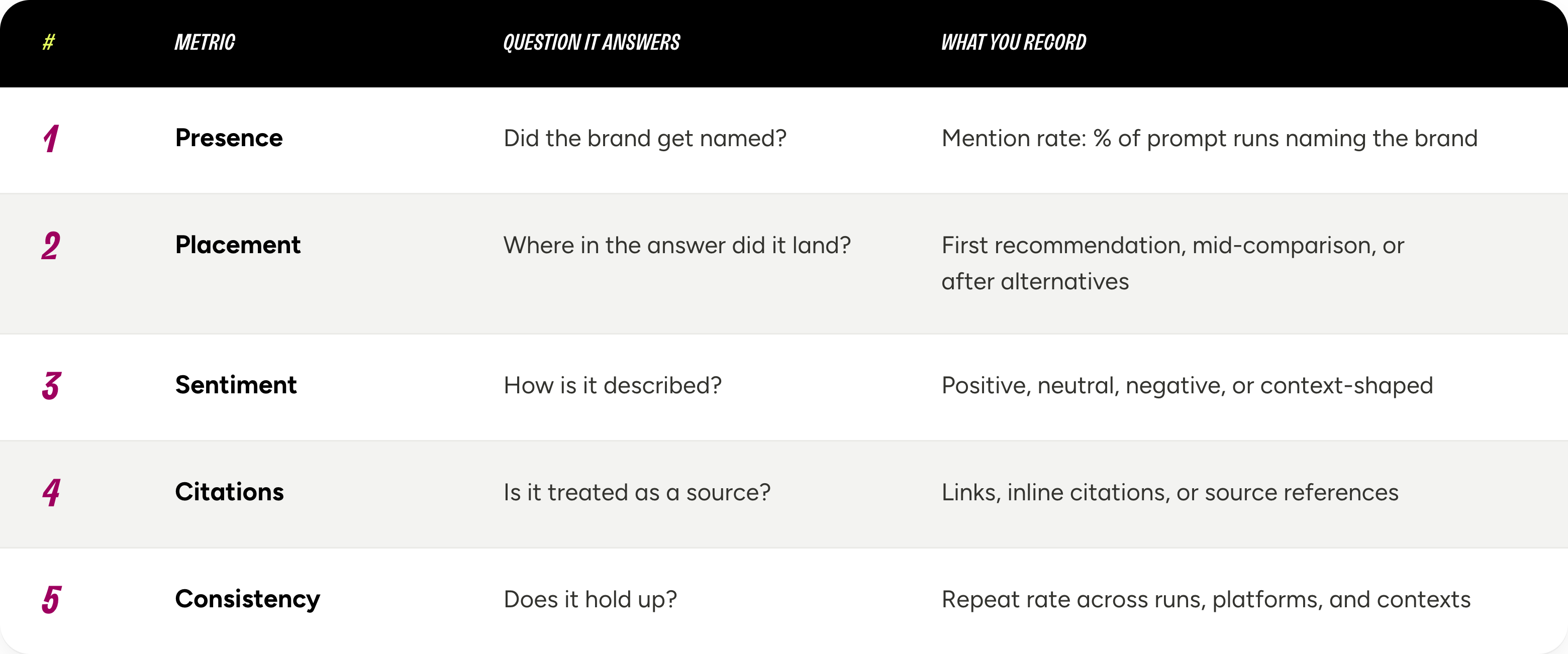
Measurement that holds up answers a few related questions. How does the brand appear in the answer? Where in the response does it land? What's driving its inclusion? How reliably does that repeat? In practice, that breaks into five things worth putting in a report, which are presence, placement, sentiment, citations, and consistency.
The Five Things Worth Tracking in AI Search
1. Presence
Presence measures the mention rate, or share of voice. It answers the most basic question, whether the brand made the cut. This is the percentage of total prompt iterations in which the brand is named, or how frequently it appears across the tracked prompt library.
This is the baseline visibility metric for AI search. Running a prompt 100 times with the brand appearing in 65 of the responses puts the Mention Rate at 65%. This shows how consistently the brand appears when users ask relevant questions.
2. Placement
Placement shows where the brand appears within the AI response. Unlike traditional search, where visibility is tied to a ranking position, AI responses mention multiple brands in different parts of the answer. A brand might appear as the first recommendation, somewhere in the middle of a comparison, or only after several alternatives.
Being mentioned is not the same as being visible. A brand that appears early in an answer has a different level of exposure than one buried near the end. Placement reveals whether a brand is simply present or being prominently featured.
3. Sentiment
Sentiment captures how AI systems describe the brand, including whether the mention is positive, neutral, negative, or shaped by specific context.
Visibility alone is not the full picture. A brand with a high mention rate can still be framed in ways that don't support its positioning. Sentiment analysis shows whether AI systems understand and communicate the brand accurately.
4. Citations
Citations measure when AI responses reference a brand's website or other sources as supporting information. Depending on the platform, this includes direct links, inline citations, or source references.
A brand can be mentioned without being cited, and cited without being recommended. Citation tracking shows whether AI systems recognize the brand as a source of information and where opportunities exist to earn more visibility.
5. Consistency
Consistency measures whether a brand's visibility holds across repeated prompt runs, different AI platforms, and changing contexts. Because AI responses can vary from one request to another, reliable visibility depends on more than a single appearance.
One strong AI response does not establish a lasting presence. A brand that appears consistently across tests has a stronger position in AI search than one that appears only occasionally due to variation in prompts or responses.
How to Actually Track AI Visibility
There’s a manual approach that works, and most teams benefit from spending a few weeks on it before buying software. It consists of creating 25 to 50 prompts that reflect the types of questions real customers ask, choosing two AI search platforms (like ChatGPT and Google AI Overviews), and running those prompts on a consistent schedule while saving the complete responses in a spreadsheet. For each prompt, track whether the brand appears, where it appears in the response, how it is described, and which sources are cited. The process is time-consuming and requires a few hours each week, but it provides a deeper understanding of how these systems behave.
Once tracking expands beyond a few dozen prompts and multiple AI systems, dedicated tools start earning their cost. Platforms like Rankscale, Peec.ai, Profound, Nightwatch, and Ahrefs Brand Radar approach the problem differently, with varying levels of prompt tracking, competitor analysis, citation monitoring, sentiment analysis, and enterprise reporting.
Budget is an important consideration. Most of these tools tie pricing to usage in some way, so the bill grows with the number of prompts, the engines each prompt runs against, the markets covered, and how often the whole set repeats.
Where This Leaves Brands
In AI search, brands that show up often, in the right context, with reliable citations and consistent positioning, are the ones that have a much stronger foundation than brands mentioned only occasionally.
There is no single correct approach to tracking AI search visibility, but measuring it is what shows whether a brand's efforts to improve its presence in AI answers are working, and pinpoints the gaps and the areas that need attention.
Some teams prefer building and maintaining their own prompt libraries, while others will invest in dedicated tools. Many even choose to work with an agency like Coalition Technologies to let specialists monitor their visibility and turn those insights into action. Each of these approaches works, provided the process stays consistent.
But as AI search continues to expand, the one thing brands cannot afford to do is simply ignore how and how often they appear across these platforms.
Subscribe to the Shoplift newsletter
Get insights like these emailed to you bi-weekly!
{{hubspot-form}}


