Supplements CRO Playbook for Shopify Brands
100 category-specific test ideas, a 12-month testing roadmap, and a masterclass built for DTC supplements operators. Everything you need to validate claims, drive subscription attach, and grow RPV season after season.

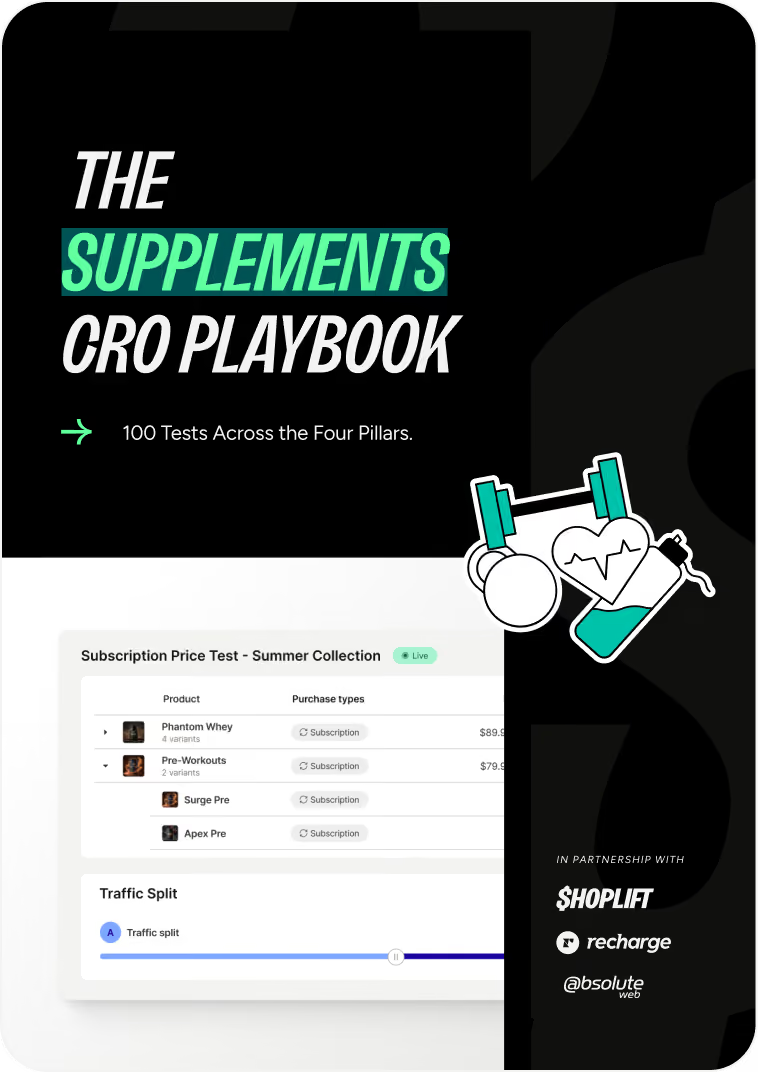
100 A/B Test Ideas for Supplements Brands.

The Supplements CRO Playbook

The 12-Month Testing Roadmap Template

The Key CRO Opportunities for Supplements Brands


Value Perception
value perception
DTC supplements brands have a structural advantage most never fully use: you control the entire product page experience. There is no identical SKU at GNC pulling shoppers away. Every element you test, from certification placement to clinical dosing to cost-per-serving framing, shapes what your product is worth in the customer's mind.

kill your conversion
Trust is the number one reason supplement shoppers abandon a $45 bottle. How you present third-party certifications, clinical dosing, and ingredient transparency directly determines whether a visitor adds to cart or leaves to compare labels. Test what earns trust before your next SKU launch.

discipline of testing
Supplements brands that test consistently, 2 to 3 experiments per month across the full calendar, build a compounding library of customer insights that every SKU launch, seasonal push, and ingredient trend inherits. Brands that sprint before January and stall by March repeat the same guesses every cycle. The gap grows every month you're not testing.

Supplements convert on trust, routine fit, and subscription value, not ingredient lists alone. A first-time subscriber is worth 3 to 5x a one-time buyer over the next year. Every element you test, from subscribe-and-save defaults to stack cross-sells to certification placement, compounds directly into LTV. Validate which combination drives the highest RPV for your audience.
Build your 12-month Supplements testing roadmap
A 60-minute live session with supplements brand operators, covering how to build a CRO roadmap, which test categories move revenue most, and how to prioritize across SKU launches, seasonal demand cycles, and subscription expansion. Featuring Shoplift, Absolute Web, and Recharge.
Map the calendar
Find what moves revenue
Test every launch
Earn the first purchase
Plan your week
Supplements CRO content built for your category.
We publish supplement-specific CRO content throughout the year for DTC supplement operators on Shopify who want category-specific guidance.

Common questions from Supplements brands
Conversion rate optimization (CRO) for supplements brands is the process of systematically testing your Shopify store to find the experiences that turn more visitors into first-time buyers and, over time, into repeat customers on subscription. In supplements specifically, that means testing how you present ingredients, clinical backing, third-party certifications, stack guidance, and formula transparency, since those elements drive purchase decisions more in this category than in most others. Done well, CRO lifts revenue per visitor without increasing ad spend, and compounds over time as each test builds a library of what your customers actually respond to.
Supplement A/B testing is different because trust is the conversion gate, not a nice to have. Shoppers do not impulse buy a $60 protein powder. They study ingredient panels, scrutinize clinical backing, and read reviews from people with similar health goals before checking out, so tests that work in apparel or home goods (shorter pages, fewer trust signals, bigger hero images) often underperform here. Four dynamics change how you design your tests. Ingredients are the product story, which means every hero callout, ingredient panel format, and clinical data block is a testable decision. Products are replenishable, so a 5% lift on first-order conversion compounds 3 to 5 times across the replenishment cycle. Demand is seasonal and follows health and fitness patterns, with New Year resolutions peaking in January and immune support rising in fall, so your testing calendar has to follow the same rhythm. And health goal is the real segmentation axis, which is why quiz-driven flows convert significantly higher than standard browsing. Put together, supplement CRO rewards brands that test the signals that earn trust, not just the mechanics of the checkout.
A CRO roadmap is a 12-month testing plan that maps specific experiments to your product launches, seasonal demand peaks, and promotional moments, so testing stops being a pre-launch scramble and becomes an operational discipline. Supplement brands need one because the category has a built-in rhythm: New Year fitness goals in January, spring performance prep, fall immune support, and holiday gifting in Q4. Trying to learn and launch inside the same window almost always means you finish the test after the revenue window has already closed. A good roadmap pulls tests from a structured backlog, prioritizes them by effort versus impact, and aligns each one to the right seasonal phase, while off-season months are reserved for foundational work like navigation, goal-based quiz flows, and checkout. The payoff is compounding. After 12 months, you have a library of proven PDP templates, certification placement configurations, and stack builders specific to your customers, not borrowed from another category.
Start with five foundational tests that are low effort, high impact, and relevant to almost every supplement brand regardless of sub-category. The first is ingredient panel presentation and clinical proof placement above the fold, with benefit statements, third-party validation, and dosage context, since supplement shoppers evaluate formula quality before almost anything else. The second is results content and before-and-after proof versus standard product-only shots, because closing the efficacy gap is often worth more than any copy change. The third is health goal quiz placement in the navigation or homepage hero, since goal-based quizzes outperform standard browsing and capture emails at high rates. The fourth is trust badge hierarchy on the PDP, including NSF Certified, third-party tested, COA availability, Informed Sport verification, and clinical study citations, placed consistently above the fold. The fifth is stack-aware cross-sells in the cart, labeled "what pairs with this in your stack," instead of generic "you might also like" recommendations. Run all five over 60 to 90 days, and let the results guide which category deserves your next round of tests.
Shoplift is built for Shopify brands that want to A/B test at the theme level, natively inside the store. Tests run directly on your Shopify theme, not through overlays, third-party scripts, or injected code, which means no flicker, no performance hit, and no doubt about whether the testing tool itself is affecting your numbers. A visual editor lets you build and deploy variations without a developer, whether you are swapping a hero image, restructuring a PDP, rewriting a headline, or testing an entirely new collection page layout. Every test automatically tracks revenue per visitor, conversion rate, and AOV across variations, and calculates statistical significance for you, so you know when a result is real and when you need more data. For supplement brands, that covers the layout, content hierarchy, certification placement, and navigation tests that make up the highest impact categories in the playbook, from PDP reorganization to ingredient callouts to stack building experiences.
The revenue math favors supplements more than most DTC categories, and the numbers are consistent across the industry. A brand doing $10M a year with a 2.5% conversion rate that lifts to 3% through testing adds $200K in annual revenue with zero increase in ad spend, and that lift compounds because supplements replenish, often every 30 days. Health goal quizzes convert significantly higher than standard browsing, with top brands attributing millions in sales to goal-based quiz funnels, while stack builders and bundle experiences consistently show higher AOV than single-product browsing. Top-performing supplement brands on Shopify build repeat purchase rates well above the DTC average, and brands with strong subscription attach see repeat rates that are nearly double the non-subscription baseline. First-order conversion is the hardest sale in supplements, which is why any test that wins on new visitors carries 3 to 5 times the long-term LTV impact once that customer starts reordering every 30 days.
Building a 12-month roadmap starts with an honest audit of where you lose visitors today, identifying the three to five biggest gaps in your funnel by looking at the highest traffic pages with the lowest conversion, the steepest drop-offs, and the weakest AOV moments. From there you select two to three tests per month from a backlog, match each one to a seasonal phase, and measure on revenue per visitor rather than conversion rate alone. A typical supplement calendar treats January as New Year Resolution Peak, the highest-intent month in the category, with focus on goal-based quizzes, homepage tests, and navigation. February and March are Spring Prep (ingredient callouts, clinical proof, trust badges). April and May are Pre-Summer Performance (weight management and energy PDPs, stack bundles, subscription prompts). June and July are Summer Performance (hero messaging, hydration and electrolyte products, mobile optimization, replenishment). August and September are Back to Routine (immune support navigation, stress and sleep PDPs). October is Immunity and Wellness Season (ingredient education, certification placement, price anchoring). November and December are Holiday Gifting and Sets (bundles, AOV, loyalty enrollment). Winning tests become your new baseline. Losing tests still teach you what your customers do not respond to, and both are valuable. Low-traffic months are your hidden advantage, because that is when you test structural elements like navigation, quiz flows, checkout, and subscribe-and-save mechanics that pay off during the January and Q4 peaks.
Yes, and arguably more than for larger brands. A $10M supplement brand with a 2.5% conversion rate that lifts to 3% through testing adds roughly $200K in annual revenue without spending another dollar on acquisition, and that number understates the real impact because supplements replenish, often monthly, so every first order you win multiplies 3 to 5 times across the replenishment cycle. Smaller brands also have an operational advantage, with fewer stakeholders, shorter decision cycles, and more room to make meaningful structural changes without internal politics. The barrier is usually not budget, since a single test costs very little to run. The barrier is starting. Five tests over 60 to 90 days is enough to begin a compounding program, and the real cost of waiting is the competitor who tested for two years and now converts your shared traffic better than you do, pulling away every quarter you stand still.
Before-and-after content is among the strongest social proof a supplement brand can show, because it addresses the question every shopper is silently asking: whether the product will actually work for someone with their body, goals, and baseline. Tests consistently show that moving results imagery and customer transformation stories closer to the buy box, rather than leaving them buried below the fold, lifts add-to-cart and conversion on outcome-driven products like protein, fat burners, pre-workout, and sleep supplements. Timeline-based progression content labeled by week or cycle tends to outperform simple side-by-side comparisons, because it sets realistic expectations and makes the outcome feel achievable rather than exaggerated. Video reviews and testimonials from real customers outperform text-only reviews in this category, since they let shoppers evaluate visible results, hear about the experience firsthand, and assess whether the product fits their own situation. Two guardrails matter more in supplements than in almost any other category. All claims must be substantiated, properly disclaimed, and compliant with FTC and FDA guidelines, including the required disclaimer that results are not typical and the statement that the product has not been evaluated by the FDA. You also need documented usage rights from every customer featured. Without those, results content becomes a regulatory and return rate problem instead of a conversion lever, because the imagery raises expectations that the product, used normally, may not meet for every customer.
Element-level A/B testing swaps a single UI component in isolation, such as a button color, a headline, a badge, a single image, or one copy block, and measures the delta on that one variable. It is fast to set up and useful for quick wins, but it cannot tell you whether a larger structural change would perform better, because you are only moving one dial on a page that stays otherwise identical. Theme-level A/B testing, which is what Shoplift runs natively on Shopify, tests full variations of a theme, template, or page against each other. You can restructure an entire PDP, swap in a new collection page layout, rearrange the homepage, reorganize the navigation, or change how trust signals and certifications stack across the site, and measure which composed experience actually makes more money rather than which isolated element wins. For supplement brands specifically, theme-level testing matters because the highest-impact tests, including stack builders, ingredient hero layouts, PDP reorganization, and goal-based quiz placement, rarely live in a single element. They live in how the whole page is composed.