


.webp)
Market shocks don't announce themselves politely. One day you're operating with predictable costs and stable margins. The next, a new tariff adds 45% to your landed costs, your supplier raises minimum order quantities by 30%, or shipping rates double because of port congestion halfway around the world.
The pressure to respond is immediate. Your finance team is calculating the margin erosion. Your operations team is forecasting cash flow. And you're staring at the most dangerous question in e-commerce: how much can we raise prices before customers stop buying?
Most brands approach this moment with one of two strategies, both not ideal.
Strategy One: Absorb the cost and hope it's temporary. You absorb the margin loss, telling yourself things will normalize soon. Weeks turn into months. The "temporary" shock becomes permanent structural reality. Your profit margins are now 40% lower than last quarter, and you're explaining to stakeholders why you're burning cash on every sale.
Strategy Two: Raise prices immediately based on cost math alone. If costs went up 20%, you raise prices 20%. Clean, logical, and potentially catastrophic. Because cost-based pricing ignores the only number that matters: what customers will actually pay. You implement the increase, watch conversion rates plummet, and realize you've made the problem worse.
There's a third way. One that doesn't require gambling on whether customers will tolerate your new prices, and one that doesn't sacrifice profitability hoping external pressures will ease.
The Resilience Framework: Price Testing as Economic Insurance
Price testing isn't just a tool for incremental optimization. It's infrastructure for navigating uncertainty. When executed systematically, it creates pricing resilience that turns market shocks from existential threats into manageable challenges.
Here's what that looks like in practice.
1. Know Your Pricing Power Before You Need It
When rising tariff costs hit Minnow Swimwear in early 2025, they faced a choice: absorb the costs and squeeze margins, or raise prices and continue providing the premium product they are known for. Minnow tested a 10% price increase on their bestselling children's swimwear products and customers converted at normal rates, confirming their premium positioning had created real pricing power.
Rather than discovering their pricing limits by implementing changes across their catalog and watching what happened, they knew exactly what their customers would tolerate because they tested it first. Minnow is now testing pricing across all categories in a systematic way.
Read the full Minnow case study
2. Validate Premium Positioning in Competitive Markets
SAXX Underwear needed to raise prices heading into 2026, but the underwear category is notoriously price-sensitive. Making the wrong call could impact conversion rates right as they were scaling their US market presence. Their test of a 5% increase showed no statistically significant difference in conversion rates.
The data gave them confidence to accelerate their timeline, implementing the increase in early December instead of waiting until 2026, even knowing they'd be more expensive than their own wholesale partners and Amazon listings for a four-week window. The result: expected margin improvement of 1-2% over six months with no conversion rate impact.
3. Turn Crisis Response Into Strategic Advantage
Here's where price testing moves from defensive tactic to competitive advantage: the discipline you build responding to one shock prepares you for the next one.
Minnow and SAXX both started price testing to solve immediate problems, but what they built was something more valuable. They created systematic processes for making evidence-based pricing decisions quickly and confidently. They're no longer waiting for external pressure to force their hand. They're proactively testing prices, accumulating evidence about customer behavior, and building pricing strategies grounded in data rather than outdated assumptions.
This is pricing resilience in action. The infrastructure you build to survive one shock becomes the system that helps you thrive through the next one.
4. Think Beyond the Price Tag
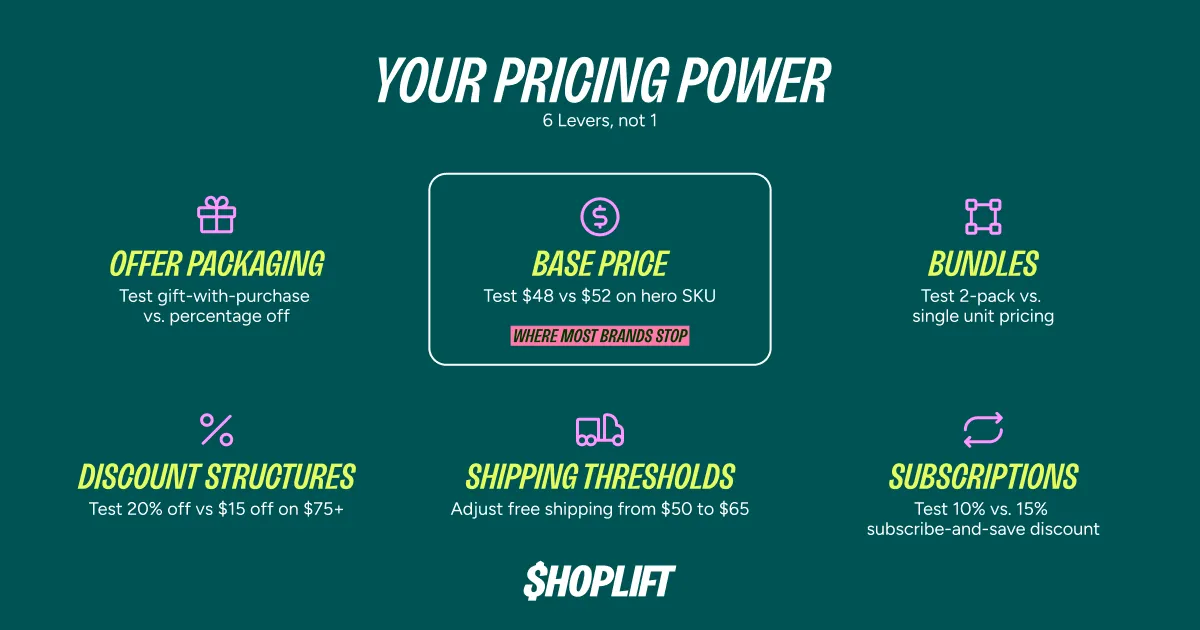
When costs spike, most brands fixate on one question: can we raise the sticker price? But price is only one lever. Bundles, subscription discounts, shipping thresholds, discount structures, and offer packaging all affect what customers actually pay and how they perceive the value they're getting.
Smart brands test across these levers to find the path of least resistance. Sometimes bundling two products absorbs a cost increase without changing the per-unit price. Sometimes adjusting a free shipping threshold recovers margin without touching a single product price. Sometimes a subscription discount offsets sticker shock and increases LTV at the same time.
The point is that you have more options than you think. And the only way to know which ones work for your specific customers is to test them.
Subscribe to the Shoplift newsletter
Get insights like these emailed to you bi-weekly!
{{hubspot-form}}
Building Your Pricing Shock Absorbers
Economic volatility isn't going away. Tariff policies shift with political winds. Supply chains remain fragile. Energy costs fluctuate. Currency exchange rates swing. Manufacturing costs trend upward over time.
Brands that treat each shock as a unique crisis will perpetually operate in reactive mode, making high-stakes pricing decisions under pressure with incomplete information.
Brands that build systematic price testing into their operations create a fundamentally different position:
They know their pricing power before they need to use it. When costs spike, they're not guessing about customer tolerance. They have data showing exactly where their price elasticity thresholds are, by product and by customer segment.
They understand their customers' psychological price boundaries. They know which price points trigger emotional resistance (the 2.0x surge effect) and which increases customers absorb without hesitation.
They test across product roles, not just top sellers. Halo products, upsell items, subscription SKUs, and bundle components all have different elasticity profiles. Systematic brands test across the catalog to build a complete picture of where pricing power lives.
They accumulate compounding knowledge. Each test builds on the last, creating institutional expertise about pricing dynamics that competitors relying on intuition simply can't match.
They can move fast when it matters. Because they've tested systematically during stable periods, they can implement changes confidently during volatile ones. No committee meetings debating whether customers will revolt. No paralysis hoping conditions improve. Just data-driven action.
When the next shock hits, and it will, you'll have three options:
- Absorb the cost and watch margins evaporate
- Raise prices blindly and hope customers don't leave
- Test systematically and make decisions based on data about your specific customers and products
The first two are gambling. The third is strategy.
Minnow and SAXX have already made this shift. They're not immune to market shocks, but they've built the infrastructure to navigate them without betting the business on gut instinct.
The question isn't whether you'll face cost pressures. The question is whether you'll have the data to respond intelligently when they arrive.


