
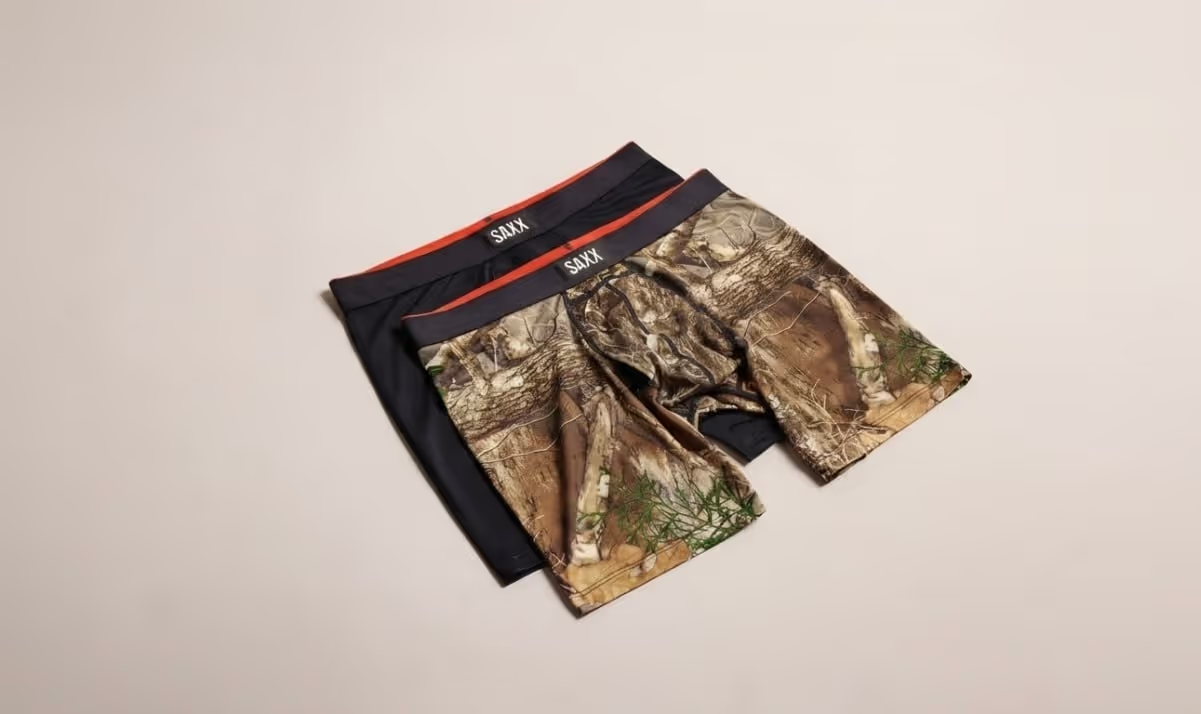
How SAXX Used Price Testing To Validate Their Premium Positioning for US Market Growth

SAXX, an innovative, premium priced men’s underwear brand faced a strategic challenge common to many multi-channel brands: how do you know if your pricing is optimized when consumers have cheaper alternatives.
For Valerie Williams, Senior Director of E-commerce at SAXX, the question became critical as the company focused on accelerating growth in the US and maintaining market share in California. SAXX had built strong brand recognition in Canada, where they generated half their revenue. But scaling in the competitive US market as a premium product required confidence that their pricing wouldn't drive customers to more economical alternatives.
The challenge was understanding customer price sensitivity without the data to back up decisions. SAXX needed confidence in their pricing strategy before pushing harder into US growth.
The Premium Brand Dilemma
SAXX manufactures most of their product overseas, with a sizeable portion of their top SKUs coming from China. Like many brands, they face consistent cost pressure from manufacturing and recent tariffs that squeezes margins. But unlike commodity underwear brands, SAXX positions itself as a premium product with proprietary comfort technology and design innovation.
This creates a strategic tension: manufacturing costs push prices up, but consumer behavior and price expectations in the underwear category presents a real challenge. When economic uncertainty hits, customers trade down to more economical products. This trade-down risk made SAXX cautious about raising prices.
Making the wrong pricing decision could mean watching customers defect to cheaper alternatives right as SAXX was trying to scale their US market presence.
The company had successfully navigated operational challenges before. When tariffs first impacted their business, they restructured their entire US fulfillment operation, moving from routing through their Canadian distribution center to direct shipping from a California warehouse. That operational shift improved their cost structure, but it didn't answer the fundamental question: what would US customers actually pay for premium underwear?
Testing Premium Pricing Without the Risk
As SAXX prepared to scale their US presence, they knew price optimization would be critical.
"We knew going into 2026 we were going to have to do a price increase," Valerie explained. "What we wanted to get a better idea of before Q4 was: what type of impact is this going to have on conversion rate? Are we concerned about the overall impact to revenue and orders with this shift?"
For a company planning to aggressively grow US revenue, getting pricing wrong could undermine the entire strategy.
Valerie knew they needed to test pricing changes with real customer behavior, not assumptions. SAXX was already using Shoplift for A/B testing on their US site when they learned about Shoplift's price testing feature. Rather than implementing a price change blindly or waiting to gather indirect signals from the market, price testing would give them exactly what they needed: direct evidence of whether a price increase would impact conversion rates.
Native Price Testing Built for Shopify Plus
When SAXX's development team started implementing Shoplift's price testing feature, they immediately recognized the architectural difference from legacy testing tools.
"I really like the attribute model," Senior Frontend Developer Jamieson Roberts noted. "Once that's done, you just section refresh, request a new section—you're changing to this product, refresh this part of the page—the data attributes are there, the mutation observer just reads them and renders. It's really seamless."
Unlike tools that manipulate pricing through JavaScript overlays, Shoplift's approach works at the theme level through data attributes and Shopify's native cart transform API. This means price changes flow through every touchpoint naturally: product pages, cart, checkout, and even buy now, pay later integrations.
The implementation Jamieson expected to take weeks took days. While there were a few edge cases specific to SAXX's multi-pack bundles and metafield-based pricing, direct communication with Shoplift's support team resolved them quickly.
Within days, SAXX had live price testing running on one of their performance underwear collections. They strategically chose a product line where SAXX offered a similar product at the same price point, allowing for clean comparison data.
Data That Drives Strategic Decisions
The test ran for four weeks, from late October to November, tracking sessions, conversion rates, average order values, and revenue per visitor with statistical significance calculations built in. Unlike typical A/B tests where you're hoping for a clear winner, Valerie's team was looking for something different: consistency in conversion rates regardless of price.
After four weeks of testing, the results were clear: no statistically significant difference in conversion rate between the control pricing and the 5% increase. US customers were buying SAXX at the same rate regardless of the price change.
For Valerie and the executive team, this data immediately changed their strategic timeline.
"We were actually planning to do this in 2026 on both our US and Canadian websites, but we made the decision to roll that out right after Black Friday versus waiting until now," Valerie explained. "From a PE perspective, every dollar counts on the bottom line by the end of the year. This test gave us the confidence to accelerate our timeline."
They made the bold decision to implement the price increase in early December knowing SAXX would be more expensive than their wholesale partners and more expensive than their own Amazon listings for a four-week window.
"We basically went out knowing that we were going to be undercut by our wholesale partners, and we were just going to ride that," Valerie said. "And it paid off because we didn't see a performance impact in December."
Strategic Validation for Market Expansion
The price increase rolled out across SAXX's direct-to-consumer sites in the first week of December 2025. The team monitored conversion rates carefully.
"We haven't seen any significant impacts, which is great," Valerie reported. "We actually saw a strong close to the year from a top line revenue perspective, and that incremental dollar to two dollars per product has definitely helped us close strong from a bottom line perspective as well."
The financial impact supported both near-term margin goals and long-term strategic positioning:
- Expected margin improvement of 1-2% over the next six months
- No conversion rate impact despite premium pricing versus wholesale and Amazon
- Accelerated implementation captured additional Q4 margin
- Strategic confidence for US market expansion with validated pricing
The test validated something critical for SAXX's US growth plans: their customers valued the brand's unique product innovation and direct-to-consumer experience enough to sustain premium pricing, even when cheaper alternatives were readily available through wholesale and Amazon channels.
Testing as Strategic Infrastructure
Looking ahead to 2025, SAXX's primary growth focus is scaling US market presence and direct-to-consumer channels. Price testing has become part of their strategic toolkit as they grow.
The SAXX team plans to continue using price testing as they expand their product assortment and deepen US market penetration. Rather than relying on competitive analysis or historical data alone, they now have a systematic way to validate pricing decisions before making them permanent.
For premium brands navigating the balance between margin pressure and customer price sensitivity during market growth, SAXX's approach offers a clear framework: test systematically, make decisions based on actual customer behavior, and use data to enable strategic conviction rather than playing it safe.


