


Most Shopify brands pulled back on acquisition spend when tariff pressure started squeezing margins. Cutting spend without a plan to recover lost revenue just trades one problem for another. Price testing gives you a way to grow revenue from the visitors you already have, improving Revenue Per Visitor (RPV) without adding a dollar to your ad budget.
Two types of Shopify brands are navigating this environment
On one side, you have the 9-figure operators. Brands like Athletic Greens, Glossier, and Everlane that raised massive rounds, built household name recognition, and have media buying operations so precise they know exactly where each marginal ad dollar stops producing a return. They can grow at razor-thin ROAS multiples because their acquisition infrastructure is dialed in at a level most brands will never reach.
Then there's the rest of the Shopify ecosystem.
If you're running a Shopify Plus brand doing 7 or 8 figures in annual revenue, you already know this gap exists. You're not going to match their acquisition efficiency by scaling ad spend the way a publicly traded or venture-backed competitor can. The gap isn't just about budget. It's about infrastructure, data, and years of optimization most brands haven't had the resources to build.
Growth isn't off the table, but the playbook looks different. The brands figuring that out aren't just pulling back on acquisition. They're pulling a different lever: price.
The squeeze is coming from both sides
Two forces are compressing margins for Shopify brands simultaneously, and neither one is temporary.
Tariffs have driven up the cost of goods. If you source products internationally (and most DTC brands do), your landed costs are higher than they were 12 months ago. At the same time, customer acquisition costs have risen an estimated 25 to 40% depending on the channel. Deloitte's Q1 2025 Retail and Consumer Trends report frames this increase as structural, driven by platform saturation, privacy regulation, and growing competition for the same audiences.
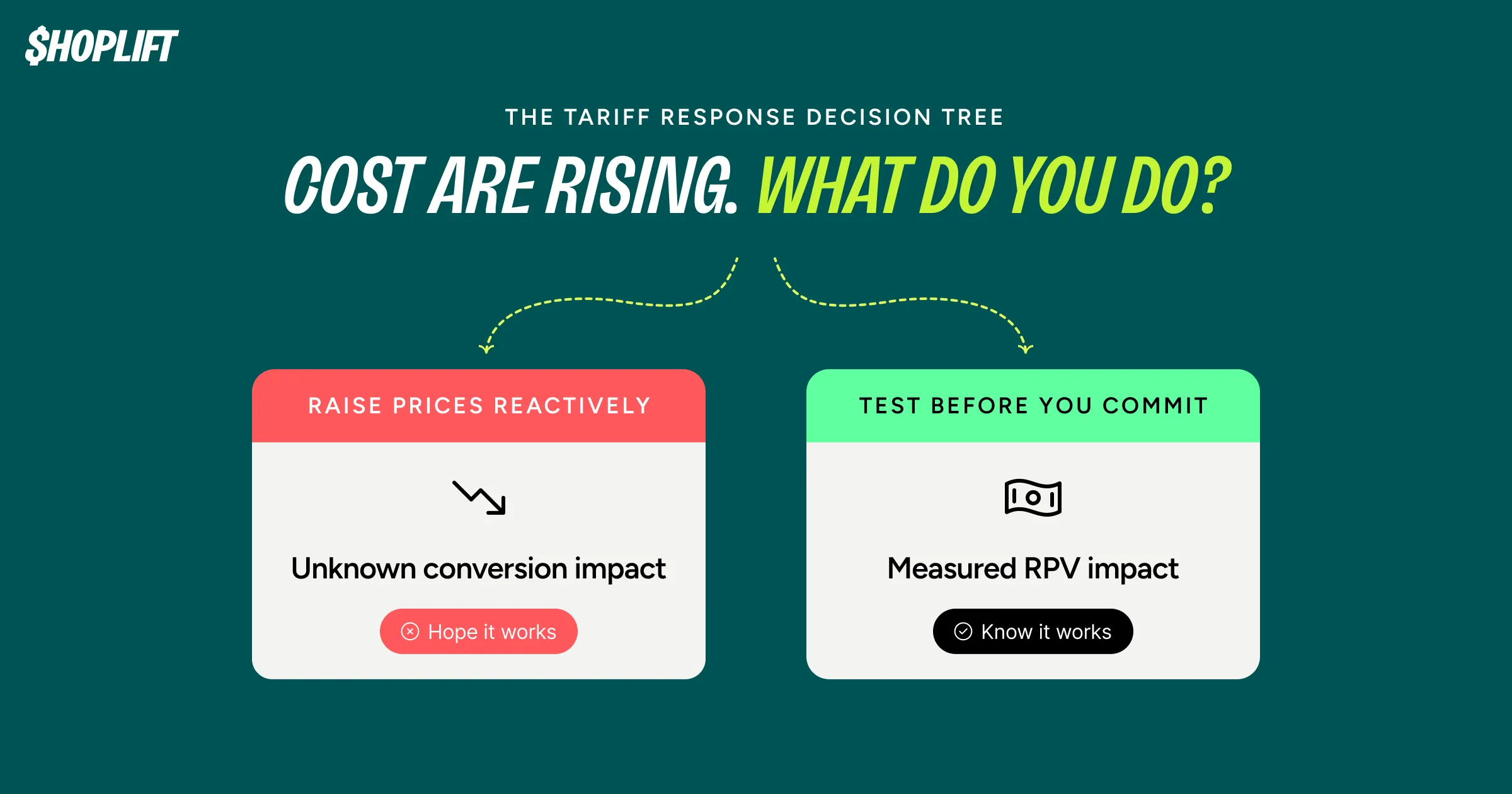
87% of ecommerce merchants have raised U.S. prices to counteract tariffs and inflation, according to the Yotpo 2026 DTC Brand Comparison. Most did it reactively. Tariffs pushed COGS up, someone opened a spreadsheet, added a margin buffer, and pushed new prices live without testing what the change would do to conversion rates, average order value, or revenue per visitor.
These forces together explain why the median DTC company grew revenue roughly 3% in 2025. The brands still running an acquisition-first playbook without adjusting their approach to revenue optimization are feeling this compression the most.
The acquisition-first response breaks down when costs are structural
When revenue targets look at risk, the familiar response is to scale ad spend and double down on the campaigns that are working. For years, this produced results. The problem is what happens when CAC is rising structurally, not cyclically. Every incremental customer costs more than the last, and because tariffs are inflating COGS at the same time, your margin per new customer is shrinking from both directions.
For the 9-figure operators, this math is uncomfortable but survivable. Their media buying teams have the data, the tooling, and the budget to find every last profitable impression. For brands doing 7 or 8 figures, the gap between what you can afford to deploy and the efficiency a well-funded competitor can achieve keeps growing. Most brands in this range are already near the ceiling of what acquisition spend alone can deliver.
Acquisition matters. But if you don't have the infrastructure to buy traffic with that level of precision, spending more on the same channels without addressing the revenue side of the equation is a reflex, not a strategy. The alternative is scaling on the traffic you already pay for.
Revenue Per Visitor is the metric that reframes the conversation
The better question, especially when acquisition budgets are constrained, is how to get more value from the visitors already on your site.
Revenue Per Visitor (RPV) combines your conversion rate and your average order value into a single number that represents what each visitor is worth. If CAC tells you what it costs to get someone to the site, RPV tells you what that person is worth once they arrive. Most brands track conversion rate and AOV separately. Almost none treat RPV as the primary lever for margin improvement.
Price is the most direct input to RPV. A pricing adjustment that holds conversion rate delivers pure margin improvement without additional ad spend, new creative, or incremental budget. More revenue from the traffic you're already paying to acquire, and every acquisition dollar works harder because the revenue foundation underneath it is stronger.
Why merchants avoid the optimization path
The biggest barrier is psychological, not technical. Merchants worry about customer backlash, fear that testing prices will feel manipulative, and assume that adjusting pricing automatically means raising prices in a way customers will resent.
The irony is that 87% of ecommerce merchants already raised prices to offset tariffs and inflation. They just did it without data to guide the decision, without knowing which products could absorb an increase and which items were actually underpriced to begin with.
Price testing is not "raise everything 10% and see what happens." It's a controlled process designed to find the price your customers are already willing to pay. Sometimes that price is higher, sometimes lower, and sometimes the optimal move is adjusting specific SKUs while holding others steady. The goal is accuracy, not inflation.
What price testing actually looks like
Price testing works the same way any A/B test does. You split your traffic into groups, show different price points, and measure the impact on conversion rate, average order value, and revenue per visitor. Brands already apply this discipline to headlines, hero images, and CTAs. Pricing is just the lever with the most direct impact on margin.
Shoplift's price testing is built at the Shopify theme level, running natively inside the store rather than through DOM overlays or third-party scripts that create flicker, slow down pages, or break when your theme updates. Pricing changes render consistently across the product detail page, cart, checkout, and any buy-now-pay-later integrations because the test is built into the infrastructure, not bolted on top of it.
The compounding return
Optimization and acquisition work best in sequence, and the order matters.
Better RPV directly improves your CAC payback period. If each visitor is worth more revenue, you can afford to acquire more of them profitably. The acquisition math that was breaking starts working again because you've improved the revenue side of the equation.
Margin gained from price optimization creates a reinvestment buffer. You can fund smarter acquisition, absorb tariff pressure on key SKUs without passing all of it to customers, or hold competitive pricing where it matters while finding margin elsewhere in the catalog. In a tariff environment where costs keep shifting, brands with a testing discipline can adapt pricing in real time instead of reacting months later with blanket increases.
The loop compounds over time. Optimize RPV, improve margins, reinvest in acquisition with better unit economics, and grow faster with less risk.
See what your traffic is actually worth
If you can't match the acquisition efficiency of the 9-figure operators (and most brands can't), start with the traffic you have. Price testing takes minutes to launch, not months to plan.
Subscribe to the Shoplift newsletter
Get insights like these emailed to you bi-weekly!
{{hubspot-form}}
Frequently asked questions
Q: Does price testing on Shopify show different prices to different customers at the same time?
A: Yes, price testing splits your traffic into groups and shows each group a different price point, just like any other A/B test. The test runs natively at the Shopify theme level so pricing stays consistent across PDPs, cart, checkout, and BNPL integrations for each visitor.
Q: How is price testing different from just raising prices across the board?
A: Price testing uses data to find the price your customers are already willing to pay for specific products. Instead of applying a blanket increase and hoping conversion holds, you measure the impact on conversion rate, AOV, and revenue per visitor before committing to any change.
Q: What is Revenue Per Visitor and why does it matter for ecommerce conversion rate optimization?
A: Revenue Per Visitor (RPV) combines your conversion rate and average order value into one metric that shows what each site visitor is worth. It gives you a single number to optimize against instead of tracking conversion and AOV separately, and it directly measures the revenue impact of pricing changes.
Q: How long does a price test take to produce results on Shopify?
A: Most price tests on Shopify reach statistical significance within a few weeks depending on your traffic volume. Higher-traffic stores see results faster, and the test launches in minutes without requiring any development or design resources.
Q: Can price testing help offset rising costs from tariffs without hurting conversion rates?
A: That's exactly what it's designed to do. Price testing identifies which SKUs can absorb an increase and which are price-sensitive, so you can recover margin where customers are willing to pay more and hold pricing where it matters for conversion.
Glossary
Customer acquisition cost (CAC): The total cost of acquiring a new customer, calculated by dividing total marketing and sales spend by the number of new customers acquired over a given period.
Revenue per visitor (RPV): A composite metric measuring the average revenue generated per website visitor, reflecting both conversion rate and average order value in a single number.
Average order value (AOV): The average dollar amount a customer spends per transaction, calculated by dividing total revenue by the number of orders.
Conversion rate: The percentage of website visitors who complete a purchase. One of the two inputs (along with AOV) that determine revenue per visitor.
Price testing: A form of A/B testing where different price points are shown to segmented groups of visitors to measure the impact on conversion rate, AOV, and RPV.
Cost of goods sold (COGS): The direct costs associated with producing or purchasing the products a business sells, including raw materials, manufacturing, shipping, and import duties or tariffs.
CAC payback period: The time it takes for a business to recoup the cost of acquiring a new customer through that customer's purchases.
Gross margin: The difference between revenue and COGS, expressed as a percentage of revenue. Tariffs, shipping increases, and raw material price changes directly impact gross margin.
DOM overlay: A method of modifying a webpage by layering changes on top of the existing page structure using JavaScript after the page loads, commonly used by third-party testing tools.


