


You've spent months perfecting your product. The photography is dialed. The product page converts. Your marketing plan is ready to go. But there's one decision that can undermine all of it: the price you put on the tag.
Pricing a new product is one of the highest-stakes decisions in ecommerce, and you're making it with almost no data. Unlike your existing catalog where you have sales history, conversion rates, and margin performance to guide you, a new product launch is essentially an educated guess.
The math on getting this right is compelling. McKinsey research shows that a 1% improvement in pricing yields an 8% increase in operating profits, making it nearly 50% more impactful than cutting variable costs by the same amount. Get pricing wrong, and you're either leaving significant revenue on the table or killing demand before you even start.
Most brands approach new product pricing by defaulting to one of three methods: calculating costs and adding a margin, matching competitors, or conducting pre-launch research. Each approach has merit. Each also has serious limitations that can lock you into suboptimal pricing from day one.
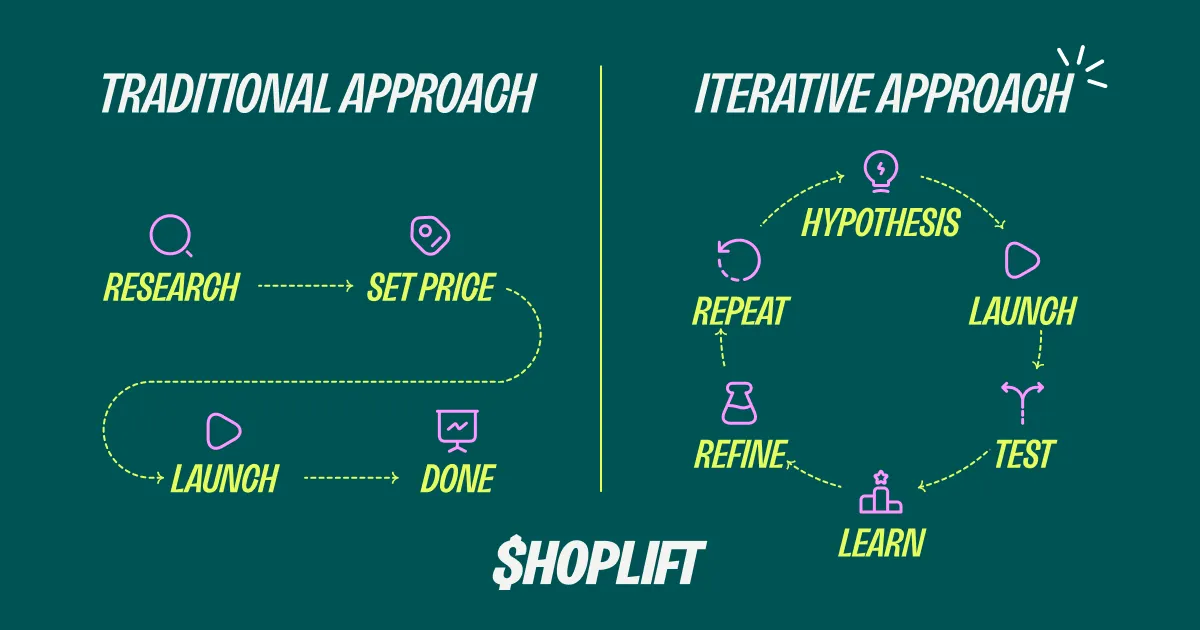
There's a better way. Instead of treating your launch price as a final decision, treat it as a starting hypothesis that gets refined with real customer data.
Why traditional pricing methods fall short
This isn't about traditional methods being wrong. They're useful starting points. The problem comes from treating any single approach as the definitive answer for a product that hasn't been tested in the market yet.
Cost-plus pricing
The most common approach is straightforward: calculate your cost of goods, add your target margin, and you have a price. It's clean math, but it ignores the most important variable in the equation.
As Shopify's pricing guide puts it: "Customers aren't thinking about what your potential production costs are. They're considering what a product is worth, which is entirely subjective."
Cost-plus pricing treats your internal economics as the primary driver when customer perception of value is what actually determines whether someone buys. You might price a product at $45 based on a 60% margin, but if customers perceive the value at $65, you've left $20 on every sale. If they perceive it at $35, you've priced yourself out of consideration entirely.
Competitor matching
Looking at competitor pricing provides useful market context. It tells you what customers are currently paying for similar products and where the market has settled.
But your product isn't identical to the competition. Different features, different brand positioning, different value propositions should mean different price potential. When you anchor to a competitor's price, you're adopting their strategy without knowing whether they got it right. For genuinely innovative products, there may not be meaningful comparisons at all.
Pre-launch surveys and WTP research
Willingness-to-pay surveys seem like the scientific solution. Ask potential customers what they'd pay, analyze the data, set your price accordingly.
The research on these methods tells a more complicated story.
A study published in the Journal of Marketing Research found that respondents are "more price sensitive in incentive-aligned settings than in non-incentive-aligned settings." In plain terms: when real money is on the line, people behave differently than when answering hypothetical survey questions. They tend to overstate what they'd pay when no actual purchase is required.
The Van Westendorp model, one of the most widely used pricing research frameworks, has its own constraints. It focuses on customer price perceptions in isolation, often without defining the competitive landscape. In real purchase decisions, customers are always comparing options. A price that seems reasonable in isolation might look expensive when placed next to alternatives.
These methods can inform your thinking. They just shouldn't be the final word.
A better approach: test your way to the right price
Instead of trying to nail the perfect price before launch, treat your initial price as an informed hypothesis that you'll validate and refine with real customer behavior.
Stripe's pricing guidance captures this mindset well: "The first price is rarely the final one. Regularly review pricing performance, run small tests when behavior shifts, talk to customers, and stay aware of how competitors are pricing."
The advantage of testing over research is straightforward. You're measuring actual purchase behavior instead of stated intentions. You're seeing real conversion data in your specific context, with your actual customers, on your product pages. That signal is fundamentally more reliable than survey responses.
The data supports this approach. Companies that test pricing regularly grow significantly faster than those that test annually or less frequently. The principle applies equally to ecommerce. Small pricing optimizations compound over time into significant revenue differences.
Simon-Kucher, one of the world's leading pricing consultancies, advises that "the innovation process does not end at launch. Continuous monitoring and adjustments based on customer feedback and market performance are essential."
Yet most companies don't do this and few SaaS companies conduct regular pricing experiments. The brands that commit to iterative testing have a structural advantage over competitors still relying on set-and-forget pricing.
How to implement price testing for a new product
Here's how to build price testing into your launch process.
Start with informed hypotheses
Use your traditional research to establish a testing range rather than a fixed price point. Your cost analysis tells you the floor. Competitor research tells you where the market currently sits. Any survey data you have suggests where customer perception lands.
From there, identify two or three price points that bracket your best estimate. If your analysis suggests $49 is the right price, you might test $39, $49, and $59 to understand how demand and revenue respond across that range.
Design clean experiments
The fundamental rule of price testing is to change only one variable. If you adjust price, images, and copy simultaneously, you won't know what caused any performance changes you observe.
Run tests during stable business periods. Overlapping with major marketing campaigns, sales events, or seasonal fluctuations introduces noise that makes results harder to interpret.
Most price tests need two to four weeks to gather enough data and smooth out daily fluctuations. Shorter tests get skewed by anomalies. An unusually strong Tuesday or a slow weekend can distort results if your sample window is too narrow.
Choose your testing method
Several approaches work for price testing on new products.
On-site A/B testing splits your traffic between price points and measures conversion and revenue differences directly. This requires sufficient traffic volume to reach statistical significance in a reasonable timeframe.
Limited market launches let you test pricing in a single geography or customer segment before broader rollout. You gather real purchase data while limiting exposure if the price misses.
Price testing through paid advertising shows different prices to controlled audience segments. Customers see different prices through ad creative rather than on your main site, which avoids the risk of the same customer encountering conflicting prices.
Measure revenue, not just conversion
A common mistake is optimizing for conversion rate alone. A lower price will often convert better, but that doesn't mean it generates more revenue.
The metric that matters is revenue per visitor. A price point that converts at 2.5% and generates $50 average order value produces $1.25 per visitor. A higher price converting at 2.0% but generating $65 average order value produces $1.30 per visitor. The "worse" converting option is actually the better business outcome.
Track margin alongside volume. Revenue growth that comes at the expense of margin isn't necessarily progress.
Iterate and refine
Start with bigger price swings to find the right general range, then narrow down with smaller variations. If testing $39, $49, and $59 shows that $49 and $59 perform similarly while $39 underperforms, your next test might compare $52, $55, and $58.
Each test builds on previous learnings. You're creating a feedback loop that continuously moves toward optimal pricing rather than hoping you guessed right on day one.
Common mistakes to avoid
A few pitfalls undermine price testing effectiveness.
Running tests without sufficient sample size leads to false conclusions. Before launching any test, estimate the traffic and conversions you need to reach statistical confidence. Low-traffic products may need longer test windows or alternative testing methods.
Ending tests too quickly produces unreliable results. Daily and weekly fluctuations can make early results misleading. Give tests at least two full business cycles before drawing conclusions.
Testing multiple changes simultaneously makes results uninterpretable. Isolate price as the only variable so you know exactly what's driving any performance differences.
Treating your launch price as permanent creates unnecessary constraints. Build pricing reviews into your regular operations rhythm. Market conditions change, customer expectations shift, and competitors adjust. Your pricing should evolve accordingly.
The bottom line
The goal isn't finding the perfect price before you launch. It's launching with a smart hypothesis and building the capability to systematically improve from there.
Brands that treat pricing as an ongoing optimization process rather than a one-time decision consistently outperform those that set and forget. The competitive advantage isn't in being right on day one, it is learning faster than everyone else.
Whether your next product launch is a month away or a quarter out, the time to build your testing infrastructure is now. Start with the methods you know, but don't stop there. Let real customer behavior guide you to the price that maximizes both conversion and revenue.
Subscribe to the Shoplift newsletter
Get insights like these emailed to you bi-weekly!
{{hubspot-form}}
FAQ Section
How long should I run a price test before drawing conclusions?
Most price tests need two to four weeks minimum. This allows enough time to gather statistically significant data and smooth out daily or weekly fluctuations that could skew results.
Can I test prices on a new product with low traffic?
Yes, but you'll need to adjust your approach. Consider longer test windows, testing through paid advertising to controlled segments, or launching in a limited market first to gather data before broader rollout.
What if customers see different prices for the same product?
This is a valid concern. Many brands test through methods that avoid this issue, such as showing different prices in ad creative, testing in separate markets, or using time-based tests rather than simultaneous variations.
Should I still do pre-launch pricing research if I'm going to test anyway?
Yes. Pre-launch research helps you establish an informed starting range for your tests. The point isn't to skip research entirely, but to avoid treating research conclusions as the final answer.
How often should I revisit pricing after launch?
Leading companies review pricing at least quarterly. Market conditions, customer expectations, and competitive dynamics all shift over time. Regular pricing reviews should be part of your standard operations rhythm.


