

How Quiet Mind Used Shoplift's Price Testing to Unlock Revenue Optimization Previously Out of Reach

From Pricing Guesswork to $53K in Additional Annual Profit
Founded in 2017, Quiet Mind built their pricing strategy the way most e-commerce brands do: by benchmarking competitors and making educated guesses. For years, they leaned heavily on discounts to drive conversion, sometimes offering up to 25% off. Third-party resellers added their own discounts on top, creating another layer of complexity. The discounts worked and conversion rates improved, providing anecdotal evidence that baseline pricing might be too high. But without empirical data, any permanent price change felt like a gamble.
The problem wasn't lack of sophistication. Working with their partner agency Clean Commit, Quiet Mind had the strategic thinking to approach pricing scientifically. What they lacked was the tool to do it reliably. Traditional A/B testing platforms required complex technical setup, risked site performance issues, and weren't built for the specific demands of Shopify price testing across products, cart, and checkout.
When Shoplift launched their price testing feature in beta, Quiet Mind and Clean Commit finally had access to native Shopify price testing that was both powerful and accessible. They ended up discovering $151,840 in hidden annual revenue, with Clean Commit's subsequent profit analysis revealing an additional $53,000 optimization opportunity.
The pricing dilemma
Mikey, Quiet Mind's owner, faced a challenge familiar to every e-commerce operator: pricing uncertainty. The company relied on competitor analysis rather than customer validation, leaving them wondering whether they were optimizing for maximum profit or leaving money on the table.
Customer review analysis revealed price sensitivity as one of the three most common themes in feedback. This presented a classic optimization question: Lower prices drive conversion, but how do you find the right balance? The standard rule of thumb is if no one complains about price, it's too cheap. If everyone complains, you're leaving money on the table. Where was Quiet Mind on that spectrum?
Past performance showed discounts up to 25% performed well, but that raised more questions than it answered. Was 25% the sweet spot, or was there a better price point somewhere in between? The company's fluctuating ROAS on paid advertising added urgency, a typical symptom when price and value perception are misaligned.
As a low-volume store with reporting responsibilities to investors and third-party resellers, Quiet Mind needed empirical data to support any pricing adjustment. But getting that data had always been a problem.
Why price testing remained out of reach
The Clean Commit team knew price testing could answer Quiet Mind's questions definitively. The challenge was execution.
Traditional A/B testing platforms presented multiple barriers. Most required developer resources for setup and maintenance. Many relied on DOM manipulation that could create site performance issues or visual flicker. Few were built specifically for Shopify's architecture, meaning price changes across product pages, cart, checkout, and buy-now-pay-later integrations required complex workarounds.
For a brand like Quiet Mind with limited technical resources and few SKUs that needed testing, the typical A/B testing platform represented significant overhead for uncertain return. The team had the strategic vision but not the practical tool to execute it.
When Shoplift announced their native Shopify price testing feature in beta, the timing couldn't have been better. Unlike traditional platforms, Shoplift's integration with Shopify's theme architecture meant price testing that actually worked across the entire customer journey without developer intervention.
Unlocking the capability
Shoplift's price testing feature solved the accessibility problem that had kept price testing out of reach. Native Shopify integration meant Clean Commit could set up comprehensive tests across Quiet Mind's flagship products in 15 minutes, with no developer resources required and no risk of site performance degradation.
The tool handled price consistency automatically across product pages, cart, checkout, and all payment integrations. Statistical significance tracking was built in. The Clean Commit team could finally execute the price testing strategy they'd always wanted to run but couldn't access reliably before.
Working together, Clean Commit and Quiet Mind designed a straightforward test: a 15% discount across three flagship products. Past sales data showed 25% discounts performed well, but starting at 15% would help reach statistical significance faster while testing whether a more moderate reduction could still drive meaningful conversion improvements.
The hypothesis was simple:
- IF we discount by 15%
- THEN conversion rate increases enough to discover hidden revenue
- BECAUSE reduced pricing removes barriers to entry that currently suppress purchase behavior.
The test setup took just 15 minutes requiring no complex code, no performance concerns, no technical barriers. They launched it immediately and eagerly awaited the results.
The revenue discovery
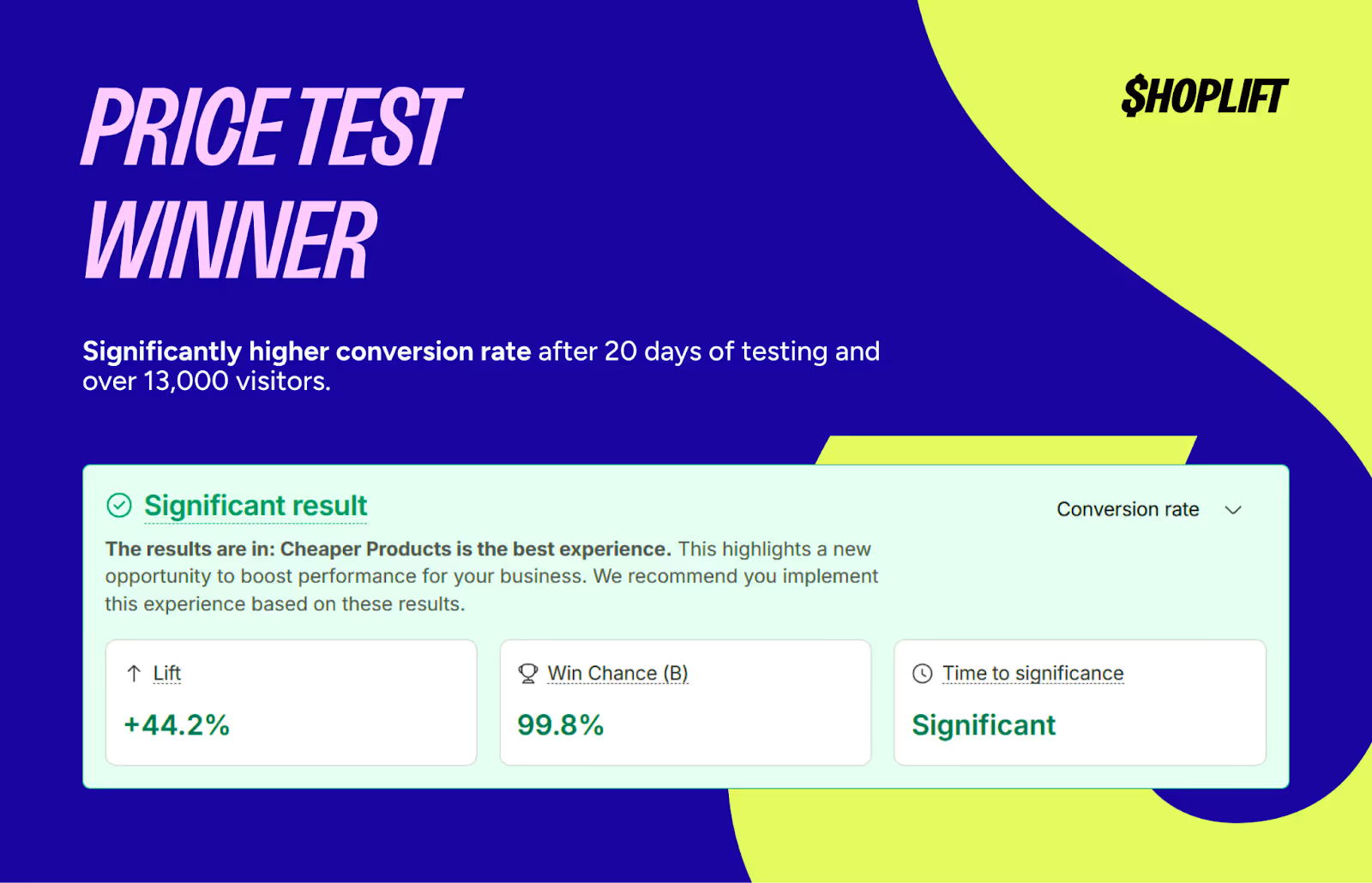
The test ran for 20 days with 13,843 visitors. The results revealed exactly the kind of hidden revenue opportunity that had been impossible to quantify before:
- Conversion rate: +42.5% (228 vs 159 purchases)
- Revenue per visitor: +33.4% overall, with returning customers showing a +62.4% lift
- Add-to-cart rate: +17.9%
The test reached statistical significance across multiple metrics. The 15% discount removed a genuine barrier to purchase without overcorrecting into unprofitable territory. Price sensitivity was real, measurable, and more impactful than anticipated.
Extrapolating the revenue per visitor increase across a full year revealed the impact: $151,840 in additional annual revenue that had been hidden behind suboptimal pricing. This was revenue Quiet Mind had been leaving on the table simply because they couldn't test their way to the optimal price point before Shoplift made it accessible.
For Mikey and the Quiet Mind team, this represented transformational growth. For Clean Commit, it validated their strategic instinct with hard data they could present to investors and third-party resellers.
Taking it to the next level: Clean Commit's profit optimization analysis
Discovering the revenue opportunity was the first breakthrough. Clean Commit took the analysis further to optimize for maximum profit, not just maximum revenue.
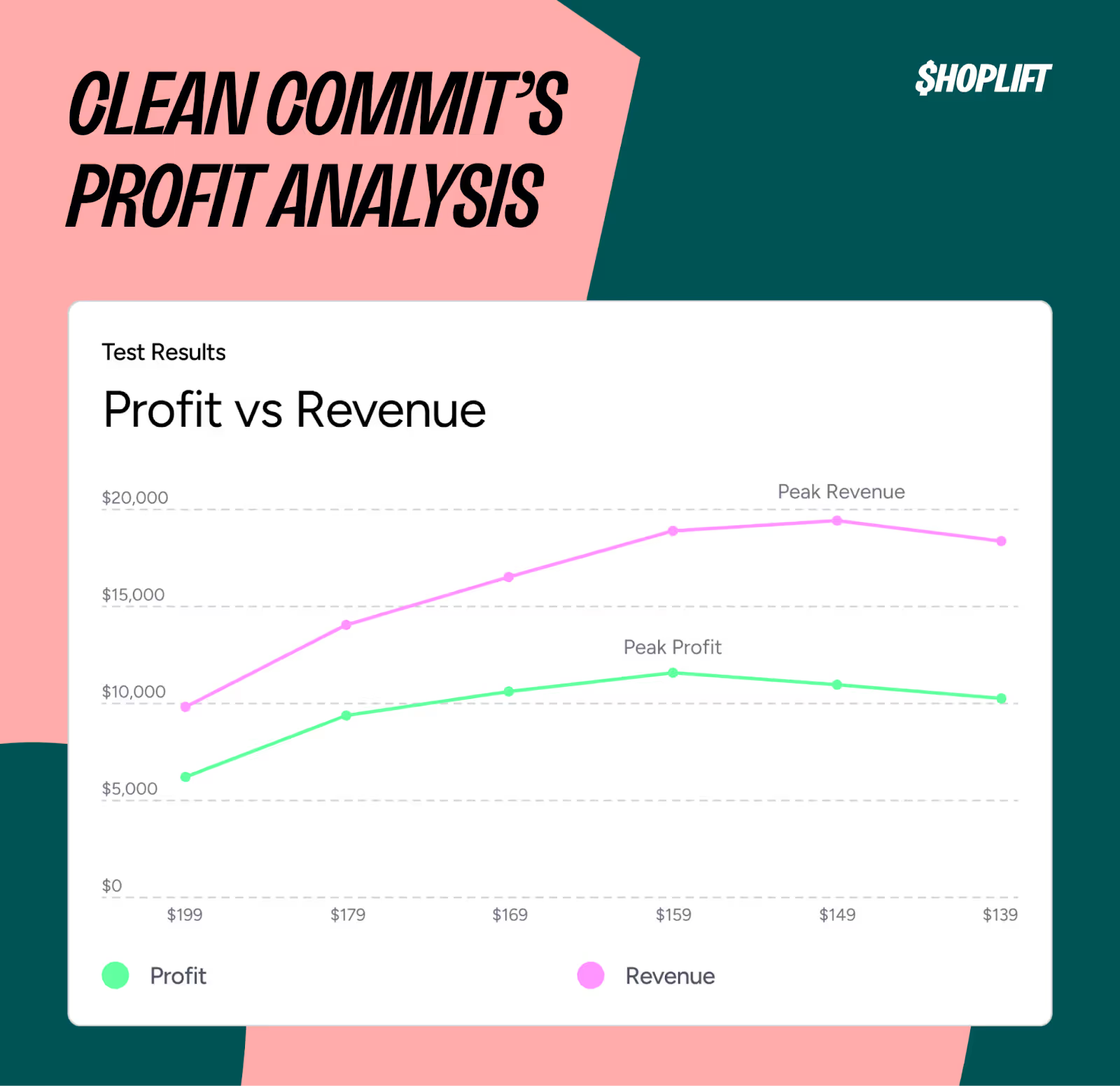
Working with Mikey, the Clean Commit team applied a profit optimization framework to the test results. The principle: as price decreases, conversion rate increases, but profit follows a curve. It rises as volume compensates for lower margins, peaks at the optimal crossover point, then declines as margins get too thin.
By analyzing the $151K revenue increase against margin impact, Clean Commit identified that the 15% discount landed at a point where total profit increased by $53,000 annually. Lower margins were more than offset by higher conversion, reaching the specific price point that maximized profit rather than just revenue.
This level of analysis, built on top of Shoplift's capability to generate reliable pricing data, gave Quiet Mind complete confidence in the pricing change. With empirical evidence of both revenue and profit impact, Mikey could present definitive findings to all stakeholders.
What's next
Shoplift unlocked the capability. The first test proved the concept and revealed substantial hidden revenue. Clean Commit's analysis optimized for maximum profit.
The next phase is a campaign of individual product testing to find each SKU's optimal price point, continuing systematically until reaching the specific price that maximizes profit for each product.
For Mikey and the Quiet Mind team, Shoplift transformed pricing from a persistent question mark into a competitive advantage. The 15-minute test setup unlocked $151,000 in hidden revenue and $53,000 in optimized profit, but the real value is the ongoing capability to ask questions about pricing and get definitive answers backed by statistical significance.
For Clean Commit, Shoplift provides the practical tool their strategic vision had always needed. They can now deliver price optimization as a standard service to clients, backed by a platform that makes rigorous testing accessible without the technical overhead that previously kept it out of reach.


